|
| |
|
 |
| |
 computational measure of texture similarity is not consistent with
human perception computational measure of texture similarity is not consistent with
human perception
need perceptually consistent similarity measure
need to be invariant to intensity, contrast, scale, orientation
|
 |
| |
construct perceptual
texture space (PTS)
map
input texture feature to PTS through invariant space
|
 |
| |
collect sample texture
images
normalize texture intensity, constrast, scale, orientation
get
human subjects to perform free sorting task
compute perceptual distance matrix from free sorting results
apply Multidimensional Scaling to obtain sample coordinates from
distance matrix |
| |
|
MDS fitting result
(stress = fitting error)
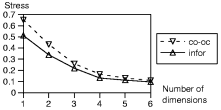
Result: 4D is optimal |
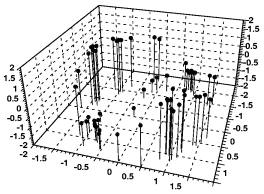
3D Perceptual Texture Space
 |
| |
 |
VRML visualization of 3D PTS (sorry,
can't visualize 4D)
(require
VRML plug-in, e.g., Cortona)
|
| |
|
|
 |
| |
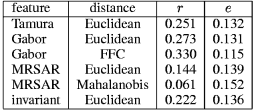
our perceptual texture
space is consistent with existing spaces
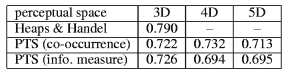
computational texture
features and distances are not consistent with PTS
|
 |
| |
use convolutional neural
network to perform invariant mapping
use
SVM to perform perceptual mapping
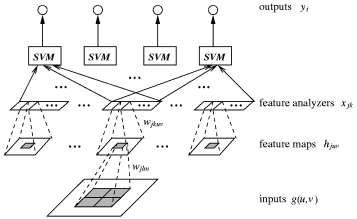
input: Gabor
features arranged in 2D |
| |
|
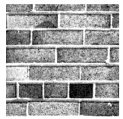
texture image
 |
Gabor features in 2D arrangement
orientation
frequency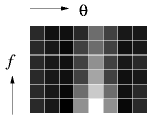
|
| |
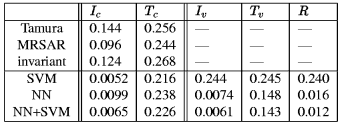
mapping performance
Tamura, MRSAR, invariant
features are mapped using SVM
Ic = new texture instance;
canonical scale, orientation
Tc = new texture type;
canonical scale, orientation
Iv = new texture instance;
variable scale, orientation
Tv = new texture type;
variable scale, orientation
R = random
NN+SVM produces best overall
results
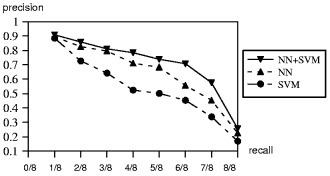
retrieval performance
NN+SVM yields best retrieval
performance
|
 |
| |
A/Prof. Leow Wee Kheng,
Dept. of Computer Science, National University of Singapore.
A/Prof. Chua Fook Kee,
Dept. of Social Work & Psychology, National University of Singapore.
Ex-students:
Dr. Long
Huizhong (Ph.D.),
Dept. of Computer Science, National University of Singapore.
Mr. Tan Chee Wee (Honours), Dept. of Computer
Science, National University of Singapore.
|
 |
| |
|
H. Long and W. K. Leow. A
hybrid model for invariant and perceptual texture mapping. In Proc.
ICPR, 2002. |
| |
|
H. Long and W. K. Leow. Perceptual
consistency improves image retrieval performance. In Proc. ACM SIGIR,
2001. |
| |
|
H. Long, C. W. Tan, and W. K.
Leow. Invariant and perceptually consistent texture mapping for
content-based image retrieval. In Proc. ICIP, 2001. |
| |
|
H. Long and W. K. Leow. Perceptual
texture space improves perceptual consistency of computational
features. In Proc. IJCAI, 1391-1396, 2001. |
| |
|
H. Long, W. K. Leow, and F. K.
Chua, F. Kee. Perceptual texture space for content-based image
retrieval. In Proc. MMM, 167-180, 2000. |
| |
|
|
 |
| |
This project is part of
the  project supported by NSTB and MOE. project supported by NSTB and MOE. |