A total of 2053 different hosts have accessed this document in the last 783 days; your host, 216.73.216.226, has accessed it 1 times.
If you're interested, complete statistics for this document are also available, including breakdowns by top-level domain, host name, and date.
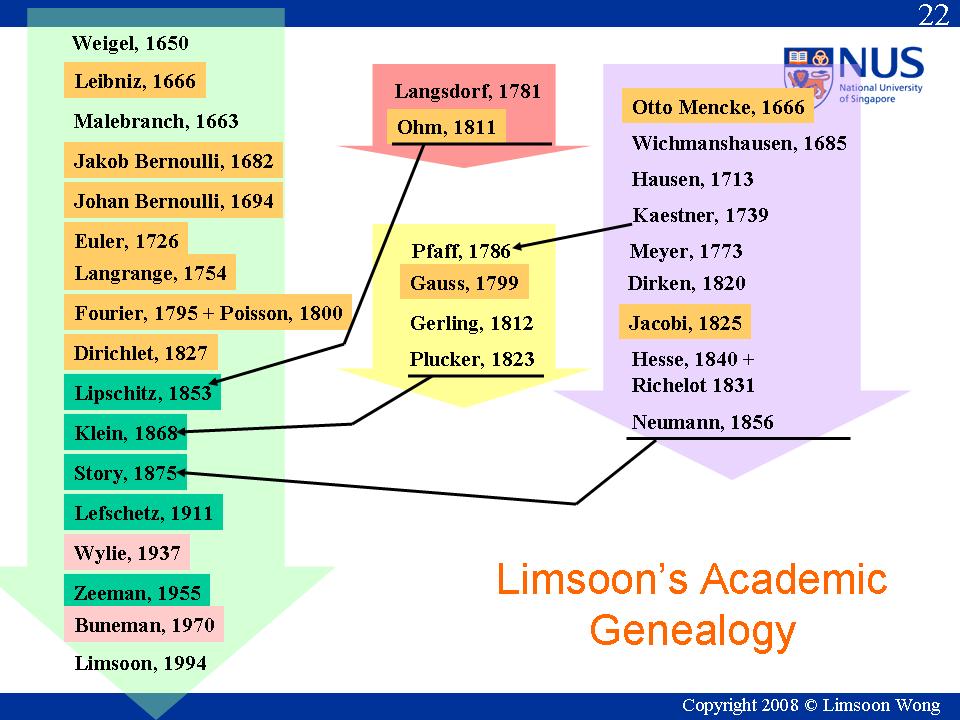
| supervisee | supervisor | remark |
|---|---|---|
|
Limsoon Wong PhD 1994 University of Pennsylvania | Peter Buneman |
Sir Erik (born February 4 1925), is a mathematician known for work in geometric topology and singularity theory. He was born in Aarhus, Denmark, and received a B.A. and Ph. D. from the University of Cambridge. After working at Cambridge, as well as the University of Chicago, Princeton and the Institut des Hautes Etudes Scientifiques, he founded the Mathematics Department and Mathematics Research Centre at the University of Warwick in 1964. |
|
Peter Buneman PhD 1970 University of Warwick | Erik Christopher Zeeman | |
|
Erik Christopher Zeeman PhD 1955 University of Cambridge | Shaun Wylie |
Shaun Wylie is a British mathematician and former World War II codebreaker. |
|
Shaun Wylie PhD 1937 Princeton University | Solomon Lefschetz |
Lefschetz was the main source of the algebraic aspects of topology. |
|
Solomon Lefschetz PhD 1911 Clark University | William Edward Story |
Klein's synthesis of geometry as the study of the properties of a space that are invariant under a given group of transformations, known as the Erlanger Programm, profoundly influenced mathematical development. |
|
William Edward Story PhD 1875 Universitat Leipzig |
Carl Gottfried Neumann & Christian Felix Klein --1--> | |
|
Carl Gottfried Neumann Dr. phil 1856 Universitat Konigsberg |
Friedrich Julius Richelot & Ludwig Otto Hesse |
Hesse's main work was in the development of the theory of algebraic functions and the theory of invariants. |
|
Friedrich Julius Richelot PhD 1831 Universitat Konigsberg | Karl Gustav Jacob Jacobi |
Jacobi made basic contributions to the theory of elliptic functions. He carried out important research in partial differential equations of the first order and applied them to the differential equations of dynamics. |
|
Ludwig Otto Hesse Dr. phil 1840 Universitat Konigsberg | Karl Gustav Jacob Jacobi | |
|
Karl Gustav Jacob Jacobi PhD 1825 Humbolt-Universitat zu Berlin | Enno Heeren Dirksen | |
|
Enno Heeren Dirksen PhD 1820 Georg-August-Universitat Goettingen |
Johann Tobias Meyer d.J. & Friedrich Anton Justus Thibaut --2--> |
Johann Tobias Mayer was mainly known for his mathematics and natural science textbooks. He is not to be confused with his famous father, the astronomer Tobias Mayer. |
|
Johann Tobias Meyer d. J. PhD 1773 Georg-August-Universitat Goettingen | Abraham Gotthelf Kaestner --3--> | |
|
Friedrich Anton Justus Thibaut <--2-- Dr. phil 1796 Christian-Albrechts-Universitat zu Kiel | Unknown |
Thibaut was leader of the philosophical school that maintained the tradition of natural law in a spirit of moderate rationalism. He is remembered chiefly because his call for the codification of German law. |
|
Christian Felix Klein <--1-- PhD 1868 Rheinische Friedrich-Wilhelms-Universitat Bonn |
Julius Plucker & Rudolf Otto Sigismund Lipschitz --4--> |
Perhaps the most remarkable fact about Lipschitz's work was the widely different topics on which he contributed: number theory, Bessel functions, Fourier series, differential equations, analytical mechanics, and potential theory. He worked on quadratic differential forms and mechanics---his mechanical interpretation of Riemann's differential geometry would prove to be a vital step in the road towards Einstein's special theory of relativity. Lipschitz's work on the Hamilton-Jacobi method for integrating the equations of motion of a general dynamical system led to important applications in celestial mechanics. Lipschitz is remembered for the "Lipschitz condition" an inequality that guarantees a unique solution to the differential equation y' = f(x,y). Lipschitz rediscovered Clifford algebras and was the first to apply them to represent rotations of Euclidean spaces. |
|
Julius Plucker PhD 1823 Philipps-Universitat Marburg | Christian Ludwig Gerling | |
|
Christian Ludwig Gerling Dr. phil 1812 Georg-August-Universitat Goettingen | Johann Carl Friedrich Gauss | |
|
Johann Carl Friedrich Gauss PhD 1799 Universitat Helmstedt | Johann Friedrich Pfaff |
Gauss worked in a wide variety of fields in both mathematics and physics incuding number theory, analysis, differential geometry, geodesy, magnetism, astronomy and optics. His work has had an immense influence in many areas. |
|
Johann Friedrich Pfaff Dr. phil 1786 Georg-August-Universitat Goettingen | Abraham Gotthelf Kaestner |
Kaestner was interested in poetry in addition to mathematics. His teacher in that field was Gottsched. |
|
Abraham Gotthelf Kaestner <--3-- PhD 1739 Universitat Leipzig | Christian August Hausen |
Hausen was known for work on electricity and has a crater on the moon named after him. The mathematics genealogy project (and countless other web sites as a consequence) confused him with his father, also named Christian August Hausen, who got a doctorate in theology under Christian Siber in 1683. The son was a mathematician from the beginning. |
|
Christian August Hausen Dr. phil 1713 Martin-Luther-Universitat Halle-Wittenberg | Johann Christoph Wichmannshausen |
Wichmannshausen was primarily an orientalist, but his thesis was on a topic in ethics. |
|
Johann Christoph Wichmannshausen PhD 1685 Universitat Leipzig | Otto Mencke |
Otto Mencke founded the first academic journal in Germany, titled Acta Eruditorum, jointly with Leibniz (the journal existed 1682-1782). Otto Mencke should not be confused with his grandson Friedrich Otto Mencke. Wichmannshausen was not only Mencke's student, but also his son in law (this puts a twist on his thesis title, Disputationem moralem de divortiis secundum ius naturae). The dates for Mencke refer to a dissertation pro loco (habilitation) in philosophy in 1666. |
|
Otto Mencke PhD 1666 Universitat Leipzig | Unknown | |
|
Rudolf Otto Sigismund Lipschitz <--4-- Dr. phil 1853 Universitat Berlin |
Gustav Peter Lejeune Dirichlet & Martin Ohm --5--> |
Dirichlet proved Fermat's last theorem for the special cases of n = 5 and 14. He was also considered the founder of the theory of Fourier series and the conditions for the convergence are now called Dirichlet's Conditions. |
|
Gustav Peter Lejeune Dirichlet Honorary 1827 Rheinische Friedrich-Wilhelms-Universitat Bonn |
Simeon Denis Poisson & Jean-Baptiste Joseph Fourier |
The Mathematics Genealogy Project did not list any year for Poisson and Fourier; the years listed for them and their predecessors (Lagrange, Bernoulli's) were years of "graduation." No formal doctoral thesis seemed to be involved. This issue created a stir when Dirichlet returned to Germany after studying in Paris and was looking for a position. The year listed for Dirichlet was that of an honorary degree from the University of Bonn which resolved the dilemma. The Mathematics Genealogy Project listed Lagrange as advisor for Poisson and Fourier; according to biographies, they were also taught by Laplace, and Fourier also by Monge. |
|
Simeon Denis Poisson 1800 | Joseph Louis Lagrange | |
|
Jean-Baptiste Joseph Fourier 1795 | Joseph Louis Lagrange |
The Mathematics Genealogy project listed Euler as Lagrange's advisor. Indeed, Euler did give substantial advice to Lagrange, although all of it was by mail. Lagrange studied Euler's work and corresponded extensively with him during the time when he wrote his early papers. Euler was also important in promoting Lagrange's career. This is why Euler is often viewed as his "advisor," even though Euler was in Berlin and Lagrange was in Torino. The year listed for Lagrange was that of his first mathematical paper. |
|
Joseph Louis Lagrange 1754 | Leonhard Euler | |
|
Leonhard Euler PhD 1726 Universitat Basel | Johann Bernoulli |
Leonhard Euler was a Swiss mathematician who made enormous contibutions to a wide range of mathematics and physics including analytic geometry, trigonometry, geometry, calculus and number theory. |
|
Johann Bernoulli 1694 | Jakob Bernoulli |
Jakob Bernoulli had a degree in theology, which he was made to study by his father. He studied mathematics and astronomy on the side, and he continued his mathematical studies while traveling in France, the Netherlands and England 1676-82. Malebranche, Hudde, Hooke and Boyle were his most important teachers during this time. |
|
Jakob Bernoulli 1682 | Nicolas Malebranche | |
|
Nicolas Malebranche 1664 | Gottfried Wilhelm Leibniz |
Malebranche studied theology at the Sorbonne and then continued his studies at the Congregation of the Oratory (a school for priests), where he became a priest in 1664. Richard Simon was mentioned in biographies as his teacher at the Oratory. Simon was later expelled from the Oratory because he questioned Moses' authorship of the Pentateuch. In 1664, Malebranche became interested in Descartes' work, which led him to mathematics. Malebranche had no formal instruction in mathematics, but he had many meetings with Leibniz, who was in Paris as a diplomat 1672-76 (Leibniz invented the calculus during the later part of this period). Malebranche was primarily remembered as a philosopher, but he also taught mathematics beginning in 1674. |
|
Gottfried Wilhelm Leibniz Dr. jur. 1666 Universitat Altdorf | Erhard Weigel |
Leibniz studied philosophy and law in Leipzig. He applied for a doctorate in law in 1666, but was refused because he was considered too young (he was 20). He then went to Altdorf, where he immediately got his doctorate and was offered a professorship as well (he did not accept). His advisors in Leipzig were Schwendendoerffer for law and Thomasius for philosophy. As a student, Leibniz learned mathematics for a semester under Erhard Weigel in Jena. He continued his mathematical studies under Huygens while he was in Paris in 1672. |
|
Erhard Weigel PhD 1650 Universitat Leipzig | Unknown |
Weigel crater on the Moon is named after him. |
|
Martin Ohm <--5-- Dr. phil 1811 Friedrich-Alexander-Universitat Erlangen-Nurnberg | Karl Christian von Langsdorf |
Martin Ohm was the brother of "the" Ohm. |
|
Karl Christian von Langsdorf Dr. phil 1781 Universitat Erfurt | Unknown |
Von Langsdorf was known for contributions to mechanical and mining engineering. A town in Mecklenburg was named after him in 1816. |
You might be able to check out your academic ancestry at Mathematical Genealogy and Theoretical Computer Science Genealogy.
ongoing
did not complete