Teaching Statement (May
2026)
Since I started teaching in 2006, I have made it a point to write a teaching
statement every 3 years to document my thoughts and insights into teaching. This
latest teaching statement
is almost 2 years late.
These last couple of years have been tumultuous. First, we had to deal
with COVID-19. Immediately after that, we have had the launch of ChatGPT and
LLMs. Both COVID-19 and LLMs have had a huge impact on education that was not
immediately clear.
I decided that I needed to spend more time understanding how these two
changes are affecting how we teach before penning my thoughts.
AI has evolved by leaps and bounds over the past 3 years. 2 years ago,
many things were still unclear. If I had tried to say anything back then, I
would likely have been wrong.
Our Students have Changed
This semester, I have officially finished my 20th year as prof. It is
hard to believe that after some 20 years, I
have actually found that I have had to re-think my approach to teaching.
Truth be told, I consider myself a relatively skilled teacher, but during
COVID-19, something seemed off with my teaching and it took me a while to
figure out what happened: it's not about me; the
students have changed.
There are likely many reasons -- mobile phones, social media, and COVID.
Also, there are societal changes: parenting styles and increasing affluence.
Things don't necessarily become better just because people are rich.
This is the crux of the issue: we might interact with students today in the same way that we used to
for students of the past, but the students these days might not respond equally well.
After COVID, many of the students are not turning up for class. I have
always had webcasts for my lectures. In the past, some
90-95% of the students would still turn
up for class; so hardly anyone needed to watch the recordings. Sadly, now
that students stop turning up for class, many also still don't watch the webcast. I
actually don't know how these students expect to be learning.
Students seem to be more fragile. We are definitely seeing many more
instances of mental health issues. And the surprising thing is that it's
not just the struggling students who are having mental health issues. I have
come across a number of high-performing students who suffer from depression.
The students these days don't like to read; many are swiping TikTok.
My own daughter watches videos at 2x playback speed.
In this light, I fear that if we don't change our teaching style to figure out how to
work with this new generation, we will
become dinosaurs. There is need to relearn how to reconnect with the students.
Maybe I am just getting older and it is harder for old people to connect
with the young. Unfortunately, I am not entirely sure what needs to be done.
Nevertheless, I am convinced that
we need to understand their psychology to make sure that we
have their attention.
That said, while students likely won't be learning much if
there is no engagement, we need to be mindful that engagement doesn't
necessarily lead to learning. Many young ones are glued to their devices
swiping TikTok and YouTube. It doesn't mean that they are learning.
We must not conflate engagement with
learning.
The Promise of AI
ChatGPT was launched in November 2022, and I remember the reaction in
academia being somewhere between fascination and panic. Many institutions
rushed to ban it. Others pretended it wasn't happening. I actually tried to
use it.
The early verdict was mixed. The output was often very good, but the LLMs
tended to hallucinate. They would cite papers that didn't exist, and state
facts with confidence that turned out to be completely wrong.
However, the improvement in frontier models over the past two years has been
genuinely startling. The hallucination problem has not disappeared entirely,
but it seems to me that for most practical purposes, the
latest models are generally trustworthy on factual matters within their
domain and they know, more often than not, when they are uncertain. These
models will only continue to get better.
The deeper problem with LLMs is not hallucination.
The deeper problem is what happens inside a student's head; or rather, what
stops happening when AI is always within reach.
Danger of Cognitive Offloading
Cognitive offloading is not new. We have always offloaded cognition to
tools: we write things down so we don't have to remember them; we use
calculators so we don't have to do arithmetic; we drive with Google Maps
instead of turning to a street directory.
The question isn't so much whether to offload, but
what and when to offload.
A student who uses a calculator to multiply is not harming themselves in any
meaningful way. However, a student who uses AI to write every essay they are
assigned will not be learning to write. Of even greater concern is that they
are not learning to think.
Writing to me is not just for communication. Writing is a thinking tool. The struggle to put an argument into
coherent sentences is the process by which an argument becomes clear. Good
writing is the consequence of clear thinking. I am writing this teaching
statement to force myself to think clearly about what I believe.
One of the ideas that I have been toying with is what I call the
AI Chasm of Death:
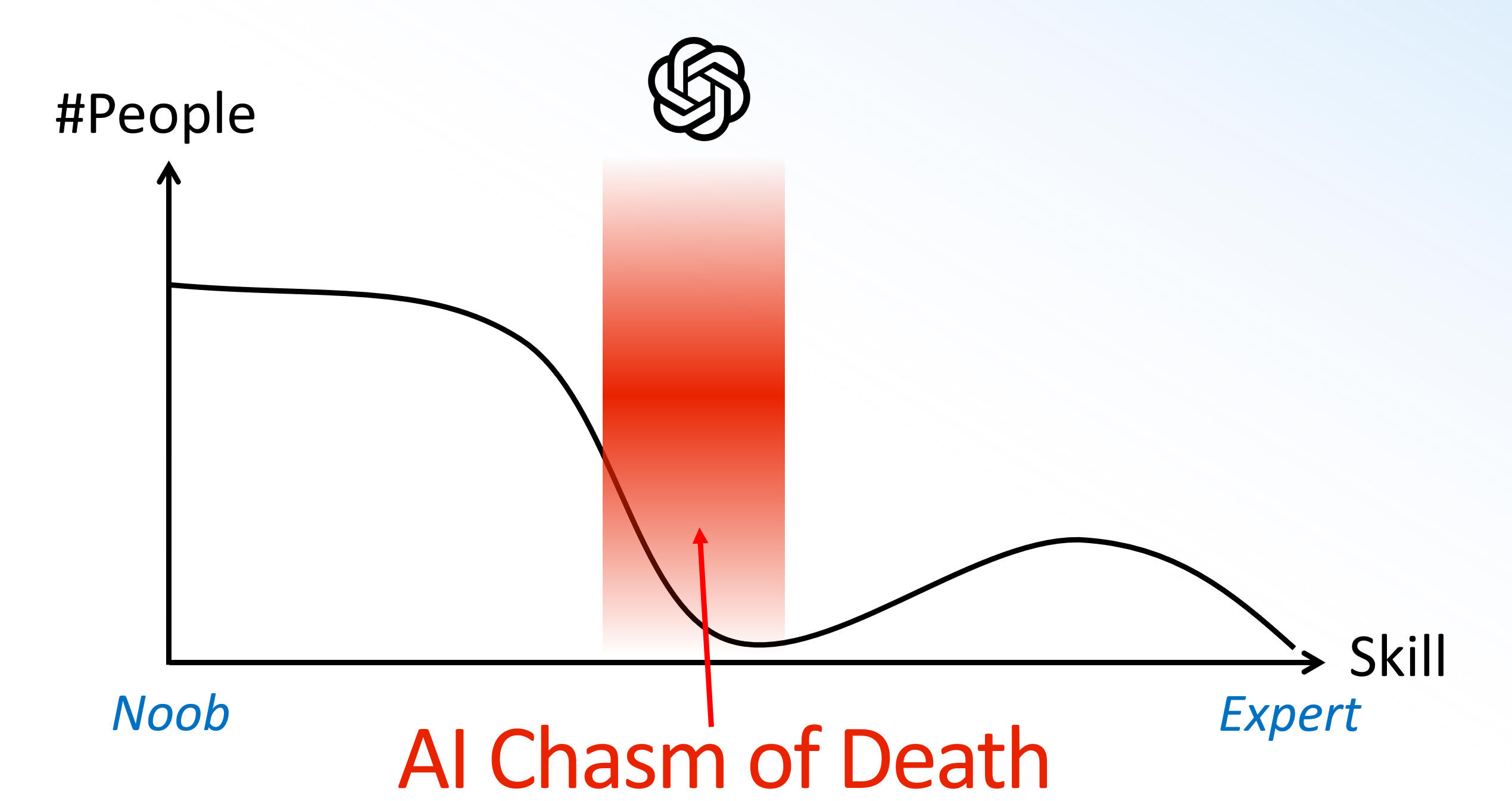
Basically, what this chart shows is that LLMs are likely already performing better than the average
layman on many skills.
By outsourcing work to LLMs, our students can have good outcomes,
but they will never actually be able to surpass what the LLMs can do and they
end up being trapped in the region of competence below the LLMs in the
region in red in the figure. What's worse is that this region is likely not
static, but it is moving right as the LLMs become increasingly powerful.
I have come to realize that there is a lot of teaching to the test. As a
result, a significant proportion of college students have
apparently not learnt how to
learn before coming to college-and they suffer for it.
In other words, performance does not imply mastery and we need to be aware of the illusion
of competence. High performance with the
assistance of AI does not necessarily imply that learning has taken place.
The irony is that the students most harmed by cognitive offloading are often
the ones who likely do not realize they have been harmed. They get the right
answers. They feel competent. Unfortunately, this
is also genuinely dangerous, because the gap between perceived and actual
ability only reveals itself at the worst possible moment: in a job
interview, in a production system failure, in the moment when one actually
needs to make a judgment call.
In other words, and to quote Prof Dragan Gasevic,
we must
not confuse copilot with autopilot.
As a digression, this situation is related to a realisation
that I had in my early years of teaching: I realized that teaching lectures
very clearly can sometimes be harmful, because the students would go away
thinking that they have learnt the material when they hadn't actually. When
I lecture, I actually aimed for this state that I called
calibrated confusion. And then I follow
up to clear up the confusion during my recitations.
Effective Use of AI Requires
Judgment and Domain Mastery
Many claim that AI can improve efficiency and equip everyone with his personal minion/intern. However, my view is that it is more
accurate to say that AI is a multiplier.
Furthermore, it is wishful thinking that anyone will be able to do better
with AI. My view is that one actually needs domain
mastery and good judgement to work effectively with AI. In other
words, the picture of how AI will affect productivity is likely to look more
like the following:
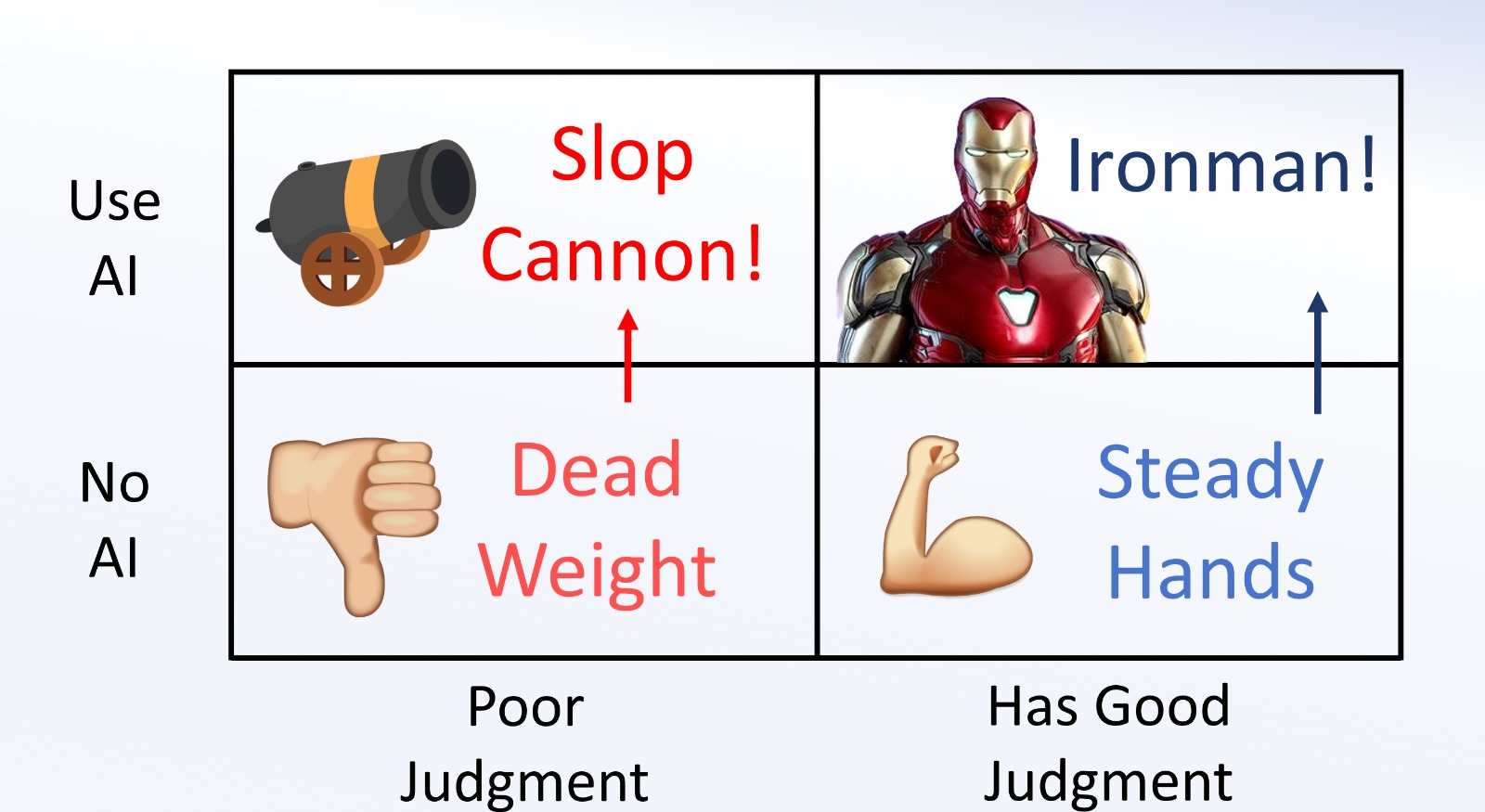
It is naive to think that AI will necessarily make everyone more
productive and employable. Those who have good judgement will do better;
those who do not will likely end up creating a lot of AI slop and eventually
end up being fired. The AI-driven future will likely be one with
significantly more inequality.
I do not believe that AI is a tide that will lift all boats. AI is likely
going to be a tsunami: the ships that can withstand the onslaught will
eventually rise higher. But the boats that cannot, might just be sunk. b
AI will Exacerbate Inequality
The advent of AI has forced us to reckon with what we ought to be
teaching.
AI is changing the workplace and I have been checking with my students in
the industry on whether they think there are any gaps in our teaching. I
have since closed the gap in human skills by developing a leadership class
which has been quite successful. My former students are also coping very
well with AI tools in big tech, so I am convinced that our current training
is actually effective.
Unfortunately, I have since come to realize that even if our current
training is set up correctly, it does not mean that the current training
system will work for the current students. The output of a training pipeline
isn't simply a function of the pipeline, it is also dependent on the inputs.
Just because our existing training pipeline worked for students of the past,
it doesn't necessarily mean it will continue to work for the current
students.
The main reason is that the
current students (with access to AI) are not like the previous generation of
students (before they had access to AI).
I have warned my students about the dangers of cognitive
offloading and the "AI Chasm of Death" (and they are convinced!).
However, when
deadlines draw close, many cannot help but still resort to using AI to do
their homework.
On the other hand, the better students are often able to use AI
effectively as a personal tutor and study buddy. Learning well involves
identifying and plugging the gaps in one's knowledge. The frontier models
are very learned and infinitely patient and can help the good students plug
their gaps faster. It requires significant metacognition to realize what
gaps need to be plugged.
In other words, I predict that AI will
exacerbate inequality
among the students: the stronger students will be accelerating in their learning
and the weaker students will start falling further behind.
Need to Focus on the Fundamentals
The temptation in the age of AI is to teach more, i.e. more tools,
more frameworks, more workflows that incorporate the latest models. Some
claim that we need to teach AI skills.
I think this is exactly wrong. My response, on the contrary, would be to teach less, but demand far deeper mastery of what remains.
AI is exceptional at retrieving, synthesizing, and applying knowledge at the
surface level. What it cannot do, or at least not yet, is to exercise
genuine judgment. Judgment requires not just knowing facts but having
internalized them deeply enough to sense when something is off, when a
model's confident-sounding answer is subtly wrong, or when the elegant
solution is actually the dangerous one. We cannot develop that sense by
outsourcing our thinking.
Learning requires productive struggle. There is no free lunch. Learning
cannot be outsourced to AI.
We need our students to continue to experience the feeling of hitting a wall
when they encounter a hard problem, not knowing the answer, and working
through the discomfort until something clicks. That eureka moment when they
achieve understanding is what builds the mental scaffolding that makes
learning effective.
Learning how to learn will become even more important. We need to be
putting more effort into
teaching metacognition.
Our current exam-centric education system is very focussed
on training students to solve well-defined problems. In other words, we are
very good at teaching students how to do things
right.
We need to reorientate our students from simply doing the things right to
learning how to ask the right questions and on doing the right things. In the
future, our children are much better off doing the right things not so well,
than doing all the wrong things perfectly well!
To Focus on Human Skills
The advent of AI has forced us to reckon seriously with what we ought to be
teaching, and what we can safely let go of.
Some things can now be safely delegated. Clearly, it is hardly a good use of
anyone's time to memorize large amounts of syntax, or to drill on rote
procedures that a model can execute in seconds. We have all likely stopped
remembering phone numbers for years.
With AI, pure technical problems will likely become much easier; what
will remain (that will allow people to get paid for) will be people
problems.
While thinking about what we ought to be teaching, I came up with the
following way to visualize the skills that we might care about:
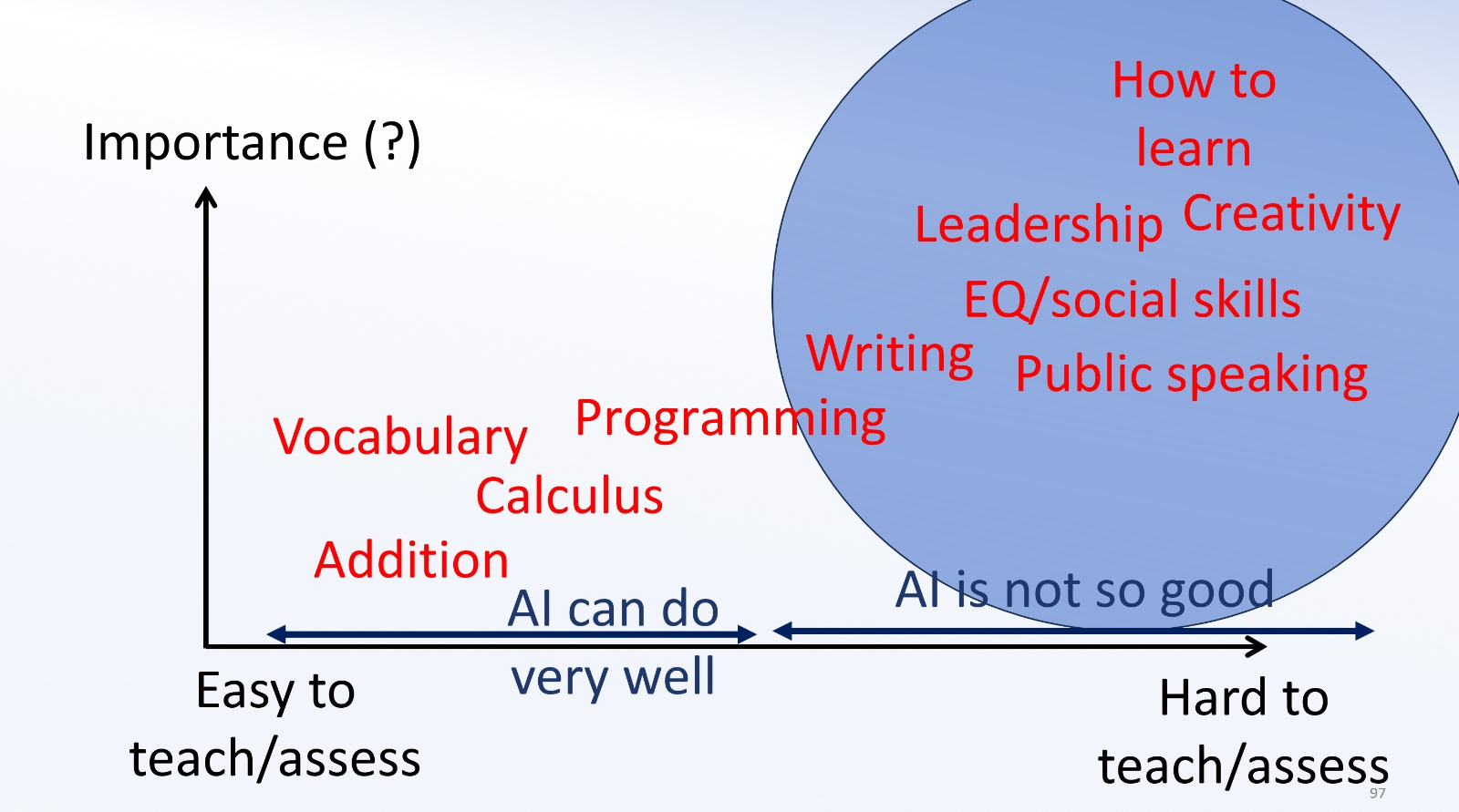
In this view, the key is to think about how easy or difficult it is to
teach or assess a skill. Pen and paper exams have been the gold standard for
exams. Today, they still are!
The challenge for humanity is that the skills that are easy to teach or
assess are also the skills that AI can do very well. For humanity to stay
ahead of AI, we need to pay more attention to human skills!
Need for New AI-driven Modes of Assessment
Nothing will change or can change if we continue assessing students the way we always have.
Traditional assessments were designed for a world where the bottleneck was
access to information. That world is gone.
It is said that it is hard to improve what we cannot measure
or assess. If we genuinely care about improving our
training of human skills, then I would argue that we first need to develop
new methods to assess human skills.
One of the key innovations I came up with last semester was to develop
role-playing bots to train students in coaching. This new approach has been
incredibly promising, but even more exciting is that our approach suggests
that with the use of LLMs, we will soon be able to develop new ways to
assess human skills.
Instead of students sitting in an exam hall answering an exam script on
paper, I envision a future where students take turns to sit in a kiosk to
interact with an AI persona and from the transcript of the interactions, we
are able to assess the level of mastery or skill.
Goalpost Shifting as We Speak
I want to end with some honesty: I do not have everything figured out. I see
the
goalposts shifting even as I write this.
What I do believe is that the educators who will serve their students well
in the coming decade are those who are willing to fundamentally rethink not just what they teach, but why.
The why of education has not
changed: our goal is to develop capable, thoughtful human beings who can
contribute to the world and navigate it with integrity. But the how might
need to change substantially, and we should not pretend otherwise out of
comfort or inertia.
I don't want to end on too pessimistic a note, but I am deeply concerned
about the impending impact of AI on jobs and on the global economy.
AI is certainly going to destroy a large swath of jobs. The proponents
of AI are going to retort that many new jobs will simultaneously be created.
Unfortunately, I don't think that the people who are losing their jobs to AI
will likely be the ones who can do the new jobs that AI will be creating. It
is likely too late to depend on governments to deal with it.
As educators, we really need to figure this out in a hurry. The stability
and future prosperity of our society likely depends on it. I hope we
succeed.