Multi-View Label Prediction for Unsupervised Learning Person Re-Identification
IEEE Signal Processing Letters (SPL) 2021
1Nanjing University of Science and Technology 2Chinese Academy of Sciences 3National University of Singapore 4Queen Mary University of London
Abstract
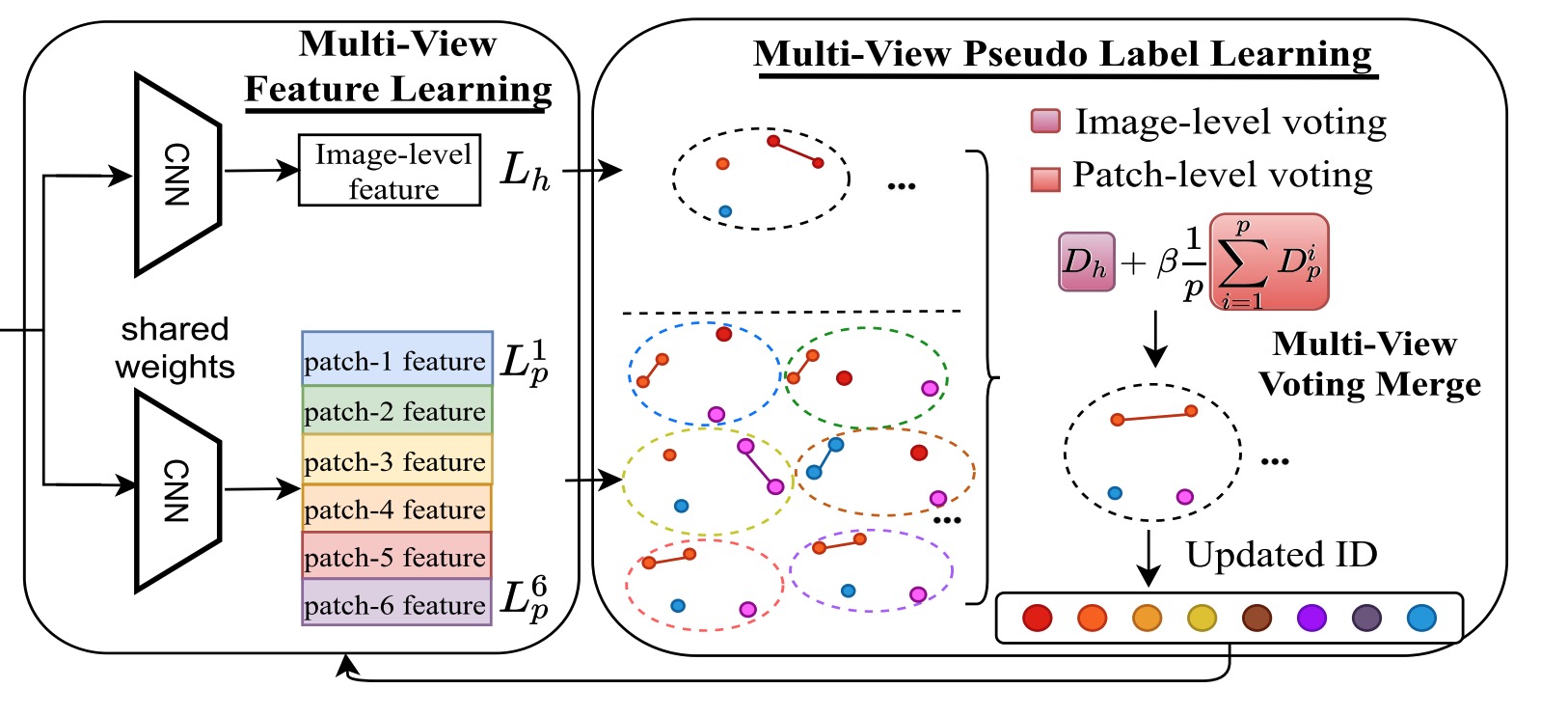
Person re-identification (ReID) aims to match pedestrian images across disjoint cameras. Existing supervised ReID methods utilize deep networks and train them with identity-labeled images, which suffer from limited annotations. Recently, clustering-based unsupervised ReID attracts more and more attention. It first clusters unlabeled images and assigns cluster index to the pseudo-identity-labels, then trains a ReID model with the pseudo-identity-labels. However, considering the slight inter-class variations and significant intra-class variations, pseudo-identity-labels learned from clustering algorithms are usually noisy and coarse. To alleviate the problems above, besides clustering pseudo-identity-labels, we propose to learn pseudo-patch-labels, which brings two advantages: (1) Patches naturally alleviate the effect of backgrounds, occlusions, and carryings since they usually occupy small parts in images, thus overcoming noisy labels. (2) It is plausible that patches from different pedestrians belong to the same pseudo-identity-label. For example, pedestrians have a high probability of wearing either the same shoes or pants but a low possibility of wearing both. The experiments demonstrate our proposed method achieves the best performance by a large margin on both image- and video-based datasets.
Citation
@article{yin2021multi,
  title   = {Multi-View Label Prediction for Unsupervised Learning Person Re-Identification},
  author  = {Yin, Qingze and Wang, Guanan and Ding, Guodong and Gong, Shaogang and Tang, Zhenmin},
  journal = {IEEE Signal Processing Letters},
  year    = {2021}
}