Rapid Person Re-Identification via Sub-space Consistency Regularization
Neural Processing Letters (NPL) 2022
1Nanjing University of Science and Technology 2Chinese Academy of Sciences 3National University of Singapore 4Queen Mary University of London
Abstract
Person Re-Identification (ReID) matches pedestrians across disjoint cameras. Existing ReID methods adopting real-value feature descriptors have achieved high accuracy, but they are low in efficiency due to the slow Euclidean distance computation as well as complex quick-sort algorithms. Recently, some works propose to yield binary encoded person descriptors which instead only require fast Hamming distance computation and simple counting-sort algorithms. However, the performances of such binary encoded descriptors, especially with short code (e.g., 32 and 64 bits), are hardly satisfactory given the sparse binary space.
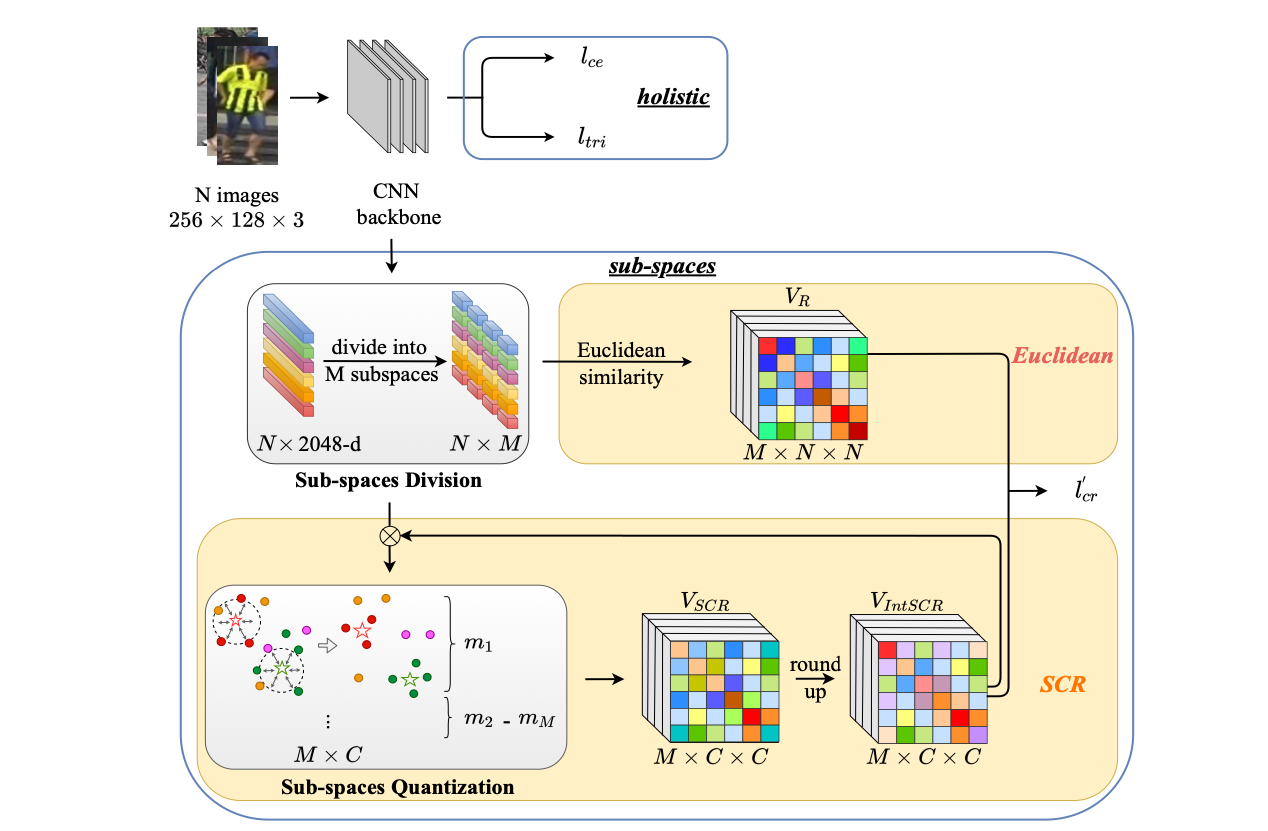
To strike a balance between the model accuracy and efficiency, we propose a novel Sub-space Consistency Regularization (SCR) algorithm that can speed up the ReID procedure by 0.25 times than real-value features under same dimensions whilst maintaining a competitive accuracy, especially under short codes. SCR transforms real-value feature vectors (e.g., 2048 float32) with short binary codes (e.g., 64 bits) by first dividing the real-value feature vector into M sub-spaces, each with C clustered centroids. Thus the distance between two samples can be expressed as the summation of respective distances to the centroids, which can be sped up by offline calculation and maintained via a look-up table. On the other side, these real-value centroids help to achieve significantly higher accuracy than using binary code. Lastly, we convert the distance look-up table to integers and apply the counting-sort algorithm to speed up the ranking stage. We also propose a novel consistency regularization with an iterative framework. Experimental results on Market-1501 and DukeMTMC-reID show promising results. Under short code, our proposed SCR enjoys real-value-level accuracy and hashing-level speed.
Citation
@article{yin2022rapid,
  title   = {Rapid Person Re-Identification via Sub-space Consistency Regularization},
  author  = {Yin, Qingze and Wang, Guanan and Ding, Guodong and Li, Qilei and Gong, Shaogang and Tang, Zhenmin},
  journal = {Neural Processing Letters},
  year    = {2022}
}