|
1
|
|
|
2
|
- Venue: PGP General Purpose Room
- Date: 23 April (Friday)
- Time: 2:30 – 4:30 pm
|
|
3
|
- One A4 sized sheet allowed to the test
- Eight questions, emphasizing material covered after the midterm
- Yes, all material in the course will be covered on the exam
|
|
4
|
- Today is the final lecture for the course
- You had your “extra” lecture in webcast as the vision, NLP or robotics
advanced topics lecture
|
|
5
|
- Agents
- Search
- Uninformed Search
- Informed Search
- Adversarial Search
- Constraint Satisfaction
- Knowledge-Based Agents
- Uncertainty and Learning
|
|
6
|
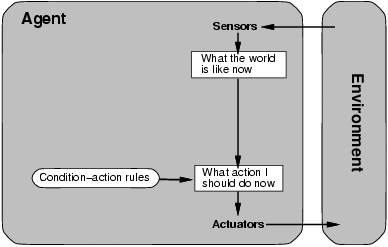
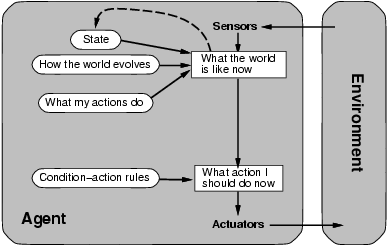
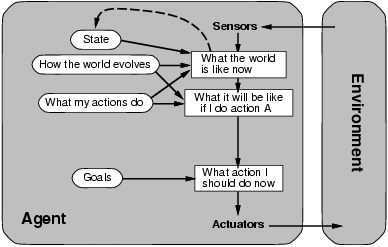
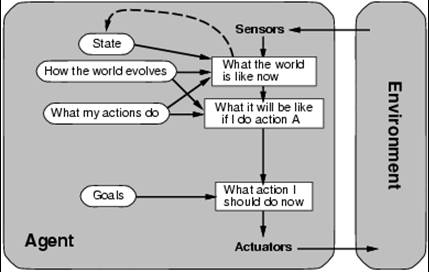
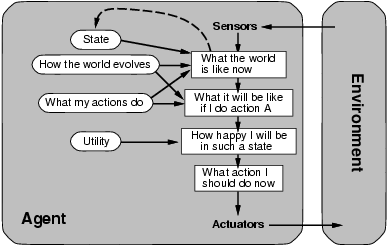
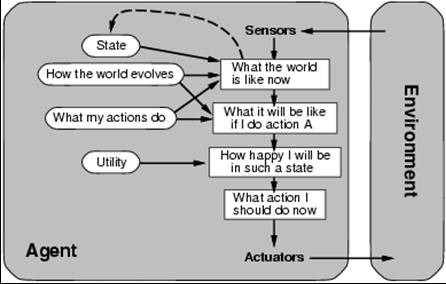
- Four basic types in order of increasing generality:
- Simple reflex agents
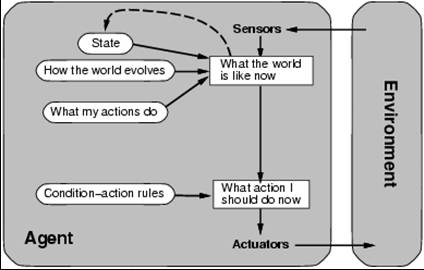
- Model-based reflex agents
- Goal-based agents
- Utility-based agents
|
|
7
|
|
|
8
|
|
|
9
|
|
|
10
|
|
|
11
|
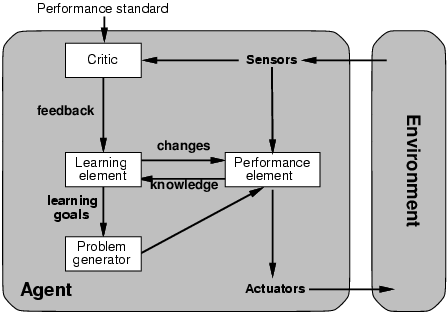
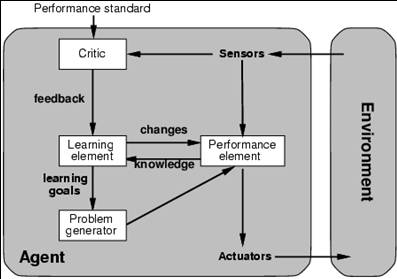
- Where does the intelligence come from?
- Coded by the designers
- Knowledge representation – predicate and first order logic
- Learned by the machine
- Machine learning – expose naïve agent to examples to learn useful
actions
|
|
12
|
|
|
13
|
- In most agent architectures, deciding what action to take involves
considering alternatives
- Searching is judged on optimality, completeness and complexity
- Do I have a way of gauging how close I am to a goal?
|
|
14
|
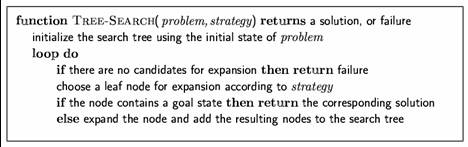
- Formulate the problem, search and then execute actions
- Apply Tree-Search
- For environments that are
- Deterministic
- Fully observable
- Static
|
|
15
|
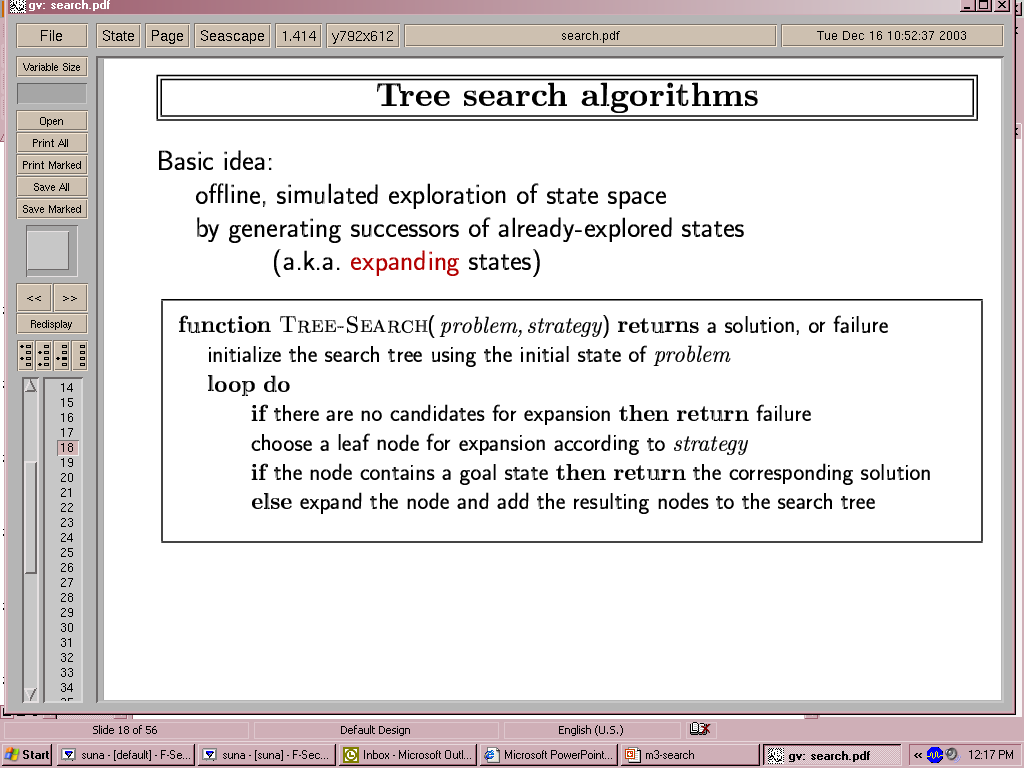
- Basic idea:
- offline, simulated exploration of state space by generating successors
of already-explored states
|
|
16
|
- Breadth-First – FIFO order
- Uniform-Cost – in order of cost
- Depth-First – LIFO order
- Depth-Limited – DFS to a maximum depth
- Iterative Deepening – Iterative DLS.
- Bidirectional – also search from goal towards origin
|
|
17
|
|
|
18
|
- Heuristic function h(n) =
cost of the cheapest path from n to goal.
- Greedy Best First Search
- Minimizing estimated cost to goal
- A* Search
|
|
19
|
- Admissible: never overestimates cost
- Consistent: estimated cost from node n+1 is than cost from node n + step cost.
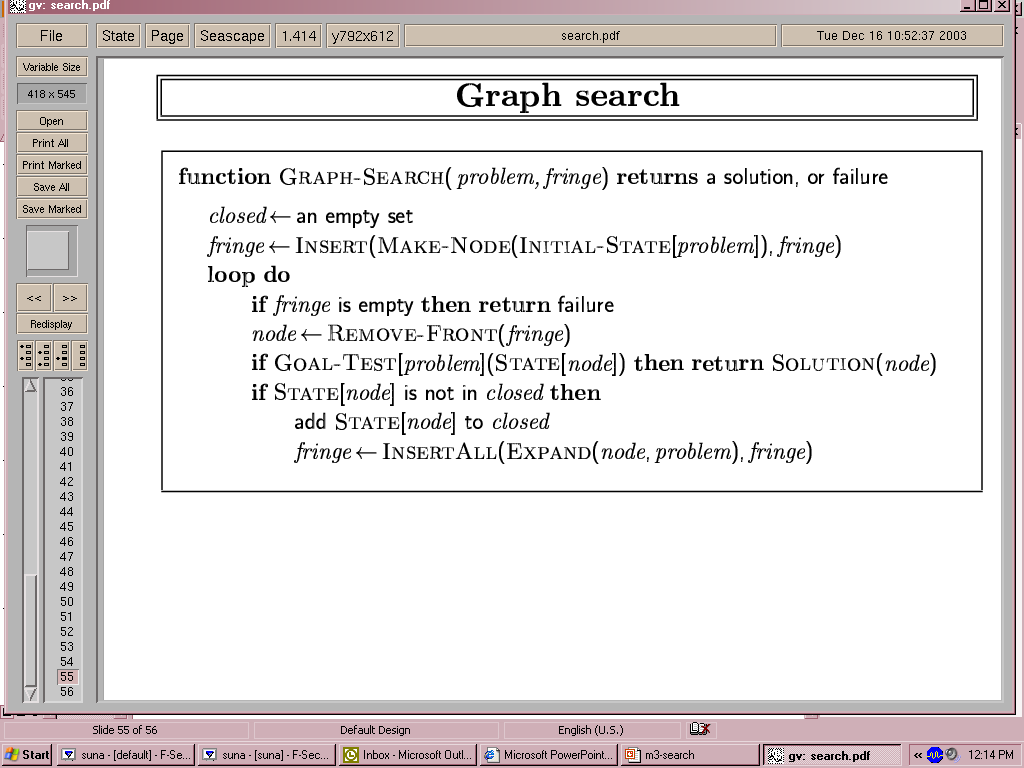
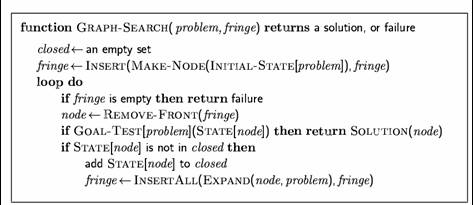
- A* using Tree-Search is optimal if the heuristic used is
- Graph-Search needs an consistent heuristic. Why?
|
|
20
|
- Good for solutions where the path to the solution doesn’t matter
- Often work on
- Don’t search systematically
- Often require very little memory
- Correlated to online search
- Have only access to the local state
|
|
21
|
- Hill climbing search – choose best successor
- Beam search – take the best k successor
- Simulated annealing – allow backward moves during beginning steps
- Genetic algorithm – breed k successors using crossover and mutation
|
|
22
|
- Properties of the problem often allow us to formulate
- Better heuristics
- Better search strategy and pruning
- Adversarial search
- Working against an opponent
- Constraint satisfaction problem
- Assigning values to variables
- Path to solution doesn’t matter
- View this as an incremental search
|
|
23
|
- Turn-taking, two-player, zero-sum games
- Minimax algorithm:
- One ply:
- Max nodes: agent’s move, maximize utility
- Min nodes: opponent’s move, minimize utility
- Alpha-Beta pruning: rid unnecessary computation.
|
|
24
|
- Discrete or continuous solutions
- Discretize and limit possible values
- Modeled as a constraint graph
- As the path to the solution doesn’t matter, local search can be very
useful.
|
|
25
|
- Basic: backtracking search
- DFS for CSP
- A leaf node (at depth v) is a solution
- Speed ups
- Choosing variables
- Minimum remaining values
- Most constrained variable / degree
- Choosing values
|
|
26
|
- Before expanding node, can prune the search space
- Forward checking
- Pruning values from remaining variables
- Arc consistency
- Propagating stronger levels of consistency
- E.g., AC-3 (applicable before searching and
during search)
- Balancing arc consistency with actual searching.
|
|
27
|
- Propositional Logic
- First Order Logic
- Relationships and properties of objects
- More expressive and succinct
- Quantifiers, functions
- Equality operator
- Can convert back to prop logic to do
|
|
28
|
- Given a KB, what can be inferred?
- Query- or goal-driven
- Backward chaining, model checking (e.g. DPLL), resolution
- Deducing new facts
- Forward chaining
- Efficiency: track # of literals of premise using a count or Rete
networks
|
|
29
|
- Chaining
- Requires
- Uses Modus Ponens for sound reasoning
- Forward or Backward types
- Resolution
- Requires Conjunctive Normal Form
- Uses Resolution for sound reasoning
- Proof by Contradiction
|
|
30
|
- Don’t have to propositionalize
- Could lead to infinite sentences functions
- Use unification instead
- Standardizing apart
- Dropping quantifiers
- Skolem constants and functions
- Inference is semidecidable
- Can say yes to entailed sentences, but non-entailed sentences will
never terminate
|
|
31
|
- CSP can be formulated as logic problems and vice versa
- CSP search as model checking
- Local search: WalkSAT with min-conflict heuristic
|
|
32
|
- Solving a CSP via inference
- Handles special constraints (e.g., AllDiff)
- Can learn new constraints not expressed by KB designer
- Solving inference via CSP
- Whether a query is true under all possible constraints (satisfiable)
- Melding the two: Constraint Logic Programming (CLP)
|
|
33
|
- Leads us to use probabilistic agents
- Only one of many possible methods!
- Modeled in terms of random variables
- Again, we examined only the discrete case
- Answer questions based on full joint distribution
|
|
34
|
- Interested in the posterior joint distribution of query variables given
specific values for evidence variables
- Summing over hidden variables
- Cons: Exponential complexity
- Look for absolute and conditional independence to reduce complexity
|
|
35
|
- One way to model dependencies
- Variable’s probability only depends on its parents
- Use product rule and conditional dependence to calculate joint
probabilities
- Easiest to structure causally
- From root causes forward
- Leads to easier modeling and lower complexity
|
|
36
|
- Inductive learning - based on past examples
- Learn a function h() that approximates real function f(x) on examples x
- Balance complexity of hypothesis with fidelity to the examples
- Minimize α E(h,D) + (1-α)
C(h)
|
|
37
|
- Many out there but the basics are:
- K nearest neighbors
- Instance-based
- Ignores global information
- Naïve Bayes
- Strong independence assumption
- Scales well due to assumptions
- Needs normalization when dealing with unseen feature values
- Decision Trees
- Easy to understand its hypothesis
- Decides feature based on information gain
|
|
38
|
- Judge induced h()’s quality by using a test set
- Training and test set must be separate; otherwise peeking occurs
- Modeling noise or specifics of the training data can lead to overfitting
- Use pruning to remove parts of the hypothesis that aren’t justifiable
|
|
39
|
- Just the tip of the iceberg
- Many advanced topics
- Introduced only a few
- Textbook can help in exploration of AI
|
|
40
|
- Thanks for your attention over the semester
- See you in April!
|

 Notes
Notes