Computing Two-dimensional Constrained Delaunay Triangulation Using Graphics Hardware
Meng Qi, Thanh-Tung Cao, Tiow-Seng Tan
{ qimeng | caothanh | tants}@comp.nus.edu.sg
National University of Singapore
School of Computing
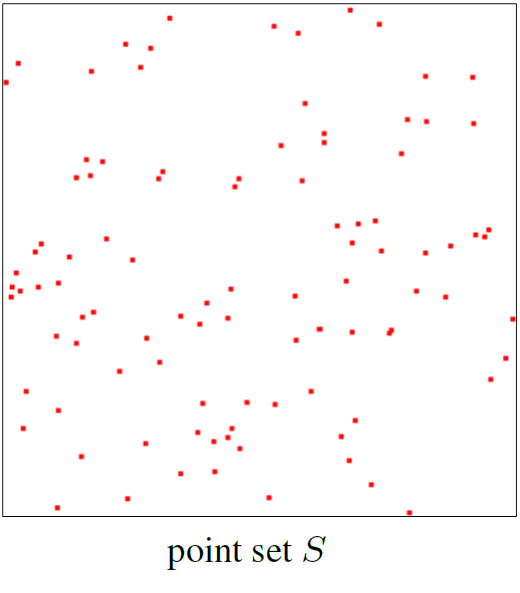
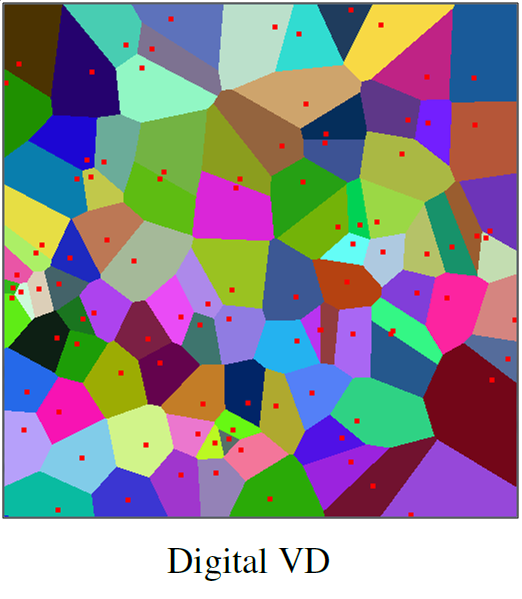
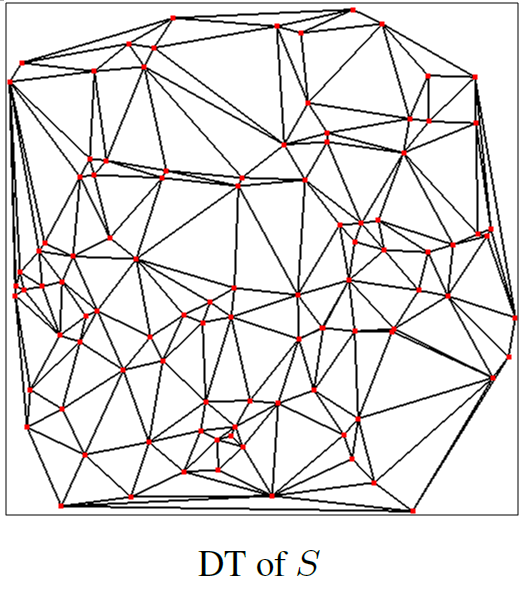
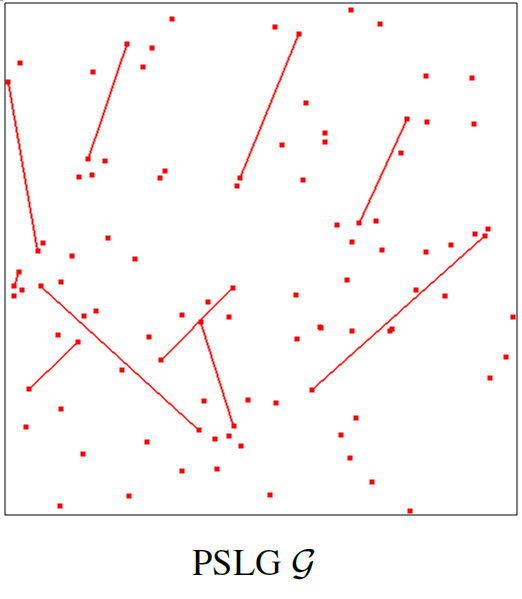
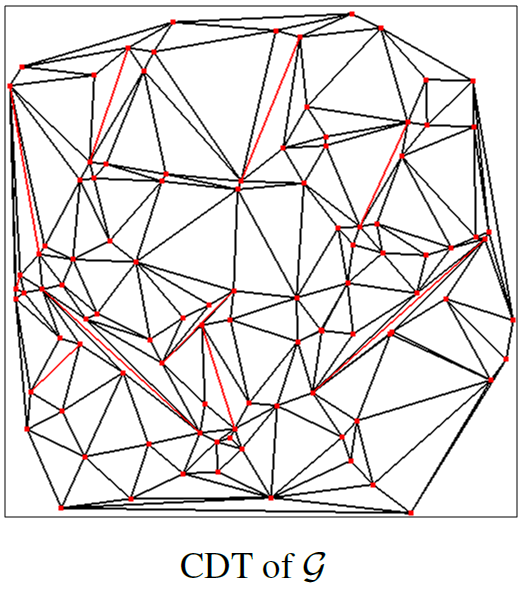
Figure 1: Delaunay triangulation (DT) and
constrained Delaunay triangulation (CDT).
Abstract
This paper
presents a novel approach, termed GPU-CDT, to compute the constrained
Delaunay triangulation (CDT) for a planar straight line graph (PSLG),
consisting of points and edges, using the graphics processing unit (GPU).
Although there are many algorithms for constructing the 2D CDT using the CPU,
there has been no known prior approach using the parallel computing power of
the GPU efficiently. For the special case of the CDT problem with PSLGs
consisting of just points, which is the normal Delaunay triangulation problem,
a hybrid approach has recently been proposed that uses the GPU together with
the CPU to partially speed up the computation. Our GPU-CDT works for such
special case too, but the whole computation is fully accelerated by the GPU.
Our implementation using the CUDA programming model on nVidia
GPUs is numerically robust and runs several times faster than any existing CPU
algorithms as well as the prior GPU-CPU hybrid approach. This result is
reflected in our experiment with both randomly generated PSLGs and real world
GIS data, with millions of points and edges.
Categories and Subject Descriptors:
I.3.5
[Computer Graphics]: Computational Geometry and Object Modeling - Geometric
algorithms
I.3.1 [Computer Graphics]: Hardware
Architecture - Graphics processors
Keywords: GPGPU, Computational Geometry, Voronoi Diagram
Software Download: here (old)
Software Download: New version using an improved 2D Delaunay triangulation algorithm, termed gDel2D is available here (October 2015)
Video (Technical Report, April 2011):
click here
(28.5M) to download
Video (I3D Conference, March 2012):
click here
(29.1M) to download
Related Projects: GPU-DT, Quality Mesh, PBA
Technical Report: TRB3/11
(March 2011)
The 2012 ACM Siggraph Symp on Interactive 3D
Graphics and Games, 9-11 March, CA, USA, pp 39--46.
here
Presentation (I3D Conference, March
2012): click here
Journal Paper: Qi, Cao and Tan, "Computing 2D Constrained Delaunay Triangulation Using the GPU".
IEEE Transactions on Visualization and Computer Graphics, vol 19 (5), 2013, 736--748.
(Invited paper for the
special issue on I3D 2012 conference)
here or Preprint
|
© 26 April 2011, 14 Dec 2011, 31 March 2013, 27 Oct 2015, 20 Feb 2017 School of Computing, National University of Singapore. |
A total of 1277 different hosts have accessed this document in the last 748 days; your host, 216.73.217.151, has accessed it 1 times.
If you're interested, complete statistics for this document are also available, including breakdowns by top-level domain, host name, and date.