Bytes
Asst Prof Umang Mathur’s Research on Data Race Detection Featured in Communications of the ACM Research Highlights
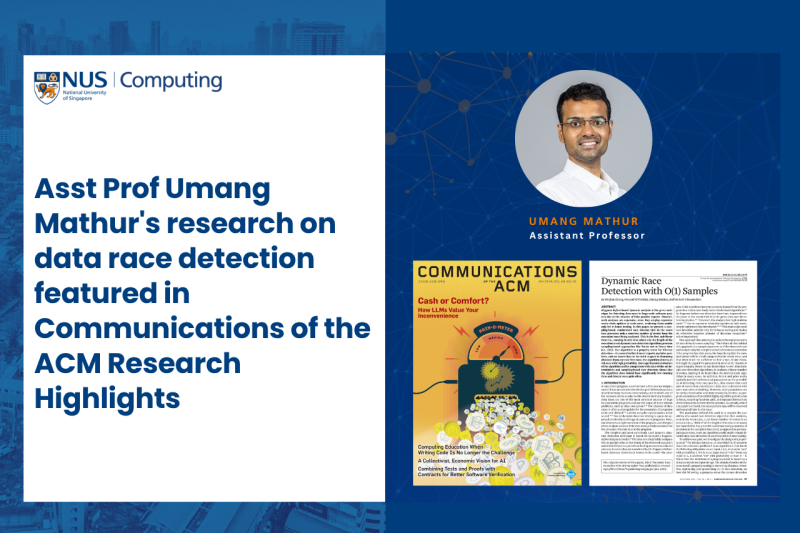
A paper co-authored by Assistant Professor Umang Mathur on detecting hard-to-catch software bugs has been featured in Communications of the ACM (CACM) Research Highlights, the flagship magazine of the world’s largest computing society.
When a program runs many tasks at once, those tasks sometimes access the same memory without coordinating. The result is a data race, a bug that can crash software or produce incorrect results. Data races are hard to reproduce, and finding them usually means tracking every step of a program as it runs, which becomes expensive for large programs.
The paper, "Dynamic Race Detection with O(1) Samples", shows that races can be found by checking only a small sample of a program’s execution. The approach comes with mathematical guarantees. The number of samples needed stays the same however long the program runs, and every race it reports is real.
Although sampling can miss bugs, it is highly likely to detect a race when an execution is sufficiently far from being race-free, that is, when eliminating its races would require changing a substantial fraction of its events. The result offers a foundation for race detection that scales to large, long-running software.
The paper was presented at the ACM SIGPLAN Symposium on Principles of Programming Languages (POPL) in Boston in 2023, where it received a Distinguished Paper Award. It was selected for SIGPLAN Research Highlights in 2025 and appears as a Research Highlight in the September 2026 issue of CACM (Vol. 69, no.9), following its online publication in August.
Asst Prof Mathur's co-authors are Minjian Zhang, a former PhD student at the University of Illinois Urbana-Champaign (UIUC) now at Nanyang Technological University, and Mosaad Al Thokair and Professor Mahesh Viswanathan of UIUC.
Read the CACM Research Highlights article here: https://cacm.acm.org/research-highlights/dynamic-race-detection-with-o1-samples/
Congratulations to Asst Prof Umang Mathur and his co-authors!
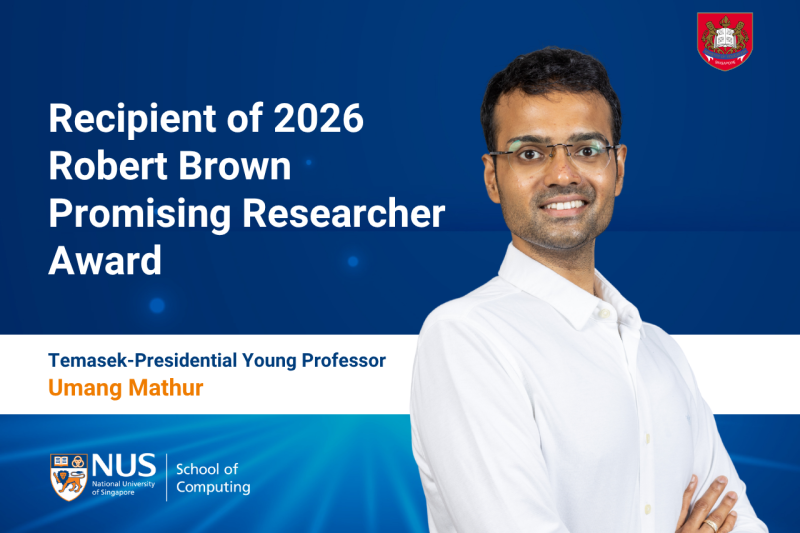
Asst Prof Umang Mathur Receives 2026 Robert Brown Promising Researcher Award
NUS Computing is pleased to share that Assistant Professor Umang Mathur has been awarded the 2026 Robert Brown Promising Researcher Award under the Ministry of Education Singapore (MOE) Academic Research Fund (AcRF) Tier 2 grant.
Established to support junior faculty, the award enables researchers to deepen their work and compete for larger grants as they progress in their careers. It is named in honour of Dr Robert Brown, founding Chairman of MOE's Academic Research Council.
As part of the AcRF Tier 2 grant, his project, "Foundations for Testing and Verifying Concurrency in Go”, will receive funding over three years to develop rigorous foundations and automated methods for understanding, testing and verifying how concurrent programs behave.
Modern software increasingly relies on many tasks running at the same time, and getting those tasks to interact correctly is difficult. Subtle mistakes can cause software to produce incorrect results, crash or stop responding. Such bugs often escape conventional testing because they surface only under particular combinations of timing and interactions.
The project focuses on Go, a programming language designed to make concurrent programming easier. Easier to write does not always mean correct, and the goal is to help developers uncover elusive concurrency bugs and build greater confidence in the software they create.
In addition to the Tier 2 award, Asst Prof Mathur will receive a S$100,000 top-up grant through the Robert Brown Promising Researcher Award to deepen this research and explore related directions.
This achievement reflects the School's continued work on reliable software systems and its support for emerging academic leaders.
Congratulations to Asst Prof Umang Mathur on this recognition!
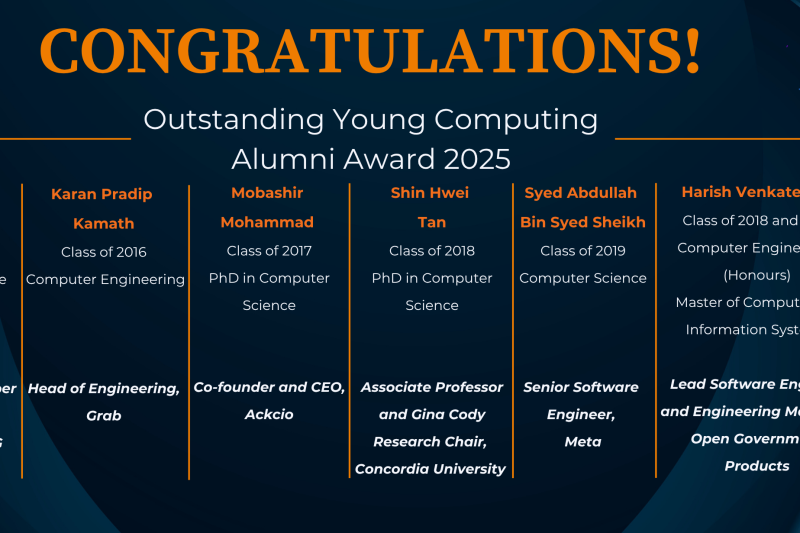
Six NUS Computing Alumni Recognised with Outstanding Young Computing Alumni Award 2025
Six alumni have been named recipients of the Outstanding Young Computing Alumni Award 2025. The award recognises NUS Computing graduates whose achievements and contributions bring honour to the University and the School.
The recipients graduated between 2015 and 2021, from the School's bachelor's, master's and PhD programmes. Their work covers a wide range:
- engineering leadership at Grab, Meta and Open Government Products
- software engineering research at Concordia University
- infrastructure monitoring at the deep-tech start-up Ackcio
- Women Devs SG, a community of more than 4,000 women in tech
Several have also given back to the School as teaching assistants, hackathon judges and bursary donors.
Recipients of the Outstanding Young Computing Alumni Award 2025
- Saloni Kaur (Class of 2015, Computer Science)
Software Developer and Director, Women Devs SGSaloni has built a strong profile in technology and community leadership through her sustained work to support women in computing. With over ten years of software development experience, she has led Women Devs SG since 2021 and grown it into an active community of more than 4,000 members. Through mentorship sessions, hands-on technical workshops, public speaking, and product management programmes, she has created opportunities for women to build confidence and progress in tech.She has also co-founded RagTech, a tech podcast focused on making industry ideas more accessible, and launched Techie Taboo, a card game that encourages people to explain technical concepts in a fun and approachable way. Her work reflects a clear commitment to inclusion, education, and community impact.
- Karan Pradip Kamath (Class of 2016, Computer Engineering)
Head of Engineering, GrabKaran is recognised for his rapid rise and sustained leadership in the technology industry. Since joining Grab in 2016 as an entry-level engineer, he has progressed through the organisation and became its youngest Head of Engineering in 2022. He has led teams across Singapore, Vietnam, Indonesia, Malaysia, and India, and has worked across product engineering, platform engineering, microservice frameworks, streaming and big data platforms, finance data warehouses, and developer experience systems.He is currently leading work on the use of large language models for code migrations, on-call automation, and internal engineering tools. His career reflects both technical depth and the ability to lead complex engineering organisations at scale.
- Mobashir Mohammad (Class of 2017, PhD in Computer Science)
Co-founder and CEO, AckcioMobashir turned his doctoral research at NUS into Ackcio. As co-founder and CEO, he has built deep-tech solutions that monitor critical infrastructure (tunnels, dams, mines, and railways) in over 50 countries, catching the first signs of failure before they happen. This is a strong demonstration of the entrepreneurship criterion and a compelling story of NUS research reaching global application.
- Shin Hwei Tan (Class of 2018, PhD in Computer Science)
Associate Professor and Gina Cody Research Chair, Concordia UniversityShin Hwei is recognised for her significant contributions to software engineering research, teaching, and academic leadership. She is a Gina Cody Research Chair at Concordia University and has played an influential role in the research community, including starting the Frontiers of Software Engineering track in ACM TOSEM and serving as General Chair of FSE 2026. In 2025, she received the ACM-W Rising Star Award, a distinguished recognition for women in computing.She has also been an active advocate for women in computing through her work with ACM-W Montreal and her mentorship of female students, both during and after her time at NUS.
- Syed Abdullah Bin Syed Sheikh (Class of 2019, Computer Science)
Senior Software Engineer, MetaAbdullah is recognised for combining strong technical achievement with meaningful service to the community and alma mater. Since 2019, he has worked at Meta in Menlo Park on large-scale production systems. During his undergraduate years, he volunteered as an Assistant Teacher under Code in the Community at Saturday Kids, helping children from underprivileged backgrounds learn Scratch and Python. He also supported the Oasis Second Chance Animal Shelter and NUS Computing Club through web development and IT administration, and served as a part-time teaching assistant for several School of Computing courses.After graduation, he continued giving back by contributing to the NUS College Alumni Bursary Fund to support students in need.
- Harish Venkatesan (Class of 2018 and 2021, Computer Engineering; Master of Computing in Information Systems)
Lead Software Engineer and Engineering Manager, Open Government ProductsHarish is recognised for his outstanding leadership across public service, industry, entrepreneurship, and education. He graduated from the National University of Singapore with a B.Eng. in Computer Engineering with Highest Distinction (2018) and earned his Master of Computing (2021) as the Singapore Computer Society Gold Medalist. Harish began his career at Visa, earning a U.S. patent in payment infrastructure, before joining Open Government Products (OGP) as Lead Software Engineer and Engineering Manager. At OGP, he leads the Isomer Next and AskGov platforms, which power critical government web traffic and enable over 100 government agencies to streamline public access to information.Beyond his engineering achievements, Harish remains deeply committed to empowering others and giving back to his alma mater. He co-founded Gratify, a media-featured digital gifting startup supported by the NUS SoC Practicum Grant. He also actively contributes to NUS as a CS3219 teaching assistant pioneering system-design clinics, serves as a Hack&Roll judge, and creates online educational content to help aspiring engineers from non-traditional backgrounds enter the computing field.
Join us in congratulating this year's recipients!
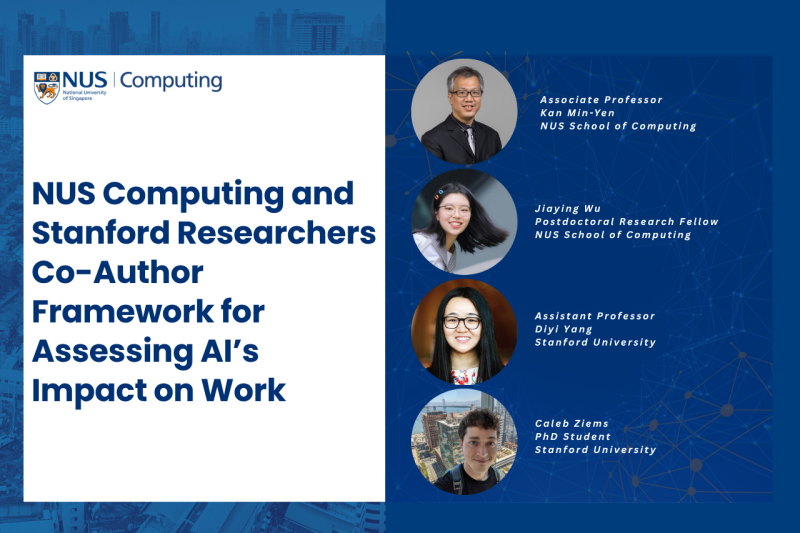
NUS Computing and Stanford Researchers Co-Author Framework for Assessing AI’s Impact on Work
Researchers from NUS Computing, Stanford University and other institutions have co-authored a whitepaper setting out six conditions for judging whether AI genuinely improves work. The paper, “When Does AI Augment Work? A Workflow-Level Framework for Human-Agent Collaboration”, was posted to arXiv two days after the Ministry of Manpower told Parliament that its surveys show most firms adopting AI are redesigning jobs or creating new roles. Its co-authors are Jiaying Wu, a postdoctoral research fellow in Associate Professor Kan Min-Yen's WING.NUS research group at NUS Computing, and Caleb Ziems, a PhD student at Stanford University advised by Assistant Professor Diyi Yang.
The whitepaper grew out of CIVIC-AI 2026, a two-day workshop held at NUS on 13 and 14 July. Co-organised by faculty, staff and students from Associate Professor Kan's WING.NUS group and Asst Professor Yang’s SALT Lab at Stanford, the workshop was the first event in a new collaboration between the two universities on AI, work and society.
The first day was open to the public, with talks and a panel on social intelligence in AI systems. On the second day, an invitation-only session brought academics together with industry practitioners and regulators to discuss redesigning work with AI agents in Singapore. The paper draws on these second-day discussions.
The white paper notes that organisations currently track AI through usage logs, investment, productivity and headcount. The authors argue this tracking can miss whether a faster first draft has created extra checking or rework further along. The paper assesses whole workflows against six conditions: durable net value, meaningful human control, clear accountability and recovery, deepening learning, career pathways and job purpose.
The first three can be assessed in a snapshot evaluation but the last three conditions can only be assessed over time. The tasks most readily handed to AI tend to be high-volume, procedural and easy to verify, and junior workers build their judgement on the same tasks. A workflow can meet the first three conditions at launch and later depend on reviewers who never had that grounding.
The authors apply the framework to AI-assisted social surveys. In the division of labour proposed by workshop participants, an AI interviewer can rephrase questions, ask follow-ups and organise responses within limits the team has approved. Researchers define the study's purpose, decide the weighting, interpret the findings and approve the final coding. They also design the first protocols and do the initial coding themselves, partly because a researcher who starts from the AI's draft risks being anchored to it. That early coding is critical, as it is where junior researchers practise the fine-grained judgement they will later need for higher-level decisions.
“Staff need to be provisioned with the opportunity to do foundation work by hand, investing the necessary arduous investment in sensemaking. Without it, junior staff risk accumulating cognitive debt, as they get immediate feedback and critiques from fluent AI systems. This can lead to the collapse of having insufficient trained experienced staff, which itself further leads enterprises to rely on AI, which may have insufficient safeguards for unusual cases,” Prof Kan said.
The authors recommend keeping a shared record for each redesigned workflow. It would log what the agent does, where people review or override it, what goes wrong, and how the arrangement affects workers' skills and progression over time.
Read the full whitepaper here: https://arxiv.org/abs/2609.12482
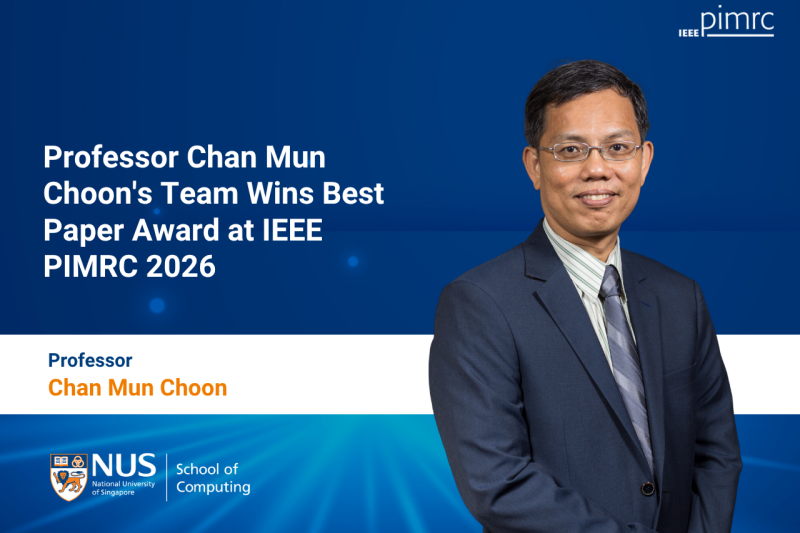
Professor Chan Mun Choon’s Team Wins Best Paper Award at IEEE PIMRC 2026
A radio unit built entirely in software has earned Professor Chan Mun Choon and his team the Best Paper Award in Track 4 of IEEE International Symposium on Personal, Indoor and Mobile Radio Communications (PIMRC) 2026.
The paper, "ProtO-RU: An O-RAN Split-7.2 Radio Unit Using SDRs", grew out of the Master's thesis of first author Zhiyu Zhou, a Master's graduate of NUS Computing whom Prof Chan supervised, alongside co-authors are Xin Zhe Khooi and Satis Kumar Perma.
Researchers building 5G testbeds on O-RAN, an open standard for mobile networks, have had to rely on commercial radio units, proprietary hardware they cannot modify or experiment with. ProtO-RU recreates the radio unit, the part of the network closest to the antenna, using ordinary computer processors and low-cost software-defined radios. The team showed that it works with two major open-source 5G software stacks and with commercial 5G devices, and that it runs stably through hour-long tests. It responds more slowly than commercial hardware and is built for research and prototyping. Because ProtO-RU is open source, other labs can use it to set up full O-RAN testbeds and try new ideas at the radio unit itself.
The award was one of six at PIMRC 2026, held in Singapore from 1 to 4 September. Each track named a single best paper, and ProtO-RU was chosen from the 117 papers submitted to Track 4.
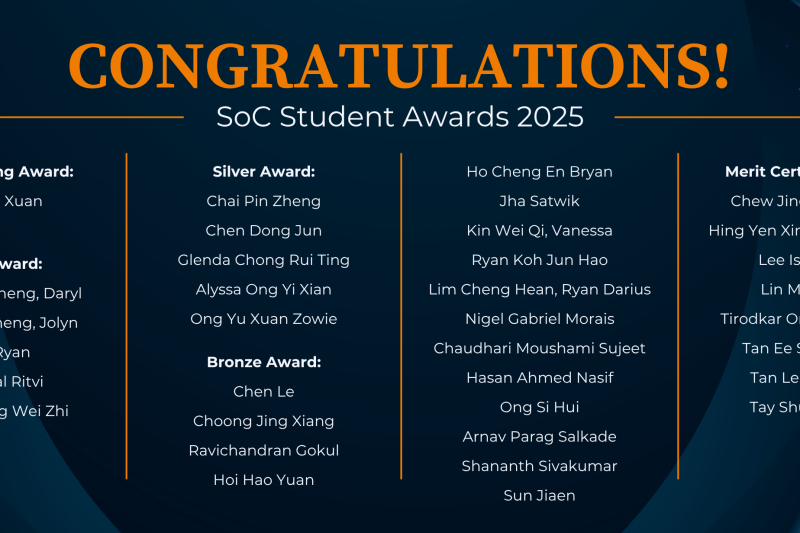
35 NUS Computing Students Recognised in SoC Student Awards 2025
35 undergraduates have been named recipients of the SoC Student Awards 2025, the School’s annual recognition of student contributions beyond academics.
Lee Kai Xuan, a Year 2 Computer Science student, received the Outstanding Award. Five students received Gold Awards, five received Silver, 16 received Bronze and eight were awarded Merit Certificates. The recipients come from every year of study and five undergraduate programmes: Computer Science, Computer Engineering, Business Analytics, Information Systems and Information Security.
The awards recognise contributions across four areas: leadership in SoC clubs and interest groups, achievement while representing the School or NUS in competition, voluntary service under the School's name, and participation in School events such as orientation and the Inter-Faculty Games.
Full List of SoC Student Awards 2025 Recipients
Outstanding Award
- Lee Kai Xuan (Year 2, Computer Science)
Gold Award
- Leong Hoi Sheng, Daryl (Year 2, Business Analytics)
- Leow Sze Theng, Jolyn (Year 3, Computer Science)
- Neo Ryan (Year 2, Computer Science)
- Agarwal Ritvi (Year 3, Computer Science)
- Darryl Yeng Wei Zhi (Year 2, Computer Science)
Silver Award
- Chai Pin Zheng (Year 1, Computer Science)
- Chen Dong Jun (Year 2, Computer Science)
- Glenda Chong Rui Ting (Year 4, Computer Science)
- Alyssa Ong Yi Xian (Year 4, Computer Science)
- Ong Yu Xuan Zowie (Year 2, Computer Science)
Bronze Award
- Chen Le (Year 3, Computer Science)
- Choong Jing Xiang (Year 2, Computer Science)
- Ravichandran Gokul (Year 2, Computer Science)
- Hoi Hao Yuan (Year 2, Business Analytics)
- Ho Cheng En Bryan (Year 4, Computer Science)
- Jha Satwik (Year 3, Computer Science)
- Kin Wei Qi, Vanessa (Year 4, Computer Science)
- Ryan Koh Jun Hao (Year 2, Computer Engineering)
- Lim Cheng Hean, Ryan Darius (Year 3, Business Analytics)
- Nigel Gabriel Morais (Year 2, Information Security)
- Chaudhari Moushami Sujeet (Year 2, Business Analytics)
- Hasan Ahmed Nasif (Year 2, Computer Science)
- Ong Si Hui (Year 3, Information Systems)
- Arnav Parag Salkade (Year 3, Computer Engineering)
- Shananth Sivakumar (Year 1, Computer Science)
- Sun Jiaen (Year 3, Computer Science)
Merit Certificate
- Chew Jing Heng (Year 4, Computer Science)
- Hing Yen Xing, Joanne (Year 4, Computer Science)
- Lee Isaac (Year 4, Computer Science)
- Lin Myat (Year 3, Business Analytics)
- Tirodkar Om Milind (Year 2, Computer Engineering)
- Tan Ee Syuen (Year 2, Computer Science)
- Tan Le Yew (Year 3, Computer Science)
- Tay Shu Sui (Year 2, Business Analytics)
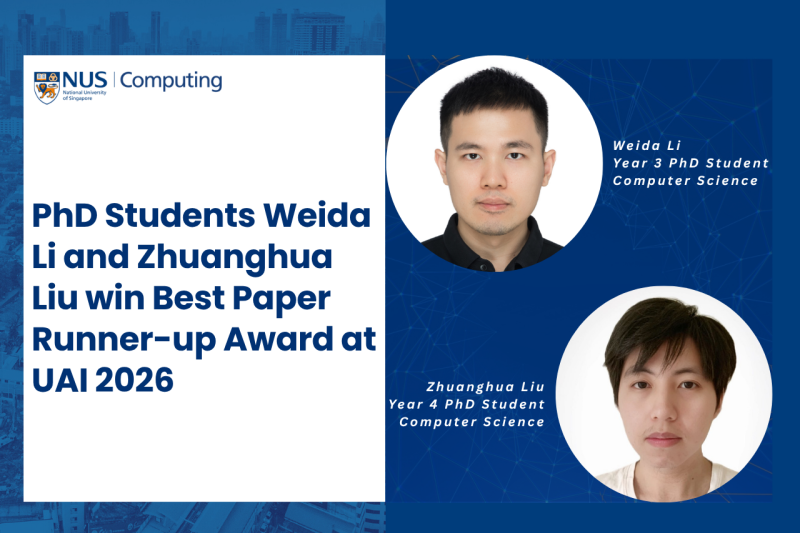
PhD Students Weida Li and Zhuanghua Liu Win Best Paper Runner-up Award at UAI 2026
Two of our Computer Science PhD students, Weida Li and Zhuanghua Liu, have won the Best Paper - Runner-up Award at the Conference on Uncertainty in Artificial Intelligence (UAI) 2026 — ranking 2nd among 1,087 submissions to one of the top-ranked venues in AI research, working under the supervision of Associate Professor Bryan Kian Hsiang Low.
Their paper, "Nonlinear Axiomatic Attribution for Cooperative Games," tackles a quiet flaw in one of machine learning's most trusted tools: the Shapley value, widely used to rank how much each player, feature, or data point contributes to an outcome. The team found that its defining strength, linearity, is also its blind spot – it can miss real differences between contributors because too much variation falls into what the method simply can't see. Their fix borrows from the "least core," a longstanding alternative to Shapley values, and builds a new family of nonlinear attribution methods around it, each one solving an optimisation problem to stay as faithful as possible to the real data.
Attribution methods like this quietly shape how AI decisions get explained, how contributions get priced in data markets, and how audits trace which inputs actually mattered.
Congratulations to Weida, Zhuanghua, and Prof Low!
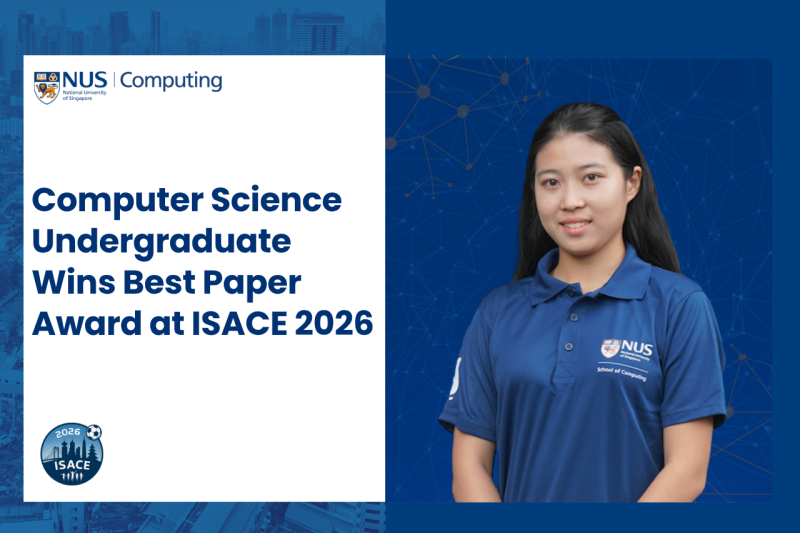
Computer Science Undergraduate Wins Best Paper Award at ISACE 2026
A research paper led by Song Yuexi, a Computer Science undergraduate at NUS Computing and member of the NUS Tennis Team, has received the Best Paper Award at the 3rd International Sports Analytics Conference and Exhibition (ISACE 2026).
The paper, TANS-Agent: Structured, Multi-Agent Tactical Reasoning for Tennis Match Analysis and Strategy Recommendation, introduces a multi-agent AI framework that uses a structured notation system to support tennis match analysis and tactical strategy recommendation. By grounding large language model (LLM) agents in explicit spatial and tactical representations, the framework enables more interpretable, consistent, and tactically grounded recommendations.
The research was conducted under the guidance of Professor Liang Zhenkai.
Congratulations to Song Yuexi, Professor Liang, and the team on this achievement.
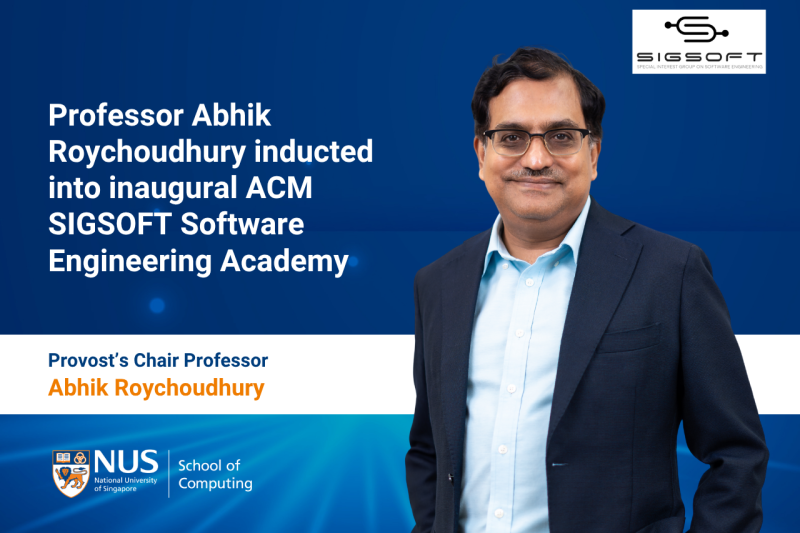
Prof Abhik Roychoudhury Inducted into Inaugural Class of the ACM SIGSOFT Software Engineering Academy
Provost's Chair Professor Abhik Roychoudhury has been named a member of the inaugural class of the ACM SIGSOFT Software Engineering Academy, joining a global cohort recognised for lasting contributions to software engineering research, practice, and education.
The Academy was established by ACM SIGSOFT, the Association for Computing Machinery's Special Interest Group on Software Engineering, as a standing body of honour marking the organisation's 50th anniversary. It was previewed at the FSE 2026 conference in Montreal in July, before the inaugural class was formally announced. New members will be elected annually through nominations from the community.
Prof Roychoudhury has been with the Department of Computer Science at NUS Computing since 2001, where he leads the Trustworthy and Secure Software (TSS) research group. His work on semantic and symbolic program repair, including the SemFix approach recognised with an ICSE Most Influential Paper (Test-of-Time) Award, helped establish program repair as a field of its own. That line of research later grew into AutoCodeRover, an autonomous program-improvement agent that was acquired by Sonar and commercialised as the SonarQube Remediation Agent, where he served as Senior Scientific Advisor.
His group's work on fuzz testing and symbolic execution has similarly shaped how the field approaches software security, earning recognition including the IEEE New Directions Award. Prof Roychoudhury is the current Editor-in-Chief of ACM Transactions on Software Engineering and Methodology (TOSEM), sits on the editorial board of Communications of the ACM, and has chaired both ICSE and FSE, the field's two flagship conferences, as well as the FSE Steering Committee. He was named an ACM Fellow in 2024 and was the inaugural recipient of the NUS Outstanding Graduate Mentor Award, with former doctoral students now on faculty at institutions around the world.
The recognition arrives alongside a decade-long throughline in his research: from the original SemFix paper in 2013, through the ICSE Test-of-Time award for that work, to AutoCodeRover's acquisition by Sonar and its commercial launch this year as the SonarQube Remediation Agent.
For more information, visit https://www2.sigsoft.org/academy/inaugural-class.html.

Professor Xiaokui Xiao and Collaborators Take Home Three Major Awards in AI, Data Systems, and Privacy
Three papers co-authored by Professor Xiaokui Xiao have won top honours at leading international conferences this year, recognising work spanning AI system efficiency, differential privacy auditing, and graph algorithms.
“I am deeply grateful to our students, research staff, former students and collaborators, whose hard work and creativity made these results possible, and to NUS Computing for its strong support of our research,” said Prof Xiao.
ACM SIGKDD Best Student Paper Award
KDD 2026, 9–13 August, Jeju, South Korea
Yiqian Huang, a Year 3 PhD candidate in Prof Xiao’s group, won the award for SCOPE: Cost-Efficient Model Selection for Compound AI Systems under Quality Constraints, co-authored with Shiqi Zhang, a postdoctoral researcher in Xiao's group, Tianyuan Jin, a former PhD student of Xiao’s, who is now an Assistant Professor in the Thrust of Data Science and Analytics (DSA) at the Hong Kong University of Science and Technology (Guangzhou), and Prof Xiao.
The paper proposes a way to choose a cost-effective combination of large language models for a multi-step AI system, while ensuring that the system as a whole meets a required quality level. In experiments, SCOPE met that quality level at as little as one-sixth of the cost of the strongest competing approach.
IEEE Symposium on Security and Privacy Distinguished Paper Award
IEEE S&P 2026, 18–21 May, San Francisco, USA
Auditing Apple's DifferentialPrivacy.framework: Implementation Bugs, Misconfigurations, and Practical Risks put a widely trusted privacy system to the test. Apple's differential privacy framework runs on more than 2.35 billion devices, quietly reassuring users that the data their phones send back can't be traced to them individually. The team, led by Rishav Chourasia and Ergute Bao, both former PhD students of Xiao’s now with BetterData and as a postdoctoral researcher at Mohamed bin Zayed University of Artificial Intelligence respectively, together with Uzair Javaid, and Prof Xiao, found that several mechanisms did not deliver their stated privacy guarantees.
In particular, some secure-aggregation protocols had local privacy protection switched off entirely, and out on the open internet, the team found analytics logs that could be decoded to reveal what websites someone had visited, or which emojis they had typed. The team disclosed the vulnerabilities to Apple, and was informed that the affected mechanisms had been deprecated.
ACM PODS Best Newcomer Award
PODS 2026, 1–3 June 2026 (part of SIGMOD/PODS), Bengaluru, India
Near-Optimality for Single-Source Personalized PageRank, by Xinpeng Jiang, Haoyu Liu, and Siqiang Luo, of the College of Computing and Data Science at Nanyang Technological University, together with Prof Xiao, won the Best Newcomer Award at the ACM Symposium on Principles of Database Systems. The paper largely closes a long-standing gap between the best known upper and lower bounds on how efficiently personalized PageRank, a graph-ranking method used in web search and recommendation systems, can be computed for a single source node.
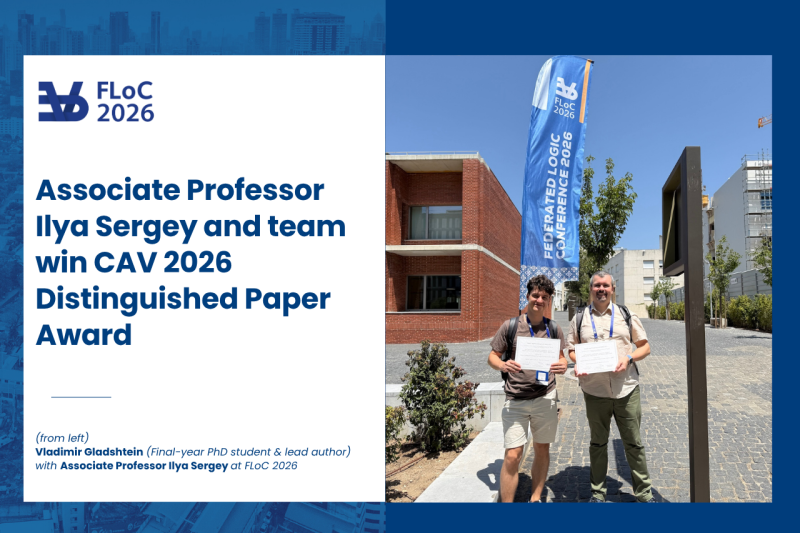
Associate Professor Ilya Sergey and Team Win Distinguished Paper Award at CAV 2026
A research group at NUS Computing has received a Distinguished Paper Award at CAV 2026, one of the flagship conferences on formal methods and verification, for their work on Velvet, a tool that automatically proves whether a piece of code does what it’s meant to do. CAV 2026 was held as part of FLoC 2026, the 9th Federated Logic Conference.
The paper, “Velvet: A Foundational Multi-Modal Verifier for Imperative Programs in Lean” was one of eight papers to receive the award, out of 81 accepted submissions and 311 papers submitted overall. The team is led by Associate Prof Ilya Sergey, together with Vladimir Gladshtein, a final-year PhD student and the paper's lead author, fellow NUS Computing PhD students Yueyang Feng, Dipesh Kafle, George Pîrlea, Qiyuan Zhao, and Vitaly Kurin.
Proving Code Does What It’s Supposed to Do
Testing a program only reveals how it behaves on the inputs someone happened to try. Velvet takes a different route, known as formal verification. Developers write a precise statement, alongside their code, describing what that code is supposed to do, and Velvet builds a mathematical proof that the code satisfies it across every possible input. It works on ordinary imperative programs, the kind most real-world software is written in, with mutable variables, loops, and exceptions.
Verification tools already exist. Dafny is one; Verus, used at Amazon AWS, Google, and Microsoft, is another. Prof Sergey's team points to two recurring frustrations with these tools. Automation that fails offers little recourse beyond reworking the code and hoping for a different outcome. And the verifiers themselves are substantial pieces of software, which means trusting the tool becomes almost as important as trusting the code it's checking.
"For decades, every program verifier has been its own island, with its own language, its own logic, and its own bugs. Our bet is that verifiers should instead be ordinary libraries inside a single proof assistant, where they can share specifications, decades of formalised mathematics, and the rapidly improving AI automation growing around Lean,” said Assoc Prof Sergey. “Velvet shows this recipe can produce a tool that matches industrial verifiers while being trustworthy down to a tiny proof-checking kernel. The award is encouragement that the community sees promise in this direction. The credit goes to the people who built Velvet: Vladimir Gladshtein, a final-year PhD student who led the effort, Vitaly Kurin, who started on it as an intern and is now joining us as a PhD student, and the rest of the VERSE Lab team, who together pushed Lean well past what it was thought to be for.”
Building a Verifier Inside a Proof Assistant
Velvet is built as a library inside Lean, the proof assistant mathematicians use to formalise research mathematics and now a leading platform for AI-driven theorem proving. Most proofs are generated automatically. Where automation runs out, developers can open the proof, see exactly what remains unproven, and finish it themselves using Lean's tactics, its Mathlib library, or AI assistance. Lean's small trusted kernel checks every proof regardless of how it was produced, so confidence in the result doesn't depend on trusting Velvet's own code.
Since the CAV 2026 paper was published, Prof Sergey says Velvet is now ten times faster than the version reported at the conference, and that it now outperforms Dafny, whose automation is considered the state of the art in automated verification. Velvet extends a broader research programme in VERSE Lab building a family of domain-specific verifiers as Lean libraries on shared foundations. An earlier tool, Veil, verifies distributed protocols and was published at CAV 2025. The work was partially supported by a Singapore Ministry of Education Tier 3 grant and a Stellar Development Foundation Academic Research Grant.
Velvet is open source, available at https://github.com/verse-lab/velvet.
What's Next
The team has two directions in mind. One treats Velvet as a form of computer-checked pseudocode. Researchers have long used pseudocode to communicate algorithms concisely, but without any guarantee that the pseudocode itself is correct. A Velvet program can serve the same purpose while carrying a machine-checked proof, opening a path toward AI-assisted algorithm discovery, where an AI proposes candidate programs, Lean checks them, and only the correct ones survive. LeetProof, a first step in this direction, is due to appear at ASE'26.
The other is teaching. As students increasingly write code with AI assistance, Prof Sergey argues that the skill worth building is learning to state precisely what a program should do. They plan to bring Velvet into the classroom, giving students immediate, rigorous feedback on whether their programs meet their own specifications.
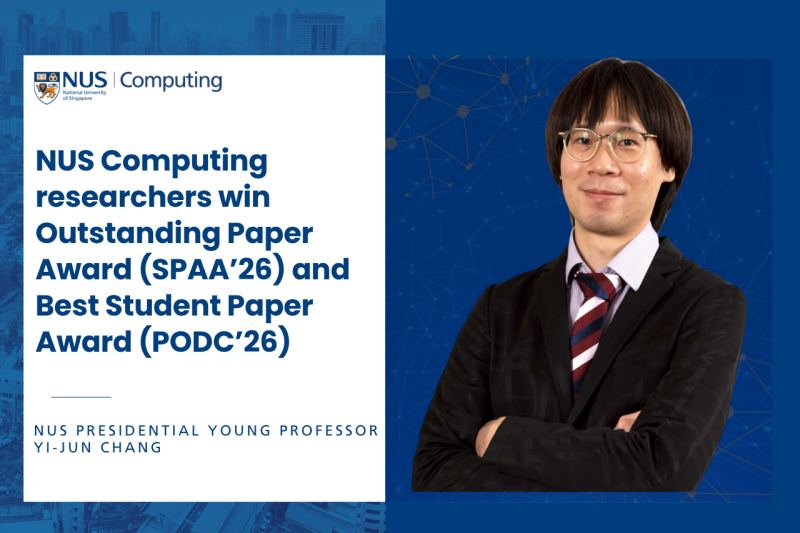
NUS Computing Researchers Win Outstanding Paper Award at SPAA 2026 and Best Student Paper Award at PODC 2026
NUS Presidential Young Professor Yi-Jun Chang and his collaborators have won two awards at leading conferences in distributed computing this year: the Outstanding Paper Award at the 2026 ACM Symposium in Parallelism in Algorithms and Architectures (SPAA), given to the top three papers at the conference, and the Best Student Paper Award at the 2026 ACM Symposium on Principles of Distributed Computing (PODC), which recognises the best paper among those with substantial contributions from student authors.
The Outstanding Paper Award at SPAA 2026 recognises “Energy-Efficient Aggregation and Minimum-Degree Spanning Trees in Radio Networks”, joint work by Prof Chang and Guan Yang Ze, who started the project as an undergraduate doing his Final Year Project under Prof Chang. Their starting point was a problem anyone who has managed a network of battery-powered sensors will recognise: devices burn through power just by listening, so pooling readings from across a network can drain them fast.
Prof Chang and Guan built a protocol where devices sleep for most of the process and wake only when needed, still ending up with a combined result, such as a total count or an aggregated reading, from across the entire network. The energy cost comes close to the lowest possible for any network shape, while maintaining efficient running time. The techniques may inform how future sensor networks for environmental monitoring or smart infrastructure are designed to run longer on a single charge.
“Efficient Counting and Simulation in Content-Oblivious Rings” won the Best Student Paper Award at ACM PODC 2026, joint work by Prof Chang, his PhD student Zhou Haoran, Jérémie Chalopin (Aix Marseille Université), and Giuseppe A. Di Luna (Sapienza Università di Roma). The paper studies the content-oblivious model, where devices communicate only through pulses that signal nothing more than that a message was sent, with no data and no sender identity attached. The model represents an extreme fault scenario: an adversary can corrupt the content of every message in the network, though genuine messages cannot be deleted and fake ones cannot be created.
The authors found that this stripped-down setting costs far less than expected. Ordinary digital communication can be reconstructed from these content-free pulses at only constant overhead, well below earlier results where the cost grew with the size of the network. From there, they developed faster algorithms for basic tasks including counting devices and combining information distributed among them, even when the contents of every message may be completely corrupted.
“Both papers improve our understanding of the capabilities of distributed computation under severe communication constraints, showing that surprisingly efficient algorithms are still possible. I am also happy to see the contributions of Yang Ze and Haoran recognised by the research community through these awards,” Prof Chang said.

Associate Professor Liang Zhenkai Receives ACM AsiaCCS 2026 Test-of-Time Award
Associate Professor Liang Zhenkai from the Department of Computer Science has received the Test-of-Time Award at the 21st ACM Asia Conference on Computer and Communications Security (AsiaCCS 2026), recognising his 2011 paper, “Jump-oriented programming: a new class of code-reuse attack”.
The paper, co-authored with Tyler K. Bletsch, Xuxian Jiang, and Vincent W. Freeh, was first presented at AsiaCCS 2011 in Hong Kong. It introduced jump-oriented programming, a code- reuse attack technique that circumvents the stack-based defences designed to stop earlier return-oriented programming attacks, revealing a new class of vulnerability in how software could be exploited without injecting malicious code.
The ACM AsiaCCS Test-of-Time Award honours papers that have demonstrated enduring significance and lasting contributions to the field of computer and communications security.
15 years on, the paper continues to be cited and built upon in the security research community studying code-reuse attacks and defences against them.
Congratulations to Associate Professor Liang on this recognition.
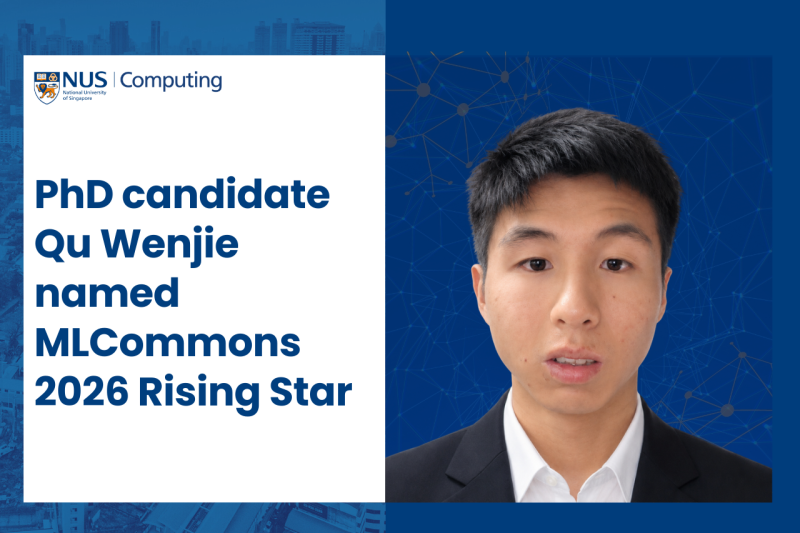
PhD Candidate Qu Wenjie Named 2026 MLCommons Rising Star
Qu Wenjie, a PhD candidate in Computer Science, has been selected as a 2026 ML and Systems Rising Star by MLCommons, an honour recognising early-career researchers shaping the future of machine learning and systems research.
Qu joins a cohort of 39 researchers from 26 institutions worldwide, chosen from a pool of more than 175 applicants. This programme connects participants with leaders across academia and industry, and this year’s group presented their work at the Rising Stars Workshop, hosted at AMD’s headquarters in Santa Clara from 30 - 31 July.
His research sits at the intersection of machine learning, security, and cryptography, focused on making large language models trustworthy and verifiable. Working under the supervision of NUS Presidential Young Professor Zhang Jiaheng and closely with Professor Dawn Song, he builds systems for auditing and proving the correctness of AI services, including zero-knowledge proofs for model inference and training, with work published in venues such as IEEE S&P, USENIX Security, ACM CCS, and NDSS.
"I am deeply honoured to receive this recognition, which reflects not only my past work but also the support of my advisor, mentors, collaborators, friends, and the NUS Computing community," said Qu. "My research focuses on building secure and trustworthy AI systems, particularly understanding and mitigating emerging security risks in large language models and autonomous agents. Going forward, I hope to develop principled security foundations that enable increasingly capable AI agents to operate safely and reliably in the real world.”
As AI agents take on more autonomous roles, from executing transactions to making decisions with real-world consequences, Qu's work on verifiable AI systems addresses a problem that will only grow more pressing: how to trust what these systems are doing.
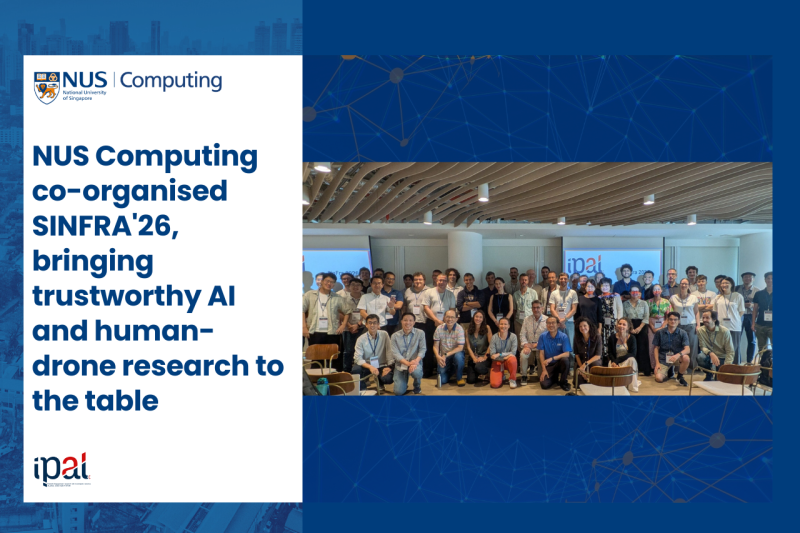
NUS Computing Co-Organised SINFRA’26, Bringing Trustworthy AI and Human-Drone Research to the Table
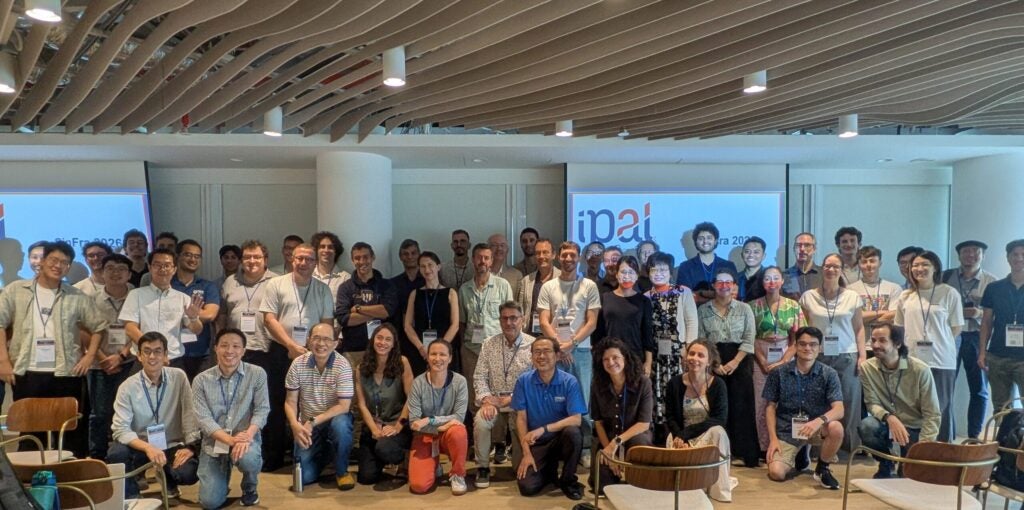
NUS School of Computing (SoC) co-organised this year's edition of SINFRA, the annual Singapore-France workshop on Computer Science and AI, bringing together more than 80 researchers from across the two countries' AI, robotics, and human-computer interaction communities.
Held over three days at NUS and A*STAR, the workshop is run each year by the International Research Laboratory IPAL, a joint venture between CNRS, NUS, A*STAR and a growing roster of French universities. The NUS Co-Director of IPAL, Associate Professor Ooi Wei Tsang welcomed participants, opening a programme that spanned 26 scientific presentations and more than 20 posters.
Among them were five oral presentations from SoC’s researchers, spanning trustworthy computing and human-drone interaction.
Professor Abhik Roychoudhury presented on trustworthy automatic programming, and Professor Xiaokui Xiao on data protection through differential privacy, both areas where SoC has built a sustained research track record in making AI systems safer and more accountable.
PhD candidates Peisen Xu and Yize Wei, alongside Peter Cleveland, a Research Fellow at the Augmented Human Lab, represented SoC’s growing body of work on human-drone interaction – spanning AR interfaces for drone piloting, assistive drones for blind and low-vision users, and the embodied experience of drone control.
This year's SINFRA also marked a milestone for the wider IPAL partnership, formally welcoming the University of Grenoble Alpes back into the fold after an online address by its president, Yassine Lakhnech – the latest step in a collaboration between CNRS, A*STAR, NUS and French partner universities now in its 28th year.