
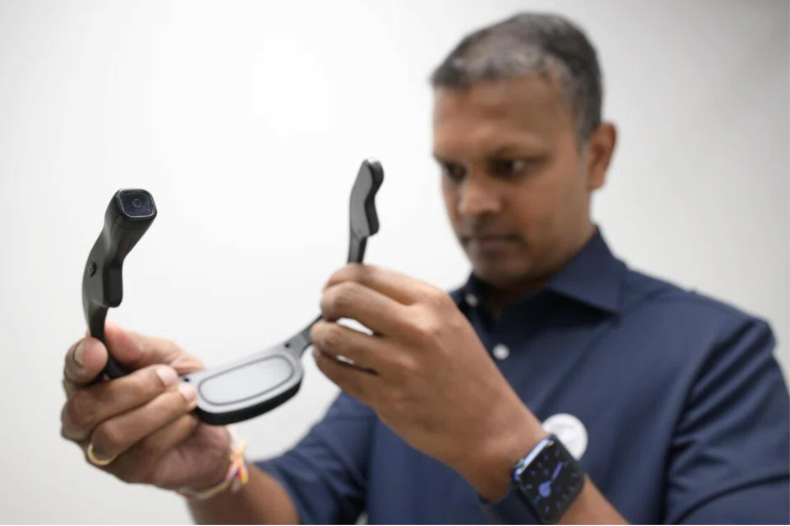
Associate Professor Suranga Nanayakkara from NUS Computing was featured in The Straits Times for his work on an AI-powered wearable headset developed by an NUS research team led by him, aimed at supporting independent navigation and daily activities for persons who are visually impaired.
The article highlighted the experience of Madam Teresa Ng, who shared how the headset could help her commute, shop, and navigate public spaces with greater confidence and independence, reducing the need to rely on assistance from others.
"It could tell me the price, size, colour, and even describe the kin of occasion each outfit is suitable for – very useful. Sometimes when I go grocery shopping, I have to ask the promoters for help and later feel obligated to buy from them. But with AiSee, I won't have to trouble anyone."
The wearable headset, AiSee, uses AI to interpret the surrounding environment and provide real-time audio guidance, helping users navigate public transport, avoid obstacles, and move safely through complex everyday settings. The system is designed to improve mobility and autonomy while preserving users' dignity.
A/Prof Nanayakkara explained that the project was developed with a strong human-centred focus, emphasising usability, real-world impact and close collaboration with visually impaired users to ensure the technology addresses practical needs rather than laboratory assumptions.
Funded by the Enabling Lives Initiative (ELI) Grant in November 2025, the team is enhancing the AiSee software with onboard object detection, navigation, expert guidance, scene sonification, and task-based functionalities, including pilot testing at the Singapore Botanic Gardens to guide users on curated tours. The ELI Grant, funded by Tote Board and managed by SG Enable, is a strategic fund that catalyses and supports innovations to improve the independence and inclusion of persons with disabilities.
This coverage highlighted the potential of assistive AI to enhance inclusion and accessibility, while recognising the importance of careful design, testing and deployment in complex real-world environments.