
Asst Prof Umang Mathur’s Research on Data Race Detection Featured in Communications of the ACM Research Highlights
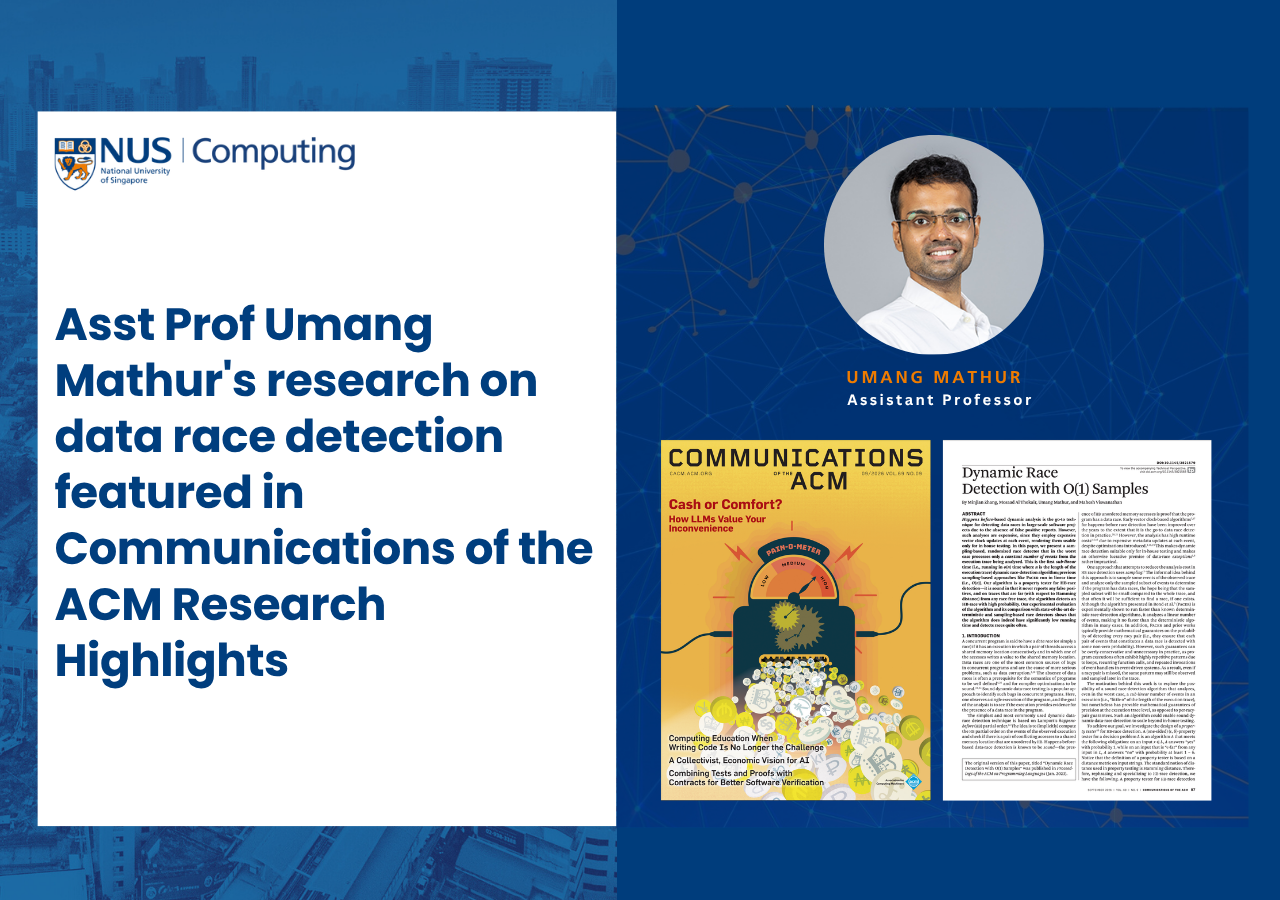
A paper co-authored by Assistant Professor Umang Mathur on detecting hard-to-catch software bugs has been featured in Communications of the ACM (CACM) Research Highlights, the flagship magazine of the world’s largest computing society.
When a program runs many tasks at once, those tasks sometimes access the same memory without coordinating. The result is a data race, a bug that can crash software or produce incorrect results. Data races are hard to reproduce, and finding them usually means tracking every step of a program as it runs, which becomes expensive for large programs.
The paper, "Dynamic Race Detection with O(1) Samples", shows that races can be found by checking only a small sample of a program’s execution. The approach comes with mathematical guarantees. The number of samples needed stays the same however long the program runs, and every race it reports is real.
Although sampling can miss bugs, it is highly likely to detect a race when an execution is sufficiently far from being race-free, that is, when eliminating its races would require changing a substantial fraction of its events. The result offers a foundation for race detection that scales to large, long-running software.
The paper was presented at the ACM SIGPLAN Symposium on Principles of Programming Languages (POPL) in Boston in 2023, where it received a Distinguished Paper Award. It was selected for SIGPLAN Research Highlights in 2025 and appears as a Research Highlight in the September 2026 issue of CACM (Vol. 69, no.9), following its online publication in August.
Asst Prof Mathur's co-authors are Minjian Zhang, a former PhD student at the University of Illinois Urbana-Champaign (UIUC) now at Nanyang Technological University, and Mosaad Al Thokair and Professor Mahesh Viswanathan of UIUC.
Read the CACM Research Highlights article here: https://cacm.acm.org/research-highlights/dynamic-race-detection-with-o1-samples/
Congratulations to Asst Prof Umang Mathur and his co-authors!