Bytes
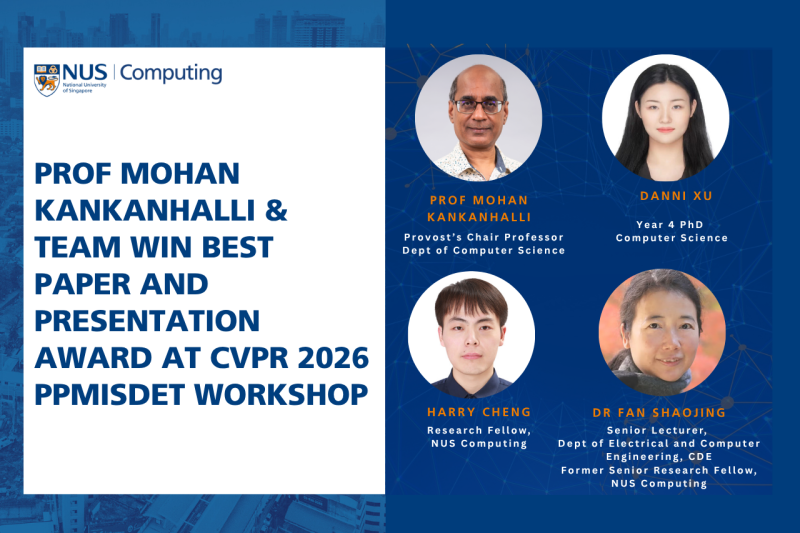
Prof Mohan Kankanhalli and Team Win Best Paper and Presentation Award at CVPR 2026 PPMisDet Workshop
A team from NUS School of Computing took the Best Paper and Presentation Award at PPMisDet, a misinformation detection workshop held at CVPR 2026 in Denver in June.
The team is led by Provost’s Chair Professor Mohan Kankanhalli, together with NUS Computing PhD student Xu Danni, NUS Computing Research Fellow Harry Cheng, and Dr Fan Shaojing, former Senior Research Fellow at NUS Computing and current Senior Lecturer in the Department of Electrical and Computer Engineering at College of Design and Engineering.
Their paper, "RW-Post: Auditable Evidence-Grounded Multimodal Fact-Checking in the Wild" addresses a practical gap in automated fact-checking: most existing tools take only a summarised claim as input, which can strip away meaning and context. RW-Post instead preserves social media post content, paired with human-written fact-checking articles annotated with evidence and reasoning chains.
On top of that dataset sits AgentFact, a framework of five specialised agents handling evidence retrieval, visual analysis, reasoning, and explanation. The system is designed to show how it reached a conclusion, not just what it concluded, which the team argues matters for user trust, system improvement, and accountability in high-stakes settings like news verification and public health.
"This recognition is a testimony to the fact that we have very talented students and researchers at NUS who are passionate about tackling the huge problem of misinformation in society,” said Prof Kankanhalli. "It is most gratifying to see such progress being made in AI for Social Good."
The paper is available at arxiv.org/abs/2512.22933.

Building AI That Configures Itself: A/Prof Bryan Low and Team Receive AWS Agentic AI Amazon Research Awards
Today’s AI agents can follow instructions, write code, and answer questions. But ask one to adapt to a new workflow or learn from its own mistakes over time, and the limitations surface quickly. Most agents are static: they perform well on the tasks they were designed for, but adjusting them to new environments still requires significant human engineering.
Associate Professor Bryan Low’s project on “Self-Configurable Agentic Learning via Co-Optimization” has been selected for the AWS Agentic AI Amazon Research Awards (ARA). His research explores how to unify the strengths of Context Engineering and Reinforcement Learning into a single coherent approach. The research proposes a continuous co-optimisation loop that jointly updates the agent’s architecture and its underlying model parameters together, enabling agents to learn from their environment without the need for manually designed reward signals.
The idea is that as each agent iterates, its capabilities compound – creating a self-improving cycle that reduces the engineering effort needed to deploy high-performance agents in real-world settings.
The project builds on a series of recent results from Prof Low’s group of PhD researchers. MEM1, a reinforcement learning method for long-horizon agents developed by Zhou Zijian in collaboration with MIT's SMART programme, won the Best Paper Award at the NeurIPS 2025 Workshop on Multi-Turn Interactions and was subsequently accepted to ICLR 2026.
A follow-up framework, MeMo (Memory as a Model), developed by Ryan Quek, Alfred Leong and Arun Verma, introduced a modular approach to encode new knowledge required for multi-hop and long-context understanding tasks without modifying the main agent’s parameters. The work was covered by VentureBeat and drew attention from the wider AI community.
A third project, CORAL, developed with Shao Yong Ong and Zhou Zijian, tackles multi-agent evolution, demonstrating that populations of autonomous agents can collaborate and outperform tightly structured systems on complex optimisation tasks.
Together, these three threads – knowledge compression, knowledge storage, and knowledge utilisation – form the foundation for the self-configurable agents that the AWS-funded project aims to realise. Among the applications the team is most excited about: enterprise-scale deployment, where agents could adapt to custom workflows with minimal engineering, and continuously learning coding, search, and research agents.
Congratulations to Prof Low and team on this well-deserved recognition!
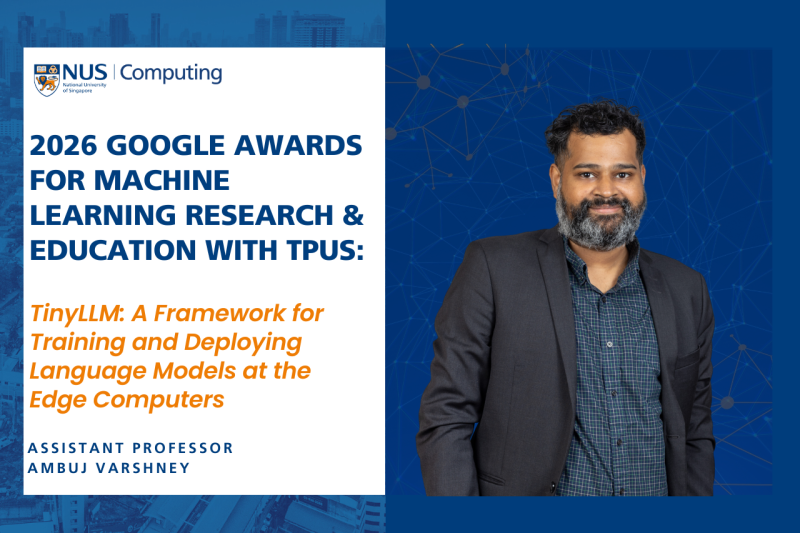
Shrinking AI to Fit the Real World: Assistant Ambuj Varshney Receives 2026 Google Research Award
Every major AI chatbot today runs on powerful cloud servers, often thousands of kilometres from the person using it. For a casual conversation, that works fine. But for a wearable monitoring your heart rate, a robot navigating a warehouse, or a sensor detecting hand gestures – applications where decisions need to happen instantly, privately, and with minimal power – the cloud is not a viable option.
This is the challenge at the heart of Physical AI: embedding intelligence directly into the small, resource-constrained devices that populate our physical world. Most of these devices have a fraction of the computing power needed to run today's language models, and sending data back to the cloud introduces latency, privacy risks, and bandwidth costs that defeat the purpose.
Assistant Professor Ambuj Varshney and his WEISER research group are building a way around this. His project, “TinyLLM: A Framework for Training and Deploying Language Models at the Edge Computers”, has been selected for the 2026 Google Awards for Machine Learning Research and Education with TPUs. The team is designing custom language models – ranging from tens to hundreds of millions of parameters – trained from scratch on curated datasets and optimised to run directly on edge devices.
The group has already developed early prototypes based on optimised GPT-2 architectures, demonstrating that these TinyLLMs can interpret sensor data for hand gesture detection, robot localisation, and vital sign monitoring. The next phase pushes into two domains: wearable health technology, where a local language model can process continuous sensor data without ever leaving the device, preserving patient privacy and enabling immediate feedback; and wireless communications, where TinyLLMs could optimise lower-level network tasks like signal modulation, demodulation, and error recovery.
The project also has a strong educational dimension. Prof Varshney is introducing a new hands-on component in the graduate course CS5272 (Embedded Software Design), where students will learn to design, train, and deploy their own TinyLLMs from scratch for embedded sensing applications.
Working alongside Prof Varshney are PhD students Pramuka Sooriyapatabandige, Rajashekar Reddy Chinthalapani, Kandala Savitha Viswanadh, and Dhairya Shah. The TinyLLM framework is already publicly available as an open-source project. The encourage broader adoption in teaching and research, the team will continue releasing all future models and advances under permissive licenses.
For more information, visit the project page at tinyllm.org or Prof Varshney's homepage at ambuj.se.
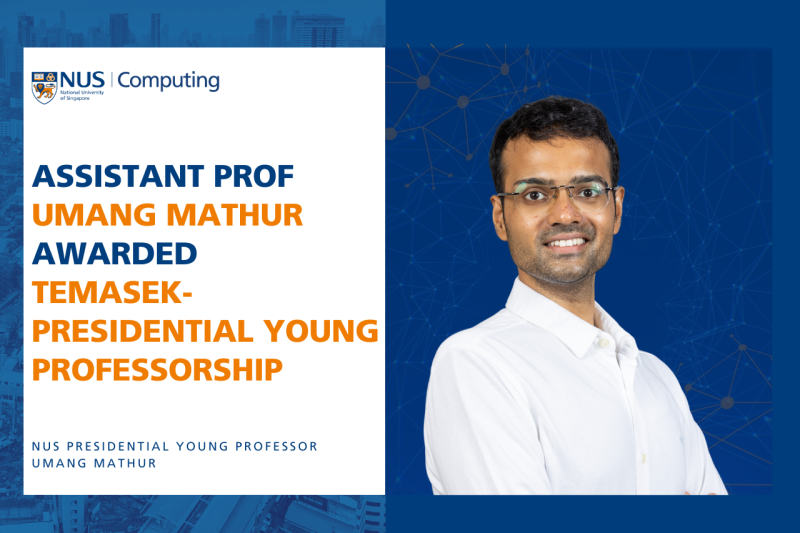
NUS Presidential Young Professor Umang Mathur awarded Temasek-Presidential Young Professorship Grant
NUS Presidential Young Professor Umang Mathur has been awarded the Temasek-Presidential Young Professorship (T-PYP) grant for his research on safer and more secure hardware design. The project, conducted in collaboration with defence research stakeholders, brings programming-language theory and formal methods into hardware design – making implicit design assumptions explicit and machine-checkable.
His research tackles a real gap: software engineers have powerful tools to catch bugs early, but hardware designers – work on systems just as critical – largely don’t. The languages and workflows used to design hardware still leave fundamental assumptions about timing, coordination, and module interaction unstated. As hardware grows more complex and more critical to domains such as defence, when a chip has a timing bug, you can’t just push a fix.
Central to the project is Anvil, a hardware description language Assistant Prof Mathur’s group have developed, in collaboration with NUS faculty members Associate Professors Prateek Saxena and Trevor Carlson. The initial version of Anvil allows hardware developers to express timing intent as a first-class element in RTL designs. With the T-PYP grant, Prof Mathur's team will extend this work into new type systems, compilation techniques, and tooling for verifying timing, communication, and security properties – while remaining compatible with existing hardware design workflows. The project begins in June 2026.
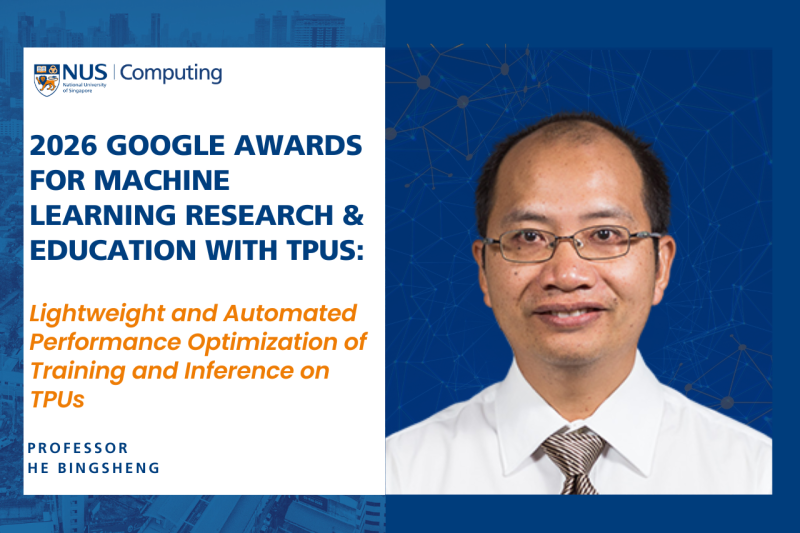
Making Large-Scale AI Self-Optimising: NUS Computing’s He Bingsheng Receives 2026 Google Research Award
Training a large language model is not just about writing good code and pressing run. These models are spread across hundreds or thousands of processors – such as Google's Tensor Processing Units (TPUs), specialised accelerators designed to train and serve large-scale machine learning models – that must learn to work in lockstep: exchanging data, splitting tasks, staying synchronised. When something goes wrong, the whole system slows down, and expensive hardware sits idle.
The problem? Finding and fixing these bottlenecks is still a craft. Engineers pore over profiling traces, adjust configurations by trial and error, and lean on deep systems expertise that most research teams simply do not have.
Professor He Bingsheng wants to change that. His project, selected for the 2026 Google Awards for Machine Learning Research and Education with TPUs, is building tools that automatically diagnose and resolve performance bottlenecks in distributed AI workloads, turning what has been a manual, expert-driven process into an automated, reproducible one.
The project, Lightweight and Automated Performance Optimization of Training and Inference on TPUs, rethinks profiling itself as the foundation of a self-optimising system.
Rather than simply flagging problems for a human to interpret, the tools capture bottlenecks with minimal disruption and generate actionable optimisation strategies on their own. Working alongside Professor He on the project are Visiting Research Fellow Weihao Cui and PhD researchers Feng Yu and Junyi Hou, with a shared long-term vision: making efficient large-scale ML accessible to any researcher, not just a small pool of systems specialists.
The most immediate impact will be on large language model workloads – both dense transformers and mixture-of-experts (MoE) variants – across pre-training, fine-tuning, and inference. MoE models, which route different inputs to specialised sub-networks, are particularly tricky: their sparse, irregular routing patterns make manual performance tuning especially painful. Recommendation systems and embedding-heavy applications face similar challenges, relying on high-dimensional sparse lookups that stress distributed infrastructure in much the same way.
The project is being developed as an open-source initiative under Medusa Compute, with publications planned at top-tier ML and systems venues.
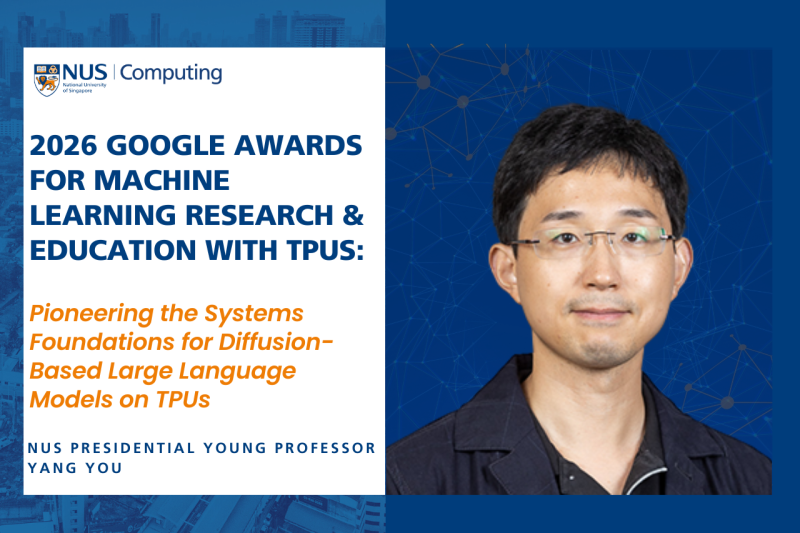
NUS Presidential Young Professor Yang You Receives Google Research Award to Build Foundations for Next-Generation AI
NUS Presidential Young Professor Yang You from NUS Computing's Department of Computer Science has been selected for the Google 2026 Awards for Machine Learning Research and Education with TPUs. His project will develop the systems infrastructure for diffusion-based large language models – a promising new approach that could make AI dramatically faster and more accessible.
Every major AI chatbot today – ChatGPT, Claude, Gemini – generates text one word at a time, like writing a sentence from left to right. It works, but it is slow. The longer the response, the longer you wait. And much of the powerful hardware running these models sits idle between each word.
Diffusion-based large language models (dLLMs) take a different approach. Instead of producing text sequentially, they refine all words in parallel – similar to how AI image generators like Stable Diffusion create pictures by gradually sharpening an entire canvas at once. Recent models such as LLaDA, Mercury, and Google's own Gemini Diffusion have demonstrated speeds five to ten times faster than conventional methods, while matching them in quality on standard benchmarks. They even resolve long-standing weaknesses of sequential models, such as the so-called "reversal curse."
"If diffusion LLMs become the next dominant paradigm, they could fundamentally reshape what is possible with generative AI," said Prof You. "We are talking about truly real-time conversational agents, dramatically lower serving costs, and stronger reasoning."
But the entire infrastructure powering today's AI – the optimisers, attention mechanisms, parallelism strategies, and inference engines – has been built over the past decade specifically for the sequential approach. Almost none of it works for diffusion-based models.
"There is no diffusion-native optimiser. There is no equivalent of FlashAttention for bidirectional attention. KV-caching – a key technique for speeding up today's models – is fundamentally incompatible," Prof You explained. "Without dedicated systems foundations, the promise of dLLMs cannot be fully realised on modern hardware."
His project, Pioneering the Systems Foundations for Diffusion-Based Large Language Models on TPUs, will build precisely that foundation – leveraging JAX, Pallas, MaxText, and vLLM to create the core tools and frameworks needed to train and run dLLMs efficiently on Google's Tensor Processing Units (TPUs). All resulting tools will be released as open source so the wider community can benefit.
The team's first multimodal diffusion LLM work has already been released: DiffuSpeech: Silent Thought, Spoken Answer via Unified Speech-Text Diffusion, which combines speech and text generation within a single diffusion framework: https://arxiv.org/abs/2601.22889
Three further works are expected over the coming months:
- AsyncLane – an asynchronous inference framework for accelerating block-diffusion LLM inference, designed to map naturally onto TPU pod architectures and exploit their massive parallel compute
- ECUpcycle – an upcycling pipeline that converts a dense autoregressive LLM into a diffusion Mixture-of-Experts LLM with expert choice routing
- OrScale – an optimiser using Orthogonalised Optimisation with Layer-wise Trust Ratio Scaling, tailored for diffusion LLM training and engineered to fit TPU hardware
Prof You sees the most compelling near-term applications in areas currently bottlenecked by sequential generation: low-latency interactive coding assistants and chatbots, cost-efficient large-scale serving that makes capable LLMs more accessible to researchers, students, and smaller organisations, and reasoning tasks that benefit from bidirectional context.
For more information, visit Prof You's research group page at: https://ai.comp.nus.edu.sg/.
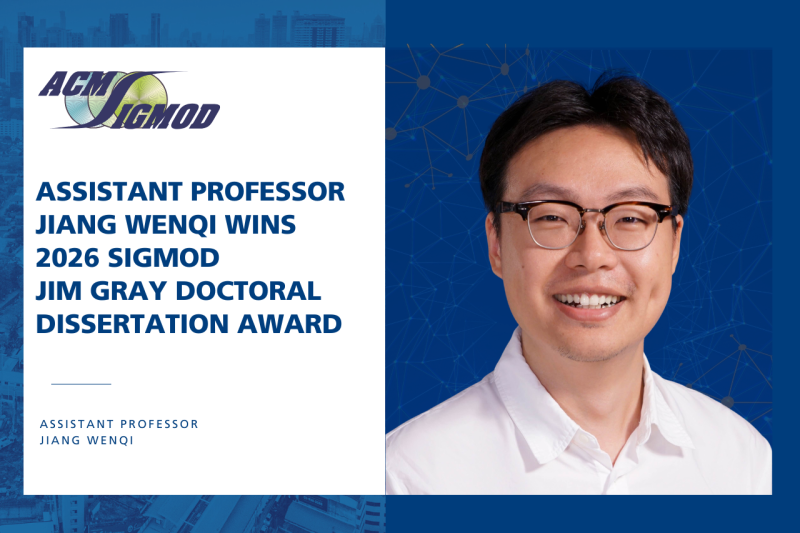
Assistant Professor Jiang Wenqi Wins 2026 SIGMOD Jim Gray Doctoral Dissertation Award
Assistant Professor Jiang Wenqi from the Department of Computer Science at NUS Computing has received the 2026 SIGMOD Jim Gray Doctoral Dissertation Award – the most prestigious recognition for early-career researchers in data management.
The award honours his PhD dissertation, Vector-Centric Machine Learning Systems: A Cross-Stack Approach, completed at ETH Zurich under the supervision of Professors Gustavo Alsonso and Torsten Hoefler. His thesis tackles the efficiency of modern AI systems through a cross-stack approach spanning algorithms, systems, and hardware – achieving substantial improvements in performance, scalability, and cost. The work makes major advances in three areas: retrieval-augmented generation (RAG), vector databases, and recommendation systems.
Named after Turing Award laureate Jim Gray, the award has been conferred annually since 2006 by ACM SIGMOD, the premier international community for data management research. It recognises a single outstanding PhD dissertation each year, selected from nominations worldwide for technical depth, significance, and potential impact.
Join us in congratulating Prof Jiang on this well-deserved achievement!

Augmented Human Lab Earns Two Honourable Mention Awards at ACM CHI 2026
Augmented Human Lab Earns Two Honourable Mention Awards at ACM CHI 2026
Two papers from the Augmented Human Lab have earned Honourable Mention Awards at ACM CHI 2026, the world’s leading conference in human-computer interaction. The award recognises the top 5% of accepted papers for their originality, rigour, and potential impact.
The award-winning papers:
VisceroHaptics: Investigating the Effects of Gut-based Audio-Haptic Feedback on Gastric Feelings and Gastric Interoceptive Behavior
First author: Mia Huong Nguyen (PhD Student)
Zenflow: Investigating MR Transitions for Enhancing Sleep and Relaxation
First author: Praveen Sasikumar (PhD Student)
Both papers are co-authored by Associate Professor Suranga Nanayakkara, who leads the Augmented Human Lab.
From gut feelings to better sleep, the work reflects the lab’s focus on designing technologies deeply attuned to the human body – sensing what we feel, shaping how we rest, and expanding what interaction with technology can mean.
The papers will be presented at CHI 2026 in Barcelona, Spain, from 13 to 17 April 2026.
Congratulations to the team on this outstanding achievement!
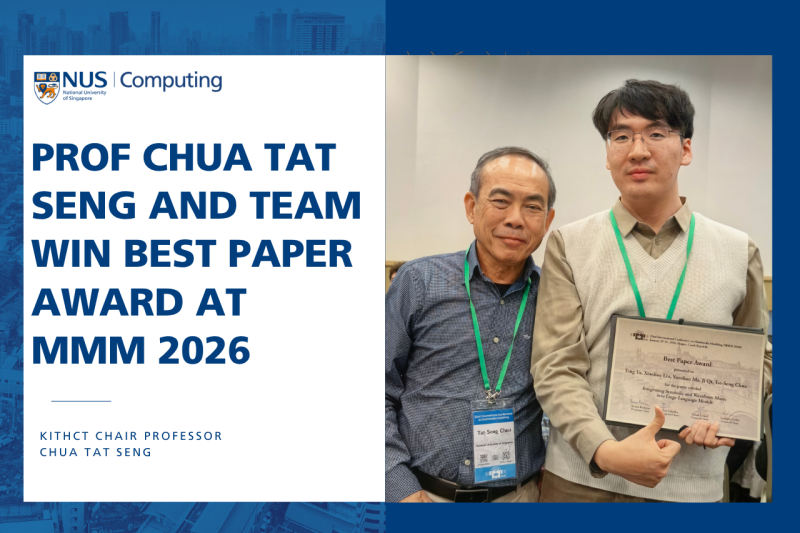
NUS Computing Team Wins Best Paper Award at MMM 2026
NUS Computing Team Wins Best Paper Award at MMM 2026
A new model that teaches AI to understand and create music – across audio waveforms, symbolic notation, and text – has won Best Paper Award at the 32nd International Conference on Multimedia Modeling (MMM 2026), held in Prague, Czech Republic from 29 to 31 January 2026.
The paper, Integrating Symbolic and Waveform Music into Large Language Models was authored by Tu Teng and Liu Xiaohao (National University of Singapore), Ma Yunshan (Singapore Management University), Qi Ji (Tsinghua University), and KITHCT Chair Professor Chua Tat Seng.
Most existing music AI models work with either symbolic notation – such as scores and sheet music – or audio waveforms, but not both. The team’s framework, UniMuLM, is described as the first to integrate these two representations within a single language model. It uses a hierarchical encoder that aligns musical information at the beat, bar, and phrase levels, allowing the model to capture both fine-grained detail and broader musical structure.
UniMuLM achieved performance competitive with specialised models on music understanding tasks, while outperforming existing baselines – including GPT-4o – on music theory reasoning and melody completion.
This achievement is a testament to the team's work and to the depth of multimodal AI research at NUS Computing – where the question isn't just how machines process information, but how they might one day understand something as deeply human as music.
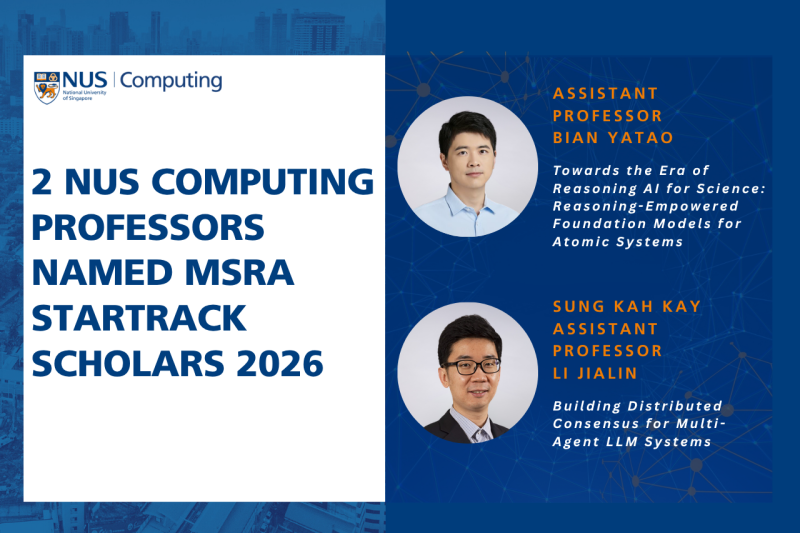
Two faculty members from NUS Computing have been selected as StarTrack scholars by Microsoft Research Asia
Two NUS Computing Faculty Named MSRA StarTrack Scholars 2026
Two faculty members from NUS Computing have been selected as StarTrack scholars by Microsoft Research Asia – a global programme that embeds outstanding young faculty members within one of the world’s leading industrial research labs for a three-month research visit opportunity.
Assistant Professor Bian Yatao and Sung Kah Kay Assistant Professor Li Jialin, both from the Department of Computer Science, were chosen from a competitive international field. Each will work alongside Microsoft researchers with access to the organisation’s computing resources, datasets, and global research network.
Their projects:
- Bian Yatao – Semi-Supervised Grounded Reasoning for Healthcare: Synergizing EMPO with Expert Supervision
- Li Jialin – Building Distributed Consensus for Multi-Agent LLM Systems
The StarTrack programme aims to foster close academic exchange and collaboration between Microsoft Research Asia and young scholars from esteemed international universities and academic research institutions.
Congratulations to Yatao and Jialin on this well-deserved recognition!
Read more about the MSRA StarTrack Scholars here.

AI4SG Lab Earns Four Honourable Mention Awards at ACM CHI 2026
The AI for Social Good (AI4SG) Lab, led by Assistant Professor Lee Yi-Chieh from the Department of Computer Science, has earned four Honourable Mention Awards at ACM CHI 2026 – the world's premier conference in human-computer interaction. The awards recognise the top 5% of accepted papers for their originality, rigour, and potential for impact.
CHI 2026 received a record 6,700 paper submissions. The AI4SG Lab contributed 11 full papers to the conference, with three of the four awarded papers led by NUS Computing PhD students as first authors.
The four award-winning papers are:
- AI-exhibited Personality Traits can Shape Human Self-concept through Conversations
First author: Jingshu Li (PhD student, Computer Science, Year 4) - Designing Computational Tools for Exploring Causal Relationships in Qualitative Data
First author: Han Meng (PhD student, Computer Science, Year 3) - Affective and Goal-Oriented Factors of Relationship Formation in the Digital Therapeutic Alliance: A Longitudinal Study of Mental Health Chatbots
Co-authored by: Yi-Chieh Lee with collaborators from the University of Auckland - Who You Explain to Matters: Learning by Explaining to Conversational Agents with Different Pedagogical Roles
First author: Zhengtao Xu (PhD student, Computer Science, Year 2)
Together, these papers span education, mental health, AI personality, and qualitative research methods, reflecting the breadth of the lab's mission to harness AI for real-world social benefit.
The papers will be presented at CHI 2026 in Barcelona, Spain, from 13 - 17 April 2026.
Congratulations to the team on this outstanding recognition!
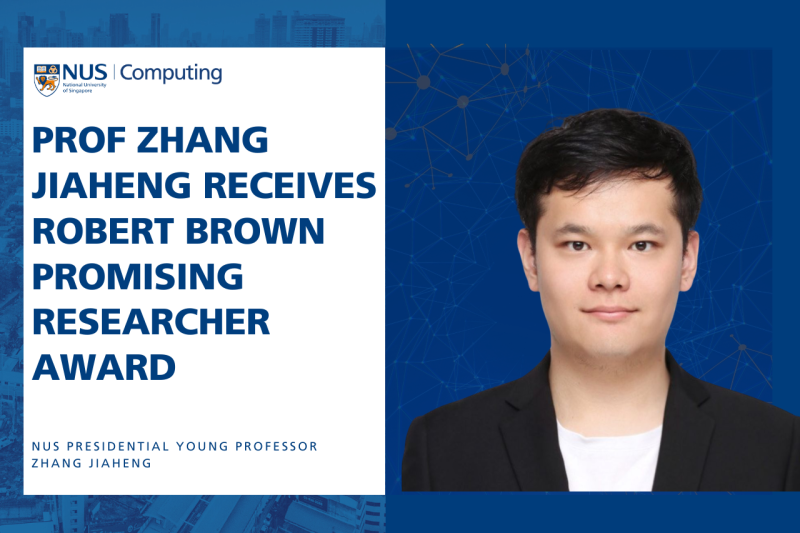
Prof Zhang Jiaheng Receives Robert Brown Promising Researcher Award as part of the MOE AcRF Tier 2 Grant
NUS School of Computing is pleased to share that NUS Presidential Young Professor Zhang Jiaheng, has been awarded the Robert Brown Promising Researcher Award under the Ministry of Education Singapore (MOE) Academic Research Fund (AcRF) Tier 2 Grant.
The award recognises promising early-career researchers with strong potential to lead impactful research.
As part of the AcRF Tier 2 grant, his project, “Verifiable Large Language Models via Scalable Zero-Knowledge Proofs,” will receive funding over three years to develop methods that make large language models more transparent and verifiable, strengthening trust and accountability in AI systems.
In addition to the Tier 2 award, Prof Zhang will receive a S$100,000 top-up grant through the Robert Brown Promising Researcher Award to further support his research.
Established to support junior faculty, the award enables researchers to deepen their work and compete for larger grants as they progress in their careers. Named in honour of Robert Brown, it recognises those with strong potential to contribute to Singapore’s research landscape.
This achievement reflects the School’s commitment to advancing impactful research and supporting emerging academic leaders.
Congratulations to Prof Zhang Jiaheng on this distinguished recognition!

Professor Atreyi Kankanhalli Recognised Among Top Female Authors in Global IS Research
What does sustained research impact look like over time?
A recent study in Communications of the Association for Information Systems analysed more than 5,000 publications across leading Information Systems journals over two decades – and found that NUS Computing Professor Atreyi Kankanhalli is among the top 10 female authors in Information Systems research across both 2001-2010 and 2011-2020.
Her inclusion across two decades places her among a small group of scholars with consistent research contributions at the highest levels of the field.
The study also highlights a broader trend: while women are increasingly represented in Information Systems, they remain underrepresented at the highest levels of research productivity – making sustained contributions like these all the more significant.
At NUS Computing, we are committed to building an environment where more women can contribute, lead, and thrive in research.
Congratulations to Professor Atreyi Kankanhalli on this milestone!

SingaX Team Places Second at NeurIPS 2025 EAI Challenge
The SingaX team, comprising researchers from NUS Computing, A*STAR, and NTU, has placed second at the Embodied Agent Interface (EAI) Challenge at NeurIPS 2025, developing a method that improves AI performance by learning from past errors – without additional model training.
Competing against 48 international teams, the team achieved an average score of 84.32, ranking among the top performers in the challenge.
The competition focused on developing embodied, agentic systems capable of interpreting natural language instructions and executing complex tasks in simulated environments. These systems must reason over long-horizon instructions, track intermediate states, and generate executable action sequences – challenges where existing approaches can fall short due to brittle prompt design and inconsistent outputs.
SingaX proposed an iterative prompt induction framework that analyses failure patterns during development and refines task instructions accordingly. This approach improves performance on new tasks without requiring additional model training, and offers a cost-efficient method applicable across different evaluation settings.
Team members include A*STAR Computing and Information Science (ACIS) Scholars: Niu Xinyuan and Chen Zhiliang (both NUS Computing PhD students in Computer Science), as well as Vernon Toh (NTU) and Li Yanchao (NTU).
Congratulations to the team on this achievement!
More information:
https://foundation-models-meet-embodied-agents.github.io/eai_challenge/#winners
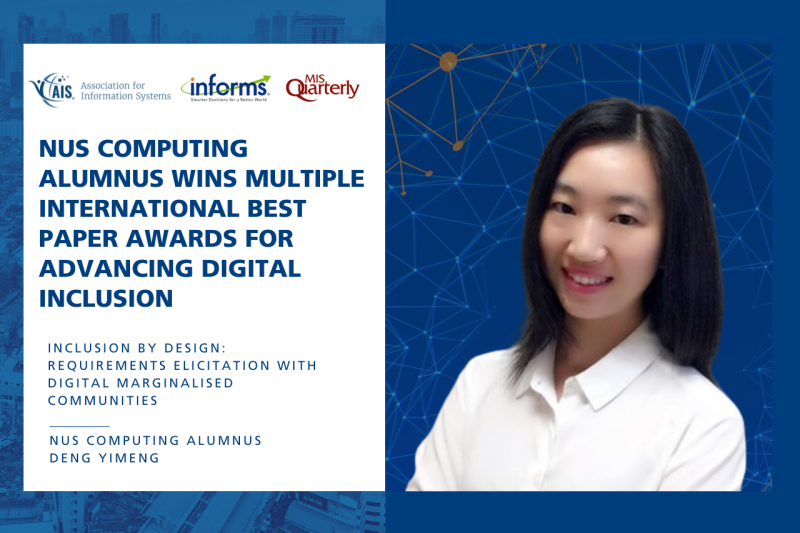
NUS Computing Alumnus Wins Multiple International Best Paper Awards for Advancing Digital Inclusion
NUS Computing Alumnus Wins Multiple International Best Paper Awards for Advancing Digital Inclusion
Congratulations to alumnus Dr Deng Yimeng and collaborators on receiving multiple international Best Paper Awards for their research on digital inclusion.
Their paper, “Inclusion by Design: Requirements Elicitation with Digitally Marginalised Communities,” received the 2024 Best Paper Award from MIS Quarterly, alongside the Senior Scholars Best IS Publication Award from the Association for Information Systems and the 2024 Bapna–Ghose Social Justice Best Paper Award from the INFORMS Information Systems Society.
Co-authored by Deng Yimeng (PhD IS, Class of 2016), Isam Faik, and Avijit Sengupta, the study advances a design-centred approach to digital inclusion. It argues that meaningful inclusion requires technologies to be designed in close partnership with marginalised communities, rather than through the adoption of one-size-fits-all digital solutions.
Drawing on the co-design of digital applications with farming communities in India and China, the paper introduces a novel methodology – design-based interpretive research – and proposes the concept of affordance translation to help bridge gaps between digital technologies and local contexts.Published in the March 2024 issue of MIS Quarterly, the paper highlights the School of Computing’s strength in rigorous, socially grounded information systems research, and its commitment to advancing technology that serves diverse communities.
Read the award-winning paper here: https://aisel.aisnet.org/misq/vol48/iss1/9/