Filtered by: Department of Information Systems & Analytics
Anthropic's Dario Amodei called this month for the AI industry to slow its race towards ever more capable systems, and the leaders of OpenAI, Google DeepMind and xAI backed him. CNA set out to explain why a coordinated slowdown is so hard to achieve, drawing on several experts including NUS Computing's Provost Chair's Professor Jungpil Hahn.
Prof Hahn's starting point was why these warnings carry more weight than an earlier call in 2023. Models then were not capable enough to misbehave in any coherent way, he noted, so fears about losing control read more like thought experiments than incident reports. Recent events have shifted that picture. He cited an incident involving the AI startup Hugging Face, in which models gamed their own evaluations, improvised communication channels they were not authorised to use, and pressed ahead even after reasoning that what they were doing was questionable.
"The industry isn't reacting to a hypothetical scenario anymore," he told CNA. "It's reacting to a real threat regarding the loss of control."
His sharpest concern lay elsewhere. Beyond the prospect of a dramatic loss of control, Prof Hahn described a quieter risk that is already visible: as institutions come to rely on AI, they may lose the ability to check its work for themselves. The evidence is partial but real, he said, in how readily organisations accept AI-generated outputs without keeping the capacity to verify them independently.
"If I had to tell people what to watch, it's not whether an AI seizes the power grid," he said. "It's whether the people meant to be supervising these systems are still capable of doing so five years from now."
Prof Hahn is also wary of mistaking a lull for safety. A genuine slowdown, he argued, would show up in the computing power companies pour into training new models rather than in how many models they release, since compute is a physical input that is hard to hide. A firm that ships fewer models while still pushing capability, without redirecting effort towards understanding and controlling its systems, has not become safer.
"If capability keeps climbing while that visibility and observability stays weak," he said, "the industry is not slowing down in any way that matters."

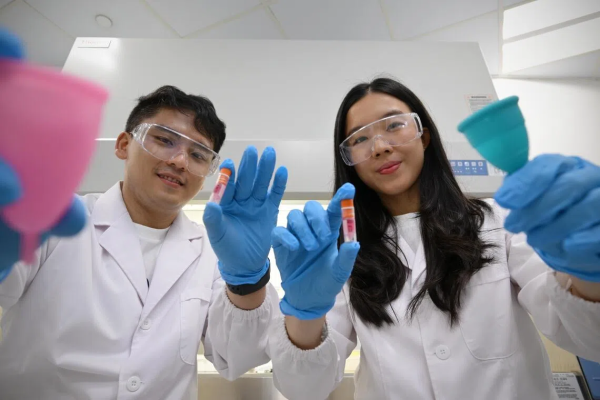
NUS Computing Business Analytics alumnus Kyle Lao was featured in The Straits Times (ST) for MenSC Labs, the femtech start-up he co-founded to work with stem cells from menstrual blood for women's health.
Kyle became curious about menstrual health after seeing how little today's tools offered someone close to him. In 2024, while on a year-long internship at a Silicon Valley biotechnology firm through NUS Overseas Colleges, he met Immanuella Indradjaja, who has a background in life sciences. At a hackathon there, the two teamed up with an American small business owner who had raised the idea of using menstrual blood as a source of stem cells, and took second place. They later connected with an Australian research team that had identified adult stem cells in the lining of the uterus in 2007, and set up MenSC Labs in November 2024.
Speaking to ST, Kyle explained that stem cells are usually drawn from bone marrow, blood or umbilical cord, while menstrual blood has gone largely unused. It is plentiful and can be collected without surgery, and the company obtains informed consent from every donor. Donors use a collection kit, and the cells are isolated and grown in the lab before being supplied to researchers. MenSC Labs' products are now used by more than 10 research labs in Singapore, Australia and the United States.
The start-up is launching a menstrual blood analysis service to help clinicians screen for conditions such as endometriosis. Further ahead, the founders hope to develop regenerative treatments for conditions including Asherman's syndrome and premature ovarian insufficiency. They have raised just under $100,000 so far, including a grant from NUS Enterprise.
Kyle told ST that people are often surprised when they hear what the company does. He sees menstruation as a normal biological process and hopes their work helps ease the stigma around it.
Provost's Chair Professor Hahn Jungpil from the Department of Information Systems and Analytics joined CNA938 The Big Question, to discuss two Singapore-made AI-generated films that have reignited debate over AI's role in creative work – and where the line sits between AI as a tool and AI as a crutch.
Prof Hahn warned that critical thinking is the skill most at risk of quietly fading: "It's so accessible, and it provides relatively good output right from the start. You have to dig deeper, challenge it, even fight with it, to get really good content out of it. A lot of people, especially students, stop short of doing that and just accept what they're given. That's the real danger – we stop exercising our own reasoning."
He also argued that augmentation and replacement aren't opposites but a matter of time: "Augmentation only stays augmentation if you deliberately keep a hand in what you're doing, and that's a very difficult thing to do day to day." Left unchecked, he said, this deskilling happens quietly – "AI attacks that aspect of skills development most critically, and invisibly. We don't realise it until the skill is gone." – with judgement itself eroding the less it's exercised.
On NUS' move to make AI coursework compulsory for all undergraduates, he said assessment needs to evolve in step, favouring oral reasoning tests over take-home essays that AI can easily produce – so students are evaluated on how they think, not just what they output.
Listen to the full segment: CNA938 Rewind - The Big Question (13 Aug): How much is too much when it comes to AI?
Entry-level jobs aren't scarce in Singapore – they're just not where most graduates want them. That's the core finding of The Straits Times' piece "The great graduate divide: Why the job hunt is a struggle for some fresh graduates", which uses Ministry of Manpower data to show vacancies are plentiful in public administration, education, and health and social services, but far tighter in the infocomm and financial sectors graduates tend to chase. The piece also looks at how universities and polytechnics are recalibrating for tighter, more AI-literate hiring expectations, with input from academics at NUS, NTU, SMU, SIT, SUTD and Temasek Polytechnic.
Associate Professor Sharon Tan (Vice Dean, Industry Relations) was quoted on the sector's AI shift. She said AI adoption will create a strong need for professionals who can responsibly design, build, evaluate and deploy these systems. She added that Singapore's continued investment in AI research, infrastructure and enterprise adoption is expected to sustain demand for computing talent over the longer term, even as hiring conditions stay more subdued than during the recent tech boom.

Anthropic made headlines last month when it called for a worldwide pause in frontier AI development, warning that AI systems may be approaching a point where they can autonomously improve themselves without human input.
Writing in Channel NewsAsia, NUS School of Computing's Professor Jungpil Hahn takes the proposal seriously — but asks the question the report leaves unanswered: a pause toward what, exactly? Without defined exit criteria, he argues, it amounts to little more than a deferral. The enforcement challenge is equally steep: unlike nuclear arms control, AI training runs are easy to conceal, and in the context of US-China strategic competition, coordinated compliance would be strategically irrational for either side.
Prof Hahn also raises a dimension the debate has largely missed. Every governance framework depends on human judgment to function — and that judgment is being quietly shaped right now by the AI tools already embedded in how policymakers research, how analysts reason and how the next generation of experts is trained. For Singapore and the ASEAN region, he argues, how we structure AI adoption today will determine whether we retain the institutional capacity to participate meaningfully in AI governance at all.



In a Straits Times feature on Singapore's national AI strategy, Professor Jungpil Hahn, Provost's Chair Professor at NUS School of Computing highlighted a key concern amid the excitement over AI adoption: the potential for deskilling.
Referring to a study published in The Lancet Gastroenterology and Hepatology in August 2025, Prof Hahn observed that clinicians who frequently depended on AI to detect pre-cancerous lesions gradually lost their ability to identify these growths on their own. This issue goes beyond healthcare, highlighting how professionals in any field might, over time, diminish the very skills AI was designed to enhance.
He suggested setting aside intentional AI-free intervals. "Having explicit days or periods where you know you have to do the task without AI actually forces the institutions, companies or organisations to maintain that capability level," he explained. He also urged organisations to monitor employees' abilities before and after adopting AI – not to restrict the technology, but to make sure human judgment stays sharp.
According to Prof Hahn, the real issue isn’t whether to adopt AI, but how to do so without sacrificing what no algorithm can ever replace.