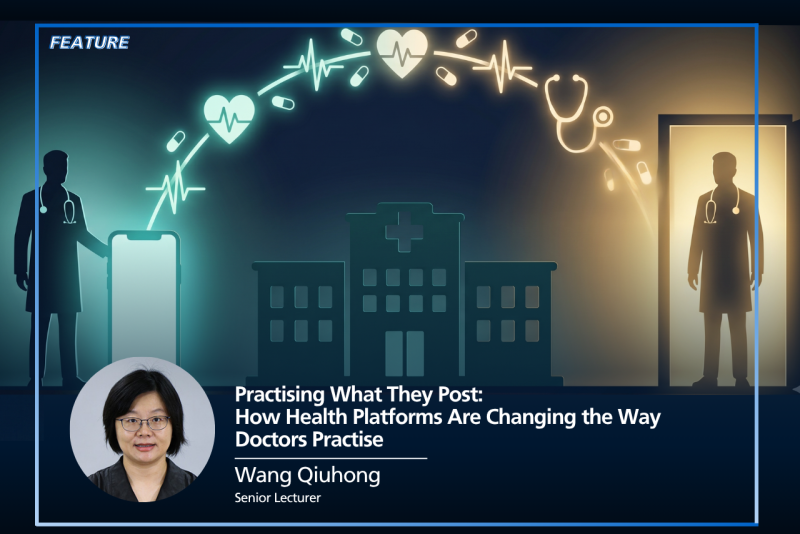

Practising What They Post:
How Health Platforms Are Changing the Way Doctors Practise
Think about the last time you looked up a doctor online. Maybe you checked their credentials, read a few patient reviews, or noticed that they had answered hundreds of questions on a health Q&A platform – carefully, patiently, and in plain language. It probably made you feel more confident about seeing them.
By posting those answers publicly, that doctor was also making a promise. And according to new research, they tend to keep it.
A study published in Information Systems Research by NUS Computing’s Senior Lecturer Dr Wang Qiuhong, together with co-authors Kai Luo, Ruibin Geng, Xi Chen, and Provost’s Chair Professor Hock-Hai Teo, has found that physicians who are more active on online health platforms tend to prescribe more judiciously and follow clinical guidelines more closely in their hospital practice – with no compromise to patient outcomes.
The Question Nobody Had Thought to Ask
Healthcare researchers have spent years studying what happens to patients after they interact with online medical platforms. Do they choose better doctors? Do they follow treatment plans more closely? The answers, while useful, all look in one direction, from the platform outward to the patient.
Dr Wang and her collaborators turned the lens around and asked what happens to the doctor.
When a physician answers a patient’s question in a public forum, explaining treatment options, reasoning through clinical decisions, commenting on medication costs, that response does not disappear. It sits there, permanently searchable, accessible to other patients, to peers, to the physician’s own future patients. The advice is written, voluntary, specific, and public. These are exactly the conditions that make a commitment stick.
The Weight of a Public Promise
Most of us have experienced this in some form. When we say something out loud, to a friend, in a meeting, or in writing, we feel a pull to follow through on it. Backing away becomes uncomfortable. Psychologists call this cognitive dissonance, the unease that arises when our actions start to contradict our stated beliefs.
For physicians, this dynamic runs deeper than it might for most people. Researchers who study medical education describe this as professional identity formation – the process by which doctors absorb the values of medicine so thoroughly through training that those values become genuinely their own rather than rules handed down from outside.
Dr Wang’s team combined these two ideas into a mechanism they call identity-based digital commitment. When a doctor posts advice online about treatment options or medication costs, they are not just sharing information. They are publicly staking out a professional position. And because that position is visible, permanent, and entirely voluntary, the pressure is internal. A doctor who has staked out a professional position in public simply finds it harder to act against it in private.
What the Data Showed
To see whether this mechanism actually plays out in practice, the researchers built a dataset linking six years of inpatient hospital records from a major public hospital in Shanghai with activity on one of China’s leading health Q&A platforms. The dataset covered 127,166 non-emergency admissions managed by 150 physicians, some of whom were active on the platform and some of whom were not.
The results were consistent across the board. Physicians with more online advisory activity prescribed lower-cost medications, favoured drugs covered by insurance over those patients would have to pay for themselves, and kept hospital stays closer to what clinical guidelines recommend for each diagnosis. None of these improvements came at a cost to patient health. Readmission rates, in-hospital mortality, and treatment refusal rates all remained stable.
To make sure they were measuring a real effect rather than a coincidence, the team compared Shanghai physicians’ behaviour against trends in the Guangzhou healthcare market – a comparable city with its own independent patient base and hospital system. This allowed them to separate the influence of a physician’s own online activity from broader shifts in medical practice happening across the country at the same time. Even under this more rigorous test, the effects held, and in fact grew larger, suggesting the original estimates had understated the true impact.
It Is About What You Say, Not Just That You Showed Up
One of the sharper findings concerned what kind of online activity produced the effect. Simply being present on a platform, accumulating replies, building a following – none of that mattered much on its own. What mattered was the content.
Physicians whose online responses were specific to the diseases they were treating in the hospital showed significantly stronger alignment between their public advice and their private clinical decisions. Those who posted general, non-specific replies showed no meaningful effect on their prescribing or discharge patterns.
The team went further, coding physicians’ responses for three specific values: patient-centred care, evidence-based reasoning, and resource stewardship (the explicit weighing of costs and financial burden on patients). Each value predicted change in exactly the domain it addressed. Physicians who wrote about responsible resource use prescribed more cost-consciously. Those who cited clinical evidence kept hospital stays closer to guideline benchmarks. The connection between what was said online and what changed in practice was not generic, it was precise.
The Patients Who Benefits Most
Not every patient benefits equally, and this is perhaps the most human dimension of the findings.
The effects on medication costs were strongest for patients with no insurance, those who pay for every prescription entirely out of their own pocket. For patients with comprehensive government insurance cover, where personal financial exposure is minimal, the effects were not significant. The pattern makes sense within the framework. A physician who has publicly committed to considering patients’ financial burden feels that commitment most acutely when the patient in front of them will bear the full cost of whatever is prescribed.
In a healthcare environment where overprescribing and the use of expensive non-reimbursable medications remains a genuine source of tension between patients and doctors, this matters. The patients with the least financial protection appear to be the ones who gain the most when their doctor is publicly accountable for the advice they give.
A Different Kind of Oversight
Healthcare systems have always struggled with the gap between what good medicine looks like in principle and what actually happens in practice. The standard response is more oversight – audits, performance targets, financial penalties, regulatory requirements. These tools have their place, but they are expensive to run, imperfect in coverage, and experienced by many physicians as external impositions rather than professional motivators.
What this research describes is something different. The researchers call it “soft governance“: the way online health platforms, by making professional commitments visible and permanent, quietly hold physicians accountable to their own stated values, no regulator required. The accountability is self-generated, emerging from the ordinary act of answering a patient’s question in public.
This has practical implications for how hospitals and health systems think about digital engagement. Supporting physicians to participate meaningfully in online advisory activity – rather than treating it as a distraction from clinical work – may, over time, reinforce exactly the professional behaviours that formal oversight struggles to reach.
For platform designers, the research points toward substance over volume. Interfaces that prompt physicians to articulate specific professional positions are likely to produce stronger effects than those that reward sheer activity. For patients, a physician who has built a thoughtful, substantive online presence may be signalling something real about how they practise, not just how they communicate.
What Public Advice Really Means
There is something quietly significant in what this research reveals about professional identity. The values at the heart of good medicine – careful prescribing, honest engagement with costs, adherence to evidence – are not just institutional requirements. For most physicians, they are deeply personal. And it turns out that saying so publicly, in writing, to a visible audience, makes them more likely to live up to those values, not less.
In a world where online presence is often treated with suspicion, or dismissed as performance, this is a more optimistic finding than it might first appear. The words doctors write online are not separate from the care they deliver. They are, in some meaningful sense, a part of it.
Read the full paper: Qiu-Hong Wang, Kai Luo, Ruibin Geng, Xi Chen, Hock-Hai Teo (2026) Living Up to Online Advice: How Health Platforms Influence Physicians’ Offline Practice. Information Systems Research 0(0)