
Skip to content
No results
  • Home
  • About
    • The School
      • Overview
      • Dean’s Message
      • Our History
      • Teaching Awards
      • Work with Us
      • Locate Us
      • Contact Us
    • Departments
      • Department of Computer Science
      • Department of Information Systems and Analytics
    • People
      • Leadership
      • Conversation With Leadership
      • Industry Advisory Committee
      • Staff Tribute
      • Faculty & Staff
    • News and Events
      • News
      • Events
      • Knowledge@Computing
  • Admissions
  • Education
    • Undergraduate
      • Artificial Intelligence
      • Business Analytics
      • Business Artificial Intelligence Systems
      • Computer Engineering
      • Computer Science
      • Information Security
      • Geospatial Intelligence
      • Special Programmes
      • Computing Innovators Programme
        (C-Innovators)*NEW
      • Current Undergraduate Students
      • Information for Freshmen
    • Graduate
      • PhD in Computer Science
      • PhD in Information Systems
      • Master of Computing (with Specialisations)
      • Master of Computing (General Track)
      • Master of Computing in Artificial Intelligence
      • Master of Science in Digital FinTech
      • Master of Science in Business Analytics
      • Executive Master in AI & Digital Transformation
      • Graduate Certificates
      • Graduate Certificates in Computing Foundations
    • Executive Education & Part-time Programmes
      • NUS Computing Executive Education
      • Bachelor of Technology
  • Community
    • Student Life
      • Overview
      • Student Awards
      • Financial Support
      • Student Wellness and Wellbeing
      • Student Clubs/Interest Groups
    • Social Good and Excellence
      • Centre for Computing for Social Good and Philanthropy (CCSGP)
      • Centre for Nurturing Computing Excellence (CENCE)
    • Our Heritage
      • NUS Computing Gallery
  • Research
    • Research
      • Overview
      • Research Initiatives
      • Research Areas
      • Research Partnership
    • Research Highlights
      • Knowledge@Computing
      • Research Bulletin 2025
    • Research Prize
      • NUS Computing Ascent Prize Awards
  • Entrepreneurship
    • Innovation and Entrepreneurship
      • Overview
      • Leadership
      • Innovation
      • Funding Opportunities
      • Alumni Companies
      • News
    • Awards & Competitions
      • Venture Initiation Programme@NUSComputing
      • NUS Computing Innovation Prize
      • Asian Business Plan Competition
    • The Furnace
      • Overview
      • Start-ups
  • Industry
    • Industry Relations
      • Overview
      • IndustryConnect (iConnect)
      • Career Fair
      • Career Services
    • Internships
      • Overview
      • For Employers
      • For Students
  • Giving
  • Current Students
  • MySoC
  • News
  • Events
  • Alumni
NUS Computing
  • Current Students
  • MySoC
  • News
  • Events
  • Alumni
  • Home
  • About
    • The School
      • Overview
      • Dean’s Message
      • Our History
      • Teaching Awards
      • Work with Us
      • Locate Us
      • Contact Us
    • Departments
      • Department of Computer Science
      • Department of Information Systems and Analytics
    • People
      • Leadership
      • Conversation With Leadership
      • Industry Advisory Committee
      • Staff Tribute
      • Faculty & Staff
    • News and Events
      • News
      • Events
      • Knowledge@Computing
  • Admissions
  • Education
    • Undergraduate
      • Artificial Intelligence
      • Business Analytics
      • Business Artificial Intelligence Systems
      • Computer Engineering
      • Computer Science
      • Information Security
      • Geospatial Intelligence
      • Special Programmes
      • Computing Innovators Programme
        (C-Innovators)*NEW
      • Current Undergraduate Students
      • Information for Freshmen
    • Graduate
      • PhD in Computer Science
      • PhD in Information Systems
      • Master of Computing (with Specialisations)
      • Master of Computing (General Track)
      • Master of Computing in Artificial Intelligence
      • Master of Science in Digital FinTech
      • Master of Science in Business Analytics
      • Executive Master in AI & Digital Transformation
      • Graduate Certificates
      • Graduate Certificates in Computing Foundations
    • Executive Education & Part-time Programmes
      • NUS Computing Executive Education
      • Bachelor of Technology
  • Community
    • Student Life
      • Overview
      • Student Awards
      • Financial Support
      • Student Wellness and Wellbeing
      • Student Clubs/Interest Groups
    • Social Good and Excellence
      • Centre for Computing for Social Good and Philanthropy (CCSGP)
      • Centre for Nurturing Computing Excellence (CENCE)
    • Our Heritage
      • NUS Computing Gallery
  • Research
    • Research
      • Overview
      • Research Initiatives
      • Research Areas
      • Research Partnership
    • Research Highlights
      • Knowledge@Computing
      • Research Bulletin 2025
    • Research Prize
      • NUS Computing Ascent Prize Awards
  • Entrepreneurship
    • Innovation and Entrepreneurship
      • Overview
      • Leadership
      • Innovation
      • Funding Opportunities
      • Alumni Companies
      • News
    • Awards & Competitions
      • Venture Initiation Programme@NUSComputing
      • NUS Computing Innovation Prize
      • Asian Business Plan Competition
    • The Furnace
      • Overview
      • Start-ups
  • Industry
    • Industry Relations
      • Overview
      • IndustryConnect (iConnect)
      • Career Fair
      • Career Services
    • Internships
      • Overview
      • For Employers
      • For Students
  • Giving
NUS Computing

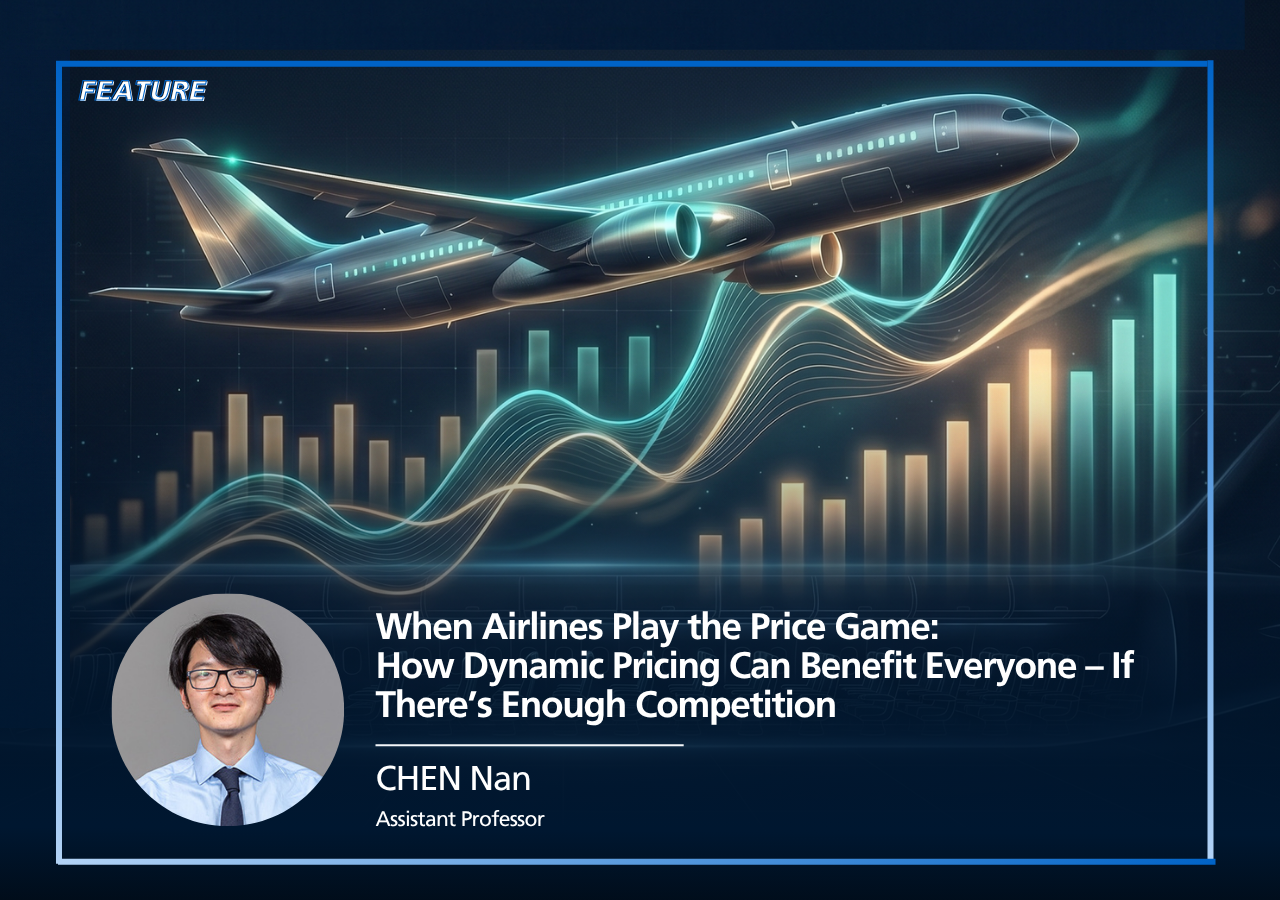
When Airlines Play the Price Game: How Dynamic Pricing Can Benefit Everyone – If There’s Enough Competition

8 June 2026
Airline, Artificial Intelligence, Competition & Market Design, Computational Social Science, Data Analytics, Department of Information Systems & Analytics, Economics of IT, Faculty Research, Research
Home » Knowledge@Computing » When Airlines Play the Price Game: How Dynamic Pricing Can Benefit Everyone – If There’s Enough Competition
CHEN Nan
Chen Nan
Assistant Professor
Information Systems and Analytics
SHARE THIS ARTICLE

When Airlines Play the Price Game:
How Dynamic Pricing Can Benefit Everyone – If There’s Enough Competition

The next time you search for a flight and watch the price jump $200 overnight, you might feel like the system is rigged against you. And you wouldn’t be alone. Few things irritate travellers quite like the volatility of airline fares, that nagging sense that some algorithm, somewhere, is squeezing every last dollar from your wallet. 

But what if that algorithm is actually making things better – for you, for the airline, and for the market as a whole? 

That’s the counterintuitive finding from research by Assistant Professor Chen Nan from NUS Computing’s Department of Information Systems and Analytics and his collaborator, Associate Professor Przemyslaw Jeziorski at the Haas School of Business at UC Berkeley. Their study examines the consequences of dynamic pricing in competitive airline markets, and the results challenge the conventional wisdom that sophisticated pricing strategies exist solely to extract more from consumers. In competitive markets, at least, dynamic pricing can be a rare win-win.

The problem with studying pricing in the wild 

Airline pricing is famously opaque. The same seat on the same plane can cost $150 one week and $600 the next. Behind those shifts are complex algorithms that adjust fares in real time based on remaining capacity, how close the departure date is, and how demand is trending. Airlines were among the first industries to adopt this approach – a practice known in the trade as revenue management – and they’ve been refining it for decades.

Yet despite its ubiquity, surprisingly little was known about how dynamic pricing actually plays out when airlines compete head to head. Most prior research had focused on monopoly routes, where a single carrier controls all the seats. The conclusions from those studies were, frankly, dispiriting for consumers: dynamic pricing tended to boost airline profits at the expense of passenger welfare.

But monopoly markets are a special case. Chen and Jeziorski wanted to know what happens when you add competition to the mix.

A natural experiment at 30,000 feet 

To answer that question, the researchers needed something rare: a clean, natural experiment where the competitive landscape shifted in a way that wasn’t tangled up with a dozen other confounding factors.

They found it on the Seattle–Tucson route.

From December 2015 to March 2016, both Alaska Airlines and Delta Air Lines operated daily nonstop flights on this corridor – a compact duopoly. But Delta’s service was seasonal. When Delta ceased operations at the end of March, the route flipped overnight from a two-player market to a monopoly. That sudden shift – from competition to no competition, with everything else held roughly constant – gave the researchers a clean case for isolating the effects of market structure on pricing behaviour.

To control for seasonal trends, they paired the Seattle–Tucson route with a stable duopoly on the San Diego–Boston corridor, where Alaska and JetBlue flew year-round. By comparing pricing and sales patterns across the two routes, before and after the exit, they could disentangle the effects of competition from broader market fluctuations.

The data itself was granular and carefully assembled. The team scraped daily prices and seat maps directly from airline websites over a 30-day window, tracking how fares and remaining capacity evolved for each individual flight as the departure date approached. In total, the dataset comprised more than 57,000 observations across 2,561 flights – a level of detail far richer than the aggregated, quarterly data typically used in airline research.

Two forces pulling in opposite directions

With this data in hand, Chen and Jeziorski built and estimated a dynamic oligopoly model. This was a mathematical framework that captures how competing airlines set prices over time, factoring in their own remaining seats, their competitors’ capacity, and the changing mix of passengers shopping for tickets.

The model allowed them to do something powerful: simulate what would happen under alternative pricing regimes. What if airlines couldn’t adjust prices at all and had to charge a single fare from the moment tickets went on sale until departure? What if they could vary prices over time but couldn’t react to how many seats they’d already sold?

By comparing these hypothetical scenarios with full dynamic pricing, the researchers were able to decompose the overall effect into two distinct mechanisms.

The first is price discrimination – the ability to charge different prices to different types of travellers based on when they book. Leisure travellers, who tend to be price-sensitive and book early, pay lower fares. Business travellers, who are less price-sensitive and often book at the last minute, pay more. This is the part of dynamic pricing that feels most like extraction – and the research confirms that, taken alone, price discrimination does shift surplus away from consumers and toward airlines. It softens competition by creating scarcity in the late market, where business travellers have fewer options and less bargaining power.

The second mechanism is revenue management – the ability to adjust prices based on how quickly seats are selling. If a flight is filling up fast, the fare rises to slow demand. If sales are sluggish, prices drop to stimulate bookings. This part of dynamic pricing, it turns out, works in consumers’ favour. It makes capacity utilisation more efficient, prevents early sellouts that would leave late-arriving travellers stranded, and – crucially –intensifies competition. When airlines can respond to real-time demand, they lose some of their ability to pre-commit to high prices, and that lost commitment power translates into lower fares.

The surprise: everyone comes out ahead

When you put both forces together in a competitive market, the net effect is striking. Under full dynamic pricing in the San Diego–Boston duopoly, consumer welfare increased by 3%, airline profits rose by 8%, and total welfare – the combined benefit to passengers and airlines – climbed by roughly 6%. Dynamic pricing, in this setting, is what economists call a Pareto improvement: everyone is better off, and no one is worse off.

Dig deeper and the distributional picture becomes even more interesting. Leisure travellers – the early bookers who are most sensitive to price – saw their welfare roughly double. Business travellers, despite facing higher fares in the late market, essentially broke even. They paid more per ticket, but they were also more likely to actually get a seat, because revenue management prevented the kind of premature sellouts that would have shut them out entirely.

The industry output effects were just as telling. Under dynamic pricing, the total number of seats sold increased by more than 15%. Airlines were filling more of their planes, and doing so more efficiently.

But remove competition, and the story flips

To test how market structure interacts with dynamic pricing, the researchers simulated a merger – collapsing the duopoly into a single carrier with the combined capacity of both airlines.

Under monopoly, dynamic pricing produced the opposite result. Consumer welfare fell by 14%. Total surplus dropped by nearly 5%. The monopolist captured all the gains from price discrimination and more, with no competitive pressure to pass any of that efficiency back to passengers.

Dynamic pricing is not inherently good or bad for consumers. Its effects depend fundamentally on the competitive environment. In a market with meaningful competition, dynamic pricing can improve efficiency by allocating scarce seats more effectively, while competition forces carriers to share some of those gains with passengers. In a monopoly, the same tools become instruments of extraction.

Why this matters beyond airlines

The implications reach well beyond the airline industry. Dynamic pricing has spread rapidly into hotels, ride-hailing, event ticketing, e-commerce, and even electricity markets. In each of these sectors, the same fundamental tension exists between the efficiency gains from responsive pricing and the risks of exploitation when competition is thin.

The research offers a clear signal for regulators and policymakers: the critical variable isn’t the pricing strategy itself, but the market structure in which it operates. Banning or restricting dynamic pricing in competitive markets could actually harm consumers by eliminating the efficiency benefits. But allowing it to flourish in concentrated markets – without adequate competition – risks tilting the balance decisively in favour of firms.

For the airline industry in particular, the findings have fresh relevance. A wave of consolidation over the past two decades has left many domestic routes in the United States served by just one or two carriers. If dynamic pricing benefits consumers primarily through the competitive channel, then the ongoing reduction in competition should give us pause. The same algorithms that improve welfare on contested routes may be doing exactly the opposite on monopoly corridors.

The bigger picture

At its core, this research is about something larger than airfares. It’s about how sophisticated, data-driven pricing strategies interact with the structure of markets – and whether the gains from technological sophistication are shared broadly or captured narrowly.

The answer, Chen and Jeziorski show, is not predetermined. It depends on choices we make about market design, competition policy, and regulatory oversight. Dynamic pricing is a powerful tool. Whether it serves the public interest depends entirely on the competitive conditions that surround it.

That’s a finding worth remembering the next time your flight fare changes overnight.

Read the full paper: Chen, Nan and Jeziorski, Przemyslaw, Consequences of Dynamic Pricing in Competitive Airline Markets (January 26, 2023) https://ssrn.com/abstract=4285718 

Trending Posts

20220113_Desmond_Ong_SOC_Features
21 January 2022
An AI that can read your emotions? Putting safeguards in place
In recent years, some companies, including Amazon, JP Morgan, and Unilever, began asking prospective employees to do a curious thing — to film themselves answering a fixed set of questions. ...
20190909_Tang_Yew_Siang_Photo_1
9 September 2019
Helping computers see the world in 3D
It is no simple feat to have a research paper accepted at a top tier computer science conference – let alone to achieve this as an undergraduate student. For recent ...
20210305_SYJ_SOC_Feature_New
5 March 2021
Archipelago — making sure no student is an island
Like everyone else, Yuen Jien Soo found himself struggling to adapt when Covid-19 first hit last year. Soo, who teaches operating systems, computer organisation, and software product engineering at NUS ...
20210401_Features_Martin_Henz_Final
1 April 2021
Aliens, spaceships, and time warps — programming lessons get funky with the Source Academy
When computer science freshmen first begin their undergraduate degree at NUS Computing, they’re required to take an innocuous-sounding module called CS1101S. There, they are introduced to the fundamentals of computer ...
Lim_Shi_Ying
4 January 2023
Problem-first or product-first?
As any Ph.D. student will tell you, paychecks at that level aren’t especially generous. “I was always trying to find cheaper alternatives for household items,” recalls Lim Shi Ying of ...
ResearchFeature-Angela Yao-Web
8 April 2025
Advancing AI: Improving Conditional Interpolation in Text-to-Image Models
Associate Professor Angela Yao and her team at NUS Computing have introduced Attention Interpolation via Diffusion (AID) and Prompt-guided Attention Interpolation via Diffusion (PAID), two new AI frameworks that take ...
Newsbyte_RF - Suranga - VisceroHaptics
26 May 2026
The Gut-Brain Hack: How Vibrations Can Reshape the Way We Feel Hunger
You've felt it before. That low, insistent rumble in your belly during a long meeting. The unsettling churn before a nerve-wracking presentation. We call these "gut feelings" – and while ...
RF-ShaoLin-DRO-Website
4 June 2025
A New Grasp on Robotics: Teaching Robots to Hold the Future
A new framework developed by NUS Computing’s Asst Prof Shao Lin and collaborators brings robots closer to human-like dexterity, overcoming a key barrier in robotic grasping. ...
RF-JungpilHahn-Mirroring-Website
4 June 2025
Designing Better Software Teams
A forthcoming study by NUS Computing’s Prof Jungpil Hahn and collaborators sheds new light on how software team structures impact product success in the digital economy. ...
RF-TanChuanHoo-EntSys-Website
4 May 2025
Unlocking the True Potential of Enterprise Systems: Why User Behavior Matters More Than You Think
A new study by NUS Computing’s Assoc Prof Tan Chuan Hoo reveals how leadership, user mindset, and system design determine whether enterprise systems are used effectively—or fail despite good technology. ...
RF-MohanKankanhalli-BullyingAI-Website
4 June 2025
Bullying the Machine: What AI’s Reactions to Psychological Pressure Teach Us About Vulnerability
A new study led by Professor Mohan Kankanhalli (Provost’s Chair Professor and Director of NUS AI Institute) reveals that large language models exhibit human-like psychological vulnerabilities when subjected to AI-driven ...
20220623-SoC-Features-_Disaster-Strikes_Gary-Tan
24 June 2022
When disaster strikes, where do people run?
When a natural disaster, terrorist attack, or any other crisis strikes, the best time to act isn’t just as it occurs, but rather in the months, even years, before it ...
20200312_Harold_Soh_Research_Feature-01
12 March 2020
Humans, Robots, and the Trust that binds them
Like so many parts along the Californian coast, Honda Point is breathtakingly beautiful. People go to visit, but when they do, it’s not for the views. ...
RF-Chua Tat Seng-AlphaEdit-Website
4 June 2025
Up-to-date AI Without the Side Effects: How AlphaEdit Could Change the Way We Edit Knowledge in Language Models
KITHCT Chair Professor Chua Tat Seng and his team have developed AlphaEdit, a breakthrough approach that allows AI models to learn new facts without losing what they already know. ...
Future of Learning
22 October 2024
COACHing the Future: How Robots Are Revolutionising Learning

Unlocking the Future of Learning: Robots as Your Personal Coaches Imagine a world where robots don’t just assist with daily tasks but actively help you learn new skills. We’re talking ...

20210806_SOC_Features_Covid_CakeCutting_Warut_S
5 August 2021
Covid, cake-cutting, and fair resource allocation
The School of Computing at NUS is set in tranquil surroundings — buildings atop gentle hills are connected by breezy walkways, and research labs and classrooms look out onto lush ...
20190326_Tulika_Mitra_Research_Article
26 March 2019
Future Wearables: smaller, faster and more independent
For those who’ve taken the plunge into the world of wearable devices — 61 million of us by the year’s end, as estimates predict — the leap can be liberating. ...
Bytes and Barriers
2 October 2024
Bytes and Barriers: Overcoming the Challenges of Integrating Electronic Health Records

Understanding the tensions and their mitigations is key to effectively managing the challenges involved in creating a seamless system of patient records. Sometimes a trip to the GP’s clinic isn’t ...

20191125_Kang_Min_Suk_Research_Article_1
25 November 2019
Making Bitcoin Safer — By Breaking It
In Greek mythology, Erebus is the primeval god of darkness, son of Chaos. It’s also the region of the underworld, where souls pass through after dying. The word is so ...
Newsbyte - Research Feature_Ambuj Varshney_AudioCast (1)
21 August 2025
Reimagining Connectivity: How AudioCast Delivers Ultra-Low-Power Wireless Communication at Scale

Reimagining Connectivity: How AudioCast Delivers Ultra-Low-Power Wireless Communication at Scale   In our increasingly connected world, the buzz of wireless signals is omnipresent – Wi-Fi in our homes, Bluetooth in ...

Newsbyte Templates NUS SOC (2)
20 August 2025
Fusing the Flows: How a New Testing Method Unearthed Decades-Old Flaws in PHP’s Core

Fusing the Flows: How a New Testing Method Unearthed Decades-Old Flaws in PHP’s Core   The Invisible Engine of the Web Every time you post on a blog, browse an ...

Heng Cheng Suang Featured Article
30 October 2024
A Tussle Between Man and Machine: Heuristics vs. Analytics?

Relying on intuition — finely-honed instincts based on years of experience, expertise, and good judgement — has long been a superpower in business. It’s often the source of innovation, and ...

20220729-Hearing_walk_Terence-Sim
29 July 2022
‘Hearing’ how you walk
In one scene from the hit TV series Star Trek, Dr Bones McCoy runs to the aid of his fallen crewmate, who lies strewn across a barren, other-worldly landscape. He ...
20190614_Atreyi_Kankanhalli_Photo
14 June 2019
Power to the consumer – user innovation drives new apps for mobile phones
In 1958, a curious sight began appearing on the sidewalks of California. People were taking apart roller skates, attaching them to the underside of wooden planks, sometimes boxes, and whizzing ...
Logic Bugs
5 January 2024
Detecting Logic Bugs in a Way That’s Quicker and More Effective
Sometime between 2019 and 2020, a curious phenomenon began surfacing on Signal, FaceTime, and four other mobile messaging applications: someone could ring a person up and listen in to the ...
20220427_SoC_Features_Brian_Lim_XAI
28 April 2022
Explainable AI gets more human-centric — thanks to cognitive psychology
Imagine if Amazon Alexa could recommend a tub of ice cream or Siri could play a cheerful song if they hear sadness in your voice. AI voice recognition can now ...
Harold Soh - DiffPath
13 December 2024
Exploring DiffPath: A Revolutionary Approach to Detecting Out-of-Distribution Data with AI

In the world of artificial intelligence (AI), one major challenge is teaching models to recognise when they encounter something they’ve never seen before—known as out-of-distribution (OOD) data. Imagine training a ...

20190528_Bryan_Low_Research_Article-1
28 May 2019
What Bayesian Optimisation can teach us about baking better cookies and more
Mention “Bayesian Optimisation” to Professor Bryan Low Kian Hsiang and he begins to talk about baking cookies. That’s because to the uninitiated, concepts such as “distributed batch Gaussian process optimisation” ...
ATung-DiversiNews
14 February 2025
DiversiNews Helps Increase News Exposure and Broaden People’s Minds

Those of us who don’t belong to Gen Z or Alpha may recall simpler times, when there were no smartphones or internet, and the only news we got was via ...

RF_Website_Lee Yi-Chieh ICA Award
3 July 2025
When AI Talks in Groups: How Multi-Agent Systems May Be Shaping Your Opinions
Explore how scalable collaborative zk-SNARKs enable fast, secure zero-knowledge proofs across multiple servers. This breakthrough improves privacy and scalability for AI verification, blockchain, and data markets, making advanced cryptography more ...
Facebook Instagram Telegram Linkedin Youtube
Support NUS Computing
  • Computing 1
    13 Computing Drive
    Singapore 117417
  • +65 6516 2727
  • Contact Us
  • Locate Us
  • Find Our Venues
Additional Links
NUS COMPUTING
  • About Us
  • Programmes
  • News
  • Events
  • Innovation & Entrepreneurship
  • Recruiters
  • About Us
  • Programmes
  • News
  • Events
  • Innovation & Entrepreneurship
  • Recruiters
Programmes
  • Undergraduate
  • Master’s
  • Doctoral
  • Graduate Certificates
  • Executive Education
  • Undergraduate
  • Master’s
  • Doctoral
  • Graduate Certificates
  • Executive Education
ADMISSIONS
  • Undergraduate
  • Graduate
  • Financial Support
  • Undergraduate
  • Graduate
  • Financial Support
RESEARCH
  • Research Initiatives
  • Research Areas
  • Research Initiatives
  • Research Areas
DEPARTMENTS
  • Department of Computer Science
  • Department of Information Systems and Analytics
  • Department of Computer Science
  • Department of Information Systems and Analytics
RESOURCES
  • School Directory
  • Student Portal
  • Facilities & Services
  • NUS WebMail
  • NUS Canvas
  • Student Jobs
  • School Directory
  • Student Portal
  • Facilities & Services
  • NUS WebMail
  • NUS Canvas
  • Student Jobs
NUS COMPUTING
  • About Us
  • Programmes
  • News
  • Events
  • Innovation & Entrepreneurship
  • Recruiters
  • About Us
  • Programmes
  • News
  • Events
  • Innovation & Entrepreneurship
  • Recruiters
Programmes
  • Undergraduate
  • Master’s
  • Doctoral
  • Graduate Certificates
  • Executive Education
  • Undergraduate
  • Master’s
  • Doctoral
  • Graduate Certificates
  • Executive Education
ADMISSIONS
  • Undergraduate
  • Graduate
  • Financial Support
  • Undergraduate
  • Graduate
  • Financial Support
RESEARCH
  • Research Initiatives
  • Research Areas
  • Research Initiatives
  • Research Areas
DEPARTMENTS
  • Department of Computer Science
  • Department of Information Systems and Analytics
  • Department of Computer Science
  • Department of Information Systems and Analytics
RESOURCES
  • School Directory
  • Student Portal
  • Facilities & Services
  • NUS WebMail
  • NUS Canvas
  • Student Jobs
  • School Directory
  • Student Portal
  • Facilities & Services
  • NUS WebMail
  • NUS Canvas
  • Student Jobs

© National University of Singapore. All Rights Reserved. • Legal • Branding guidelines