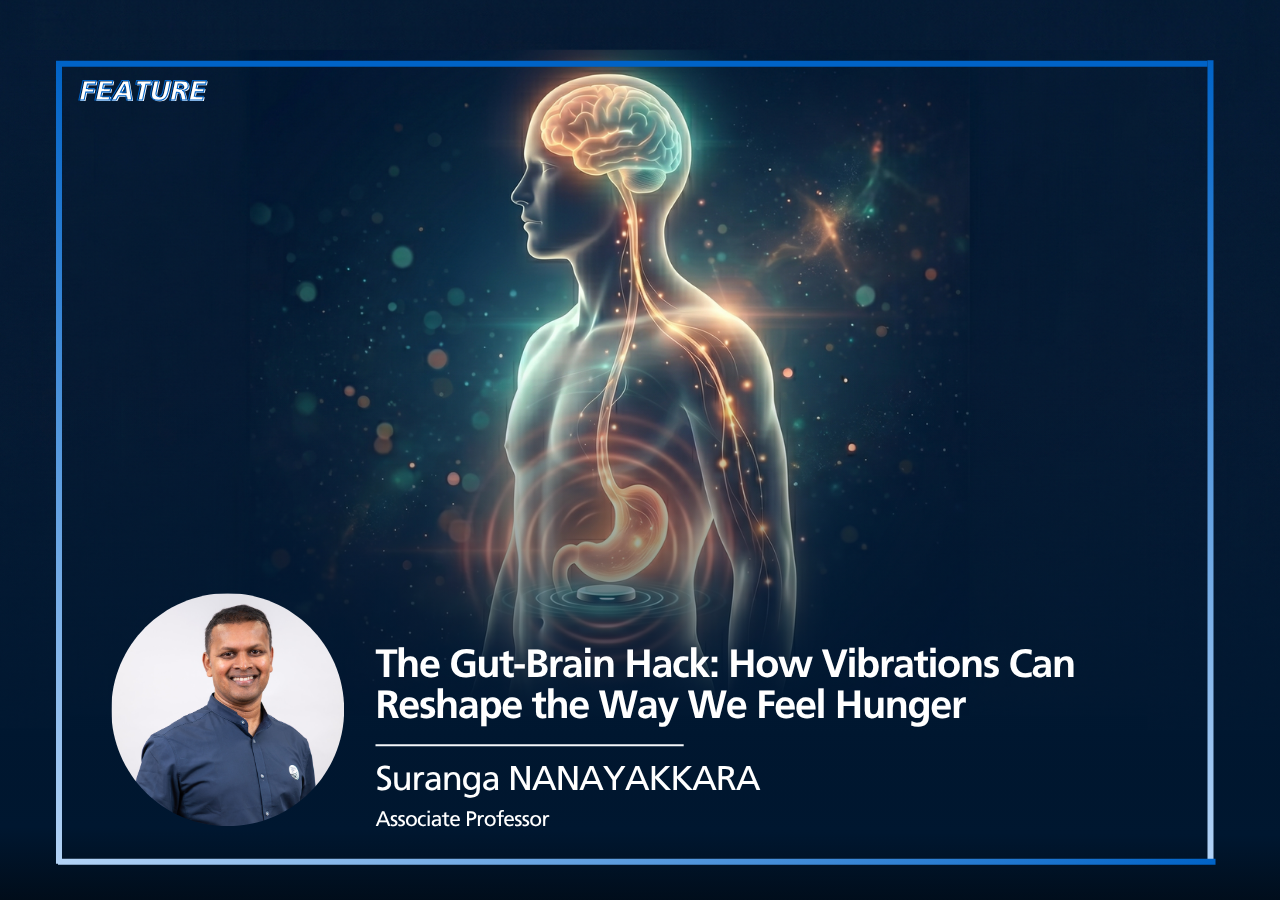

The Gut-Brain Hack: How Vibrations Can Reshape the Way We Feel Hunger
You’ve felt it before. That low, insistent rumble in your belly during a long meeting. The unsettling churn before a nerve-wracking presentation. We call these “gut feelings” – and while the phrase gets used loosely, science increasingly tells us they’re anything but casual. The gut-brain axis, a two-way communication highway between the digestive system and the brain, shapes everything from appetite and mood to decision-making.
But here’s a question few have thought to ask: what if technology could work with those internal sensations – not by putting something inside the body, but by gently replaying the gut’s own signals back to it?
That’s exactly what a team from the Augmented Human Lab at NUS School of Computing set out to investigate. Led by PhD researcher Mia Huong Nguyen and Associate Professor Suranga Nanayakkara, alongside co-investigators Moritz Alexander Messerschmidt and Jochen Huber (Furtwangen University), the group developed VisceroHaptics – a system that records the natural sounds of the bowels and plays them back as audio-haptic vibrations directly on the stomach.
Their findings, presented at CHI 2026 – the premier international conference on Human-Computer Interaction, held in Barcelona – earned an Honourable Mention Award, a recognition given to the top five per cent of submissions. The paper provides the first empirical evidence that this kind of non-invasive stimulation can alter gastric interoceptive behaviour. In plain terms: it changed how people’s bodies responded to signals about hunger and fullness.
Replaying the Gut’s Own Language
Most digital interfaces communicate through screens, sound, or touch on the skin.The team was interested in something deeper: could technology influence sensations from inside the body?
Previous attempts to modulate gut signals have relied on invasive approaches – ingestible pills or implanted electrical stimulators. Effective in clinical settings, but impractical for everyday use. Instead, they augmented gastric sensations from the outside, replaying gut-based feedback through the skin to see whether the brain could be nudged into interpreting it as real.
To build their stimuli, the researchers recorded real bowel sounds from participants undergoing a standardised water-drinking protocol (Water Load Test) used to study gastric perception. The recordings yielded over 1,300 distinct sound instances – short clicks, rapid-fire bursts, sustained rumbles, drawn-out harmonic tones.
The delivery system is disarmingly simple: two sound transducers, one strapped to the participant’s belly, the other embedded in the back of a chair. The transducers convert gut sound recordings into vibrations calibrated to feel natural – as though they were coming from the participant’s own body rather than an external device.
From Sensation to Behaviour
The team ran three studies, each building on the last, with 55 participants in total.
The first two established that gut-based audio-haptic feedback genuinely changes how people feel. In open-ended sessions, participants reported a surprisingly wide range of gastric sensations – hunger, fullness, stomach upset, thirst, even emotional responses like nervousness and anticipation.
What emerged clearly was that the type of sound pattern mattered: longer-duration sounds tended to make people feel hungrier, while short bursts were more often associated with fullness or digestion. When the team quantified these impressions in a follow-up study using a hunger-satiety scale, continuous random sounds produced significantly higher hunger ratings than single-burst patterns. But some patterns affected more people mildly, while others affected fewer people intensely – breadth and depth of hunger induction, it turned out, are different things.
The critical question was whether any of this translated into behaviour.
When Perception Changes Behaviour
In the third study, 21 new participants completed the Water Load Test across three separate sessions on different days – one with no stimulation, one with single-burst vibrations, one with continuous random sounds. They fasted beforehand, drank through metre-long straws from opaque bottles so they couldn’t gauge how much they’d consumed, and sessions were scheduled at the same time each day to minimise variation.
Single-burst variations led participants to drink significantly more water before feeling satiated – roughly 45 millilitres more than baseline. Despite consuming more, they didn’t report feeling any fuller, suggesting their internal sense of “enough” had genuinely shifted.
What This Opens Up
The work is still exploratory – the sample sizes are modest, and the Water Load Test measures water intake as a proxy for eating behaviour, not eating itself. But for the first time, there is empirical evidence that non-invasive audio-haptic stimulation can influence gastric interoceptive behaviour – changing not just what people feel, but what they do in response.
The implications range from healthcare (supporting appetite recovery after medical procedures, or helping individuals with eating disorders recalibrate their sense of hunger and fullness) to wellness technology that goes deeper than a buzzing smartwatch – working with the body’s own internal language. For HCI as a field, the work breaks new ground: most interoception research has focused on the heart and lungs, while the gut has remained largely unexplored as a site of interaction.
And in doing so, it raises an intriguing possibility: our relationship with technology may one day be shaped not only by what we see, hear, and touch – but also by what we feel inside ourselves.
Read the full paper here: https://dl.acm.org/doi/epdf/10.1145/3772318.3790268