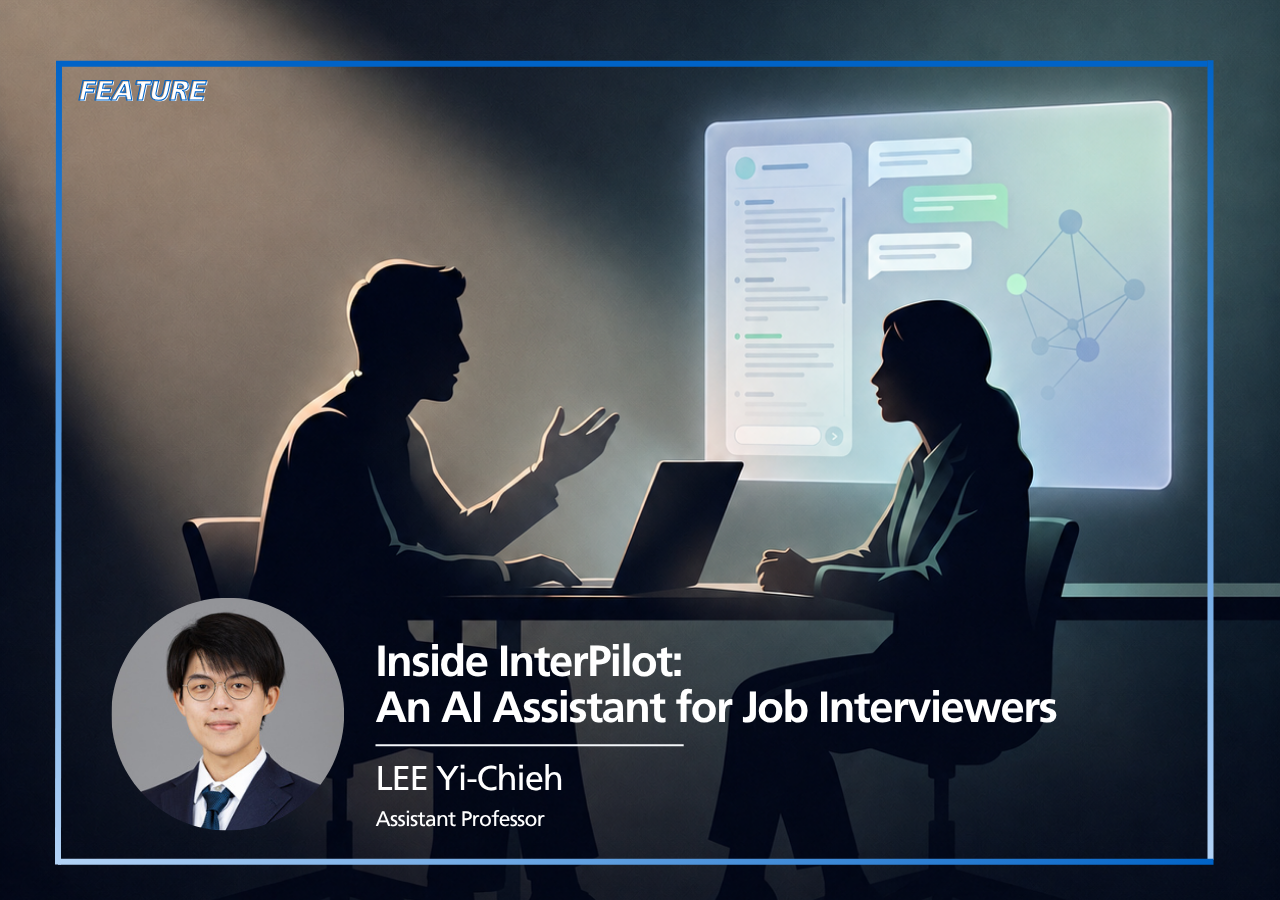
Inside InterPilot: An AI Assistant for Job Interviewers
A hiring manager conducting a 15-minute interview is doing several things simultaneously: listening, evaluating, planning the next question, and writing it all down before it disappears. In a formative study of eight HR professionals, researchers from NUS Computing, together with collaborators from recruitment software firm Avature, found that participants put it plainly: “I need to try to remember everything, and also assess the candidate at the same time.”
That tension, between paying attention and keeping a record, is where InterPilot begins.
Developed by Assistant Professor Lee Yi-Chieh with researchers Zhengtao Xu, Zimo Xia, Zicheng Zhu, and Nattapat Boonprakong, alongside collaborators from Avature, InterPilot is a prototype built to sit alongside a human interviewer during a live interview. It transcribes, summarises, suggests questions, and tracks which skills a candidate has demonstrated against which have not yet come up. None of this replaces the interviewer’s judgment. The system was designed, from the outset, around a narrower ambition: reduce the load without removing the person from the loop.
Three Problems, One System
The design started with interviews across banking, education, consulting, energy and technology sectors. Three recurring difficulties shaped what InterPilot became.
Documentation was the first. Interviewers described the mental tax of listening and writing at once. One participant recommended that “administrative tasks like taking notes should be automated,” so that professionals “concentrate on tasks related to their core expertise.” InterPilot’s note-taking widget takes rough keywords instead of full sentences, then combines them with the transcript to generate a structured summary once the interview ends.
Depth of questioning was the second. Interviewers without technical backgrounds struggled to probe convincingly in specialist domains. “If you ask me to probe on Python skills then I may not be able to pass,” one participant admitted. InterPilot offers three modes of question generation: STAR-framework follow-ups, general directional prompts, and questions targeted at a specific skill the interviewer selects.
Consistency in evaluation was the third. Skill assessments tend to rest on impression rather than evidence, and impressions are where bias settles in unnoticed. InterPilot’s knowledge graph links each assessed skill to the transcript moment where a candidate demonstrated it, giving interviewers something to point to beyond a general sense of how the conversation went.
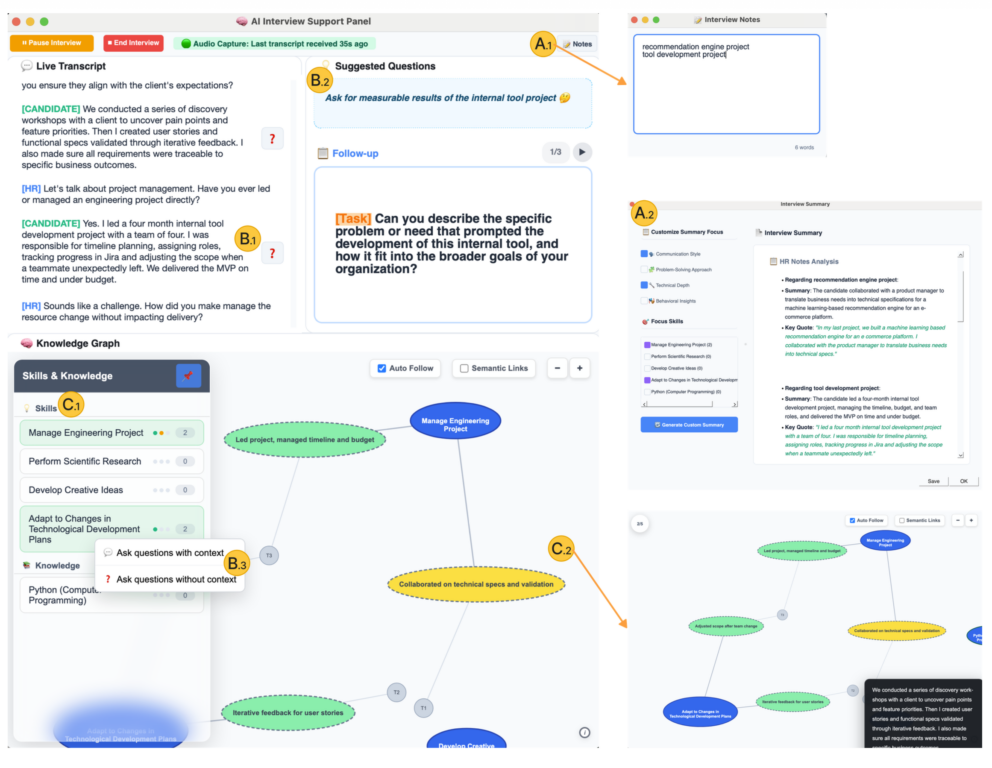
(Clockwise from top left): the live transcript and suggested questions panel, the note-taking widget, the AI-generated interview summary, and the real-time skill-evidence knowledge graph.
What the Study Found
Researchers tested InterPilot against a transcript-only baseline across two mock interview sessions with seven HR professionals, measuring workload through the NASA Task Load Index and usability through the System Usability Scale, according to the study.
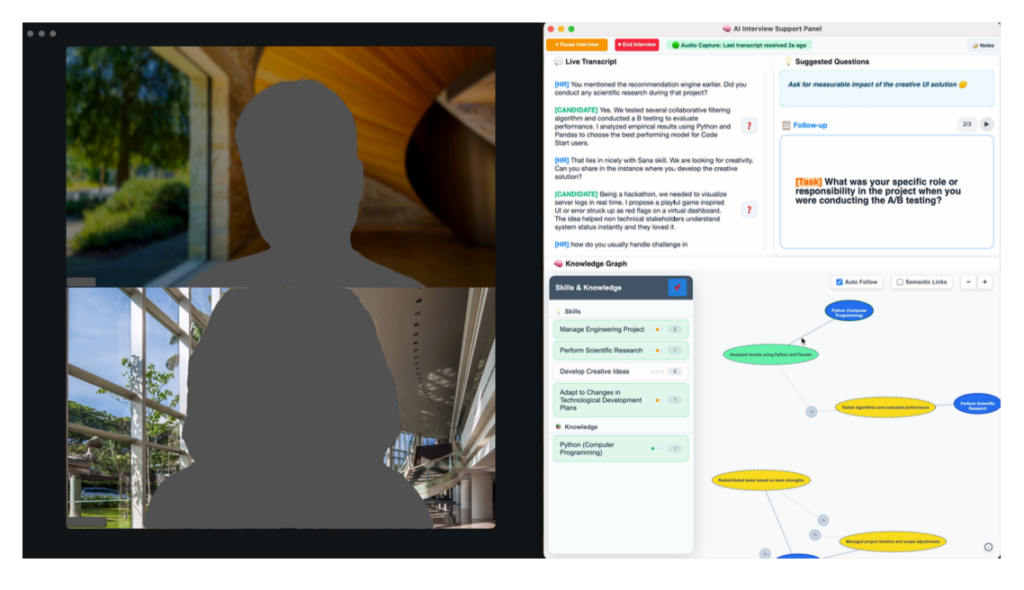
Workload held steady. Interviewers using InterPilot didn’t report a heavier mental load than those working with a plain transcript, according to the study’s workload measures. One participant felt the difference directly: “I don’t need to write down everything. I can focus on listening and maintaining eye contact.”
Usability told a different story. Participants rated InterPilot noticeably lower on standard usability measures than the baseline system, the study found. The extra windows and moving parts pulled attention away from the conversation itself. “A lot of things are happening,” one participant said. “Transcript is populated, graph is auto-followed. It will be a lot for someone to deal with.”
Reading the Results
InterPilot succeeded at what it was built to solve. It freed up attention that had been going to note-taking. It gave interviewers a documented basis for their assessments rather than a lingering impression. Neither of those gains cost the interviewers additional mental effort, per the study’s workload measures.
What the study also surfaced was something the researchers hadn’t set out to test: a system can be useful and still be a lot to manage in the moment. A live knowledge graph that helps after the interview can crowd the screen during it. A precisely worded technical question can go unasked simply because the person holding it isn’t sure it’s right.
The researchers’ proposed next step is a shift in how the AI intervenes: from supplying finished questions to pointing at raw material, areas of the conversation worth returning to, leaving the phrasing and judgment to the interviewer.
“We kept coming back to the same question: how do you build a tool that knows when to stay quiet,” said Asst Prof Lee.
For a team building AI meant to support high-stakes human decisions, that question turned out to matter more than any single feature in the system. Getting a machine to generate a good interview question was, in the end, the easier problem to solve.
Beyond the Mock Interview
The study involved seven evaluators, most of them senior, working through mock interviews for a single screening-stage role. The researchers are now planning a larger and more varied group, including junior interviewers, tested across different interview stages and eventually in live hiring settings, to see whether these patterns hold beyond a single 15-minute session.
Further Readings: Zhengtao Xu, Zimo Xia, Zicheng Zhu, Nattapat Boonprakong, Yu-An Chen, Rabih Zbib, Casimiro Pio Carrino, and Yi-Chieh Lee. 2026. InterPilot: Exploring the Design Space of AI-assisted Job Interview Support for HR Professionals. In Extended Abstracts of the 2026 CHI Conference on Human Factors in Computing Systems (CHI EA ’26), April 13–17, 2026, Barcelona, Spain DOI: 10.1145/3772363.3798373