Building OpenSentinel: Two NUS Students Win National AI Student Challenge 2026
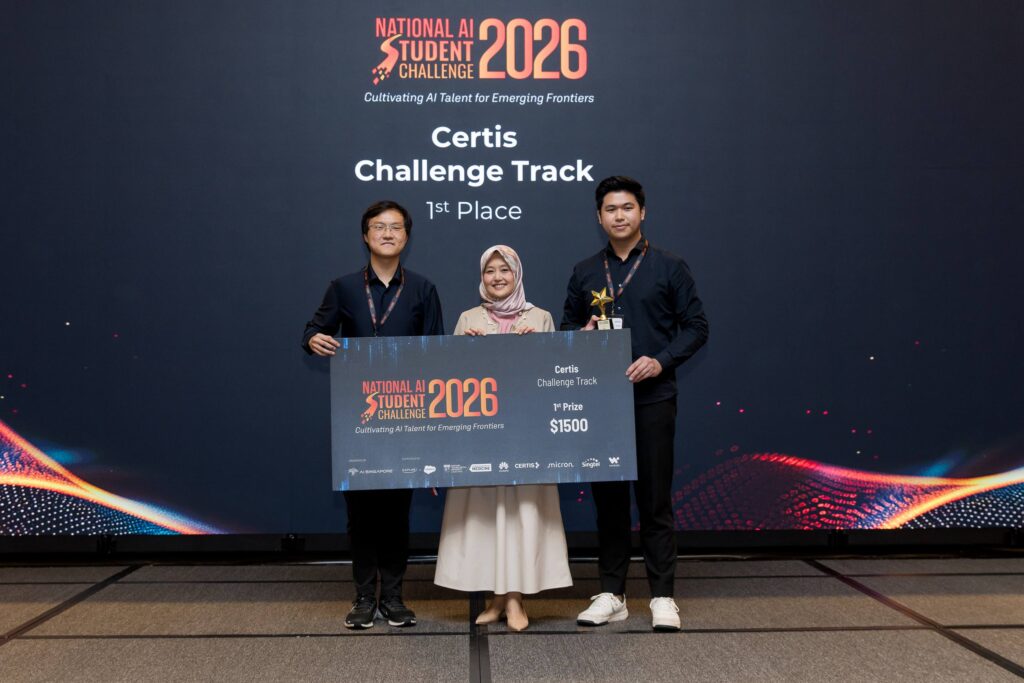
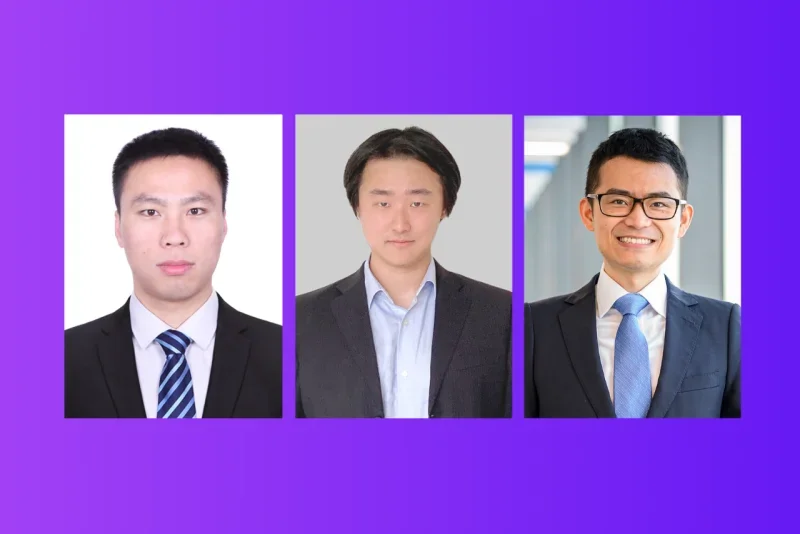
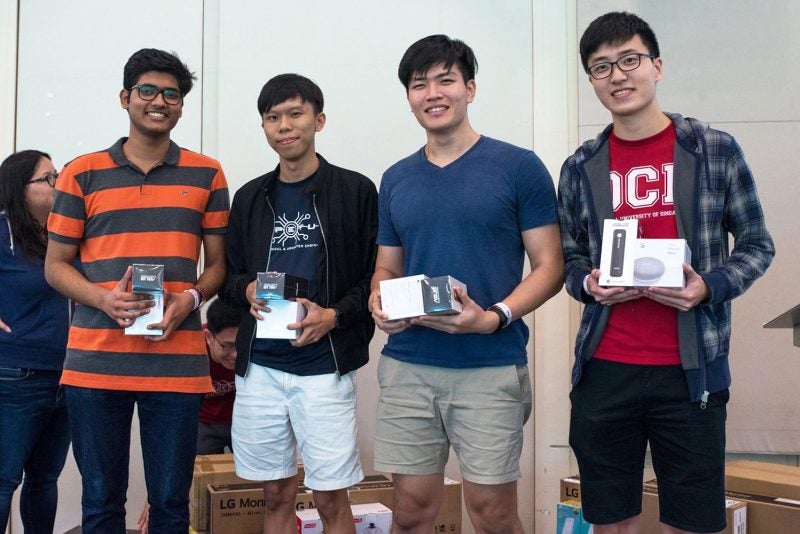
When NUS students Teoh Tze Tzun (Year 4, Computer Science & Mathematics, DDP) and Jeffinson Darmawan (Year 4, Computer Engineering) entered the National AI Student Challenge 2026, they were tasked with exploring how AI could support security operations.
Their solution, OpenSentinel, went on to win first place in the Certis Track.
Organised by AI Singapore as part of the AI Student Developer Conference, the challenge brought together students to solve real-world industry problems using AI. For Jeffinson and Tze Tzun, that meant understanding how security officers make decisions under pressure and designing a system that could support those workflows effectively.
OpenSentinel is a multimodal security advisory system that processes live data from a facility’s digital twin, identifies potential threats, and generates responses grounded in standard operating procedures. It combines optimisation algorithms for officer dispatch, machine learning for crime prediction, and large language models for incident analysis.
Throughout the project, the team focused on building around operational needs rather than individual technologies. User workflows, response clarity, and privacy considerations shaped many of the design decisions, including the use of locally hosted open-source models and safeguards around sensitive data.
The experience also highlighted the role of computing fundamentals in an era of rapidly advancing AI tools. Building OpenSentinel required the team to draw on knowledge from software engineering, machine learning, optimisation, systems design, and human-centred computing. While AI-assisted development tools accelerated implementation, decisions around architecture, trade-offs, and user experience remained firmly in the hands of the builders.
Reflecting on the project, Tze Tzun shared, “The question is rarely ‘Can we build it?’ but ‘What should we build?’ and ‘How should we build it?’”
For both graduating students, OpenSentinel was an opportunity to apply what four years of computing education had built up – the judgement to scope a problem well, and the technical grounding to see it through.