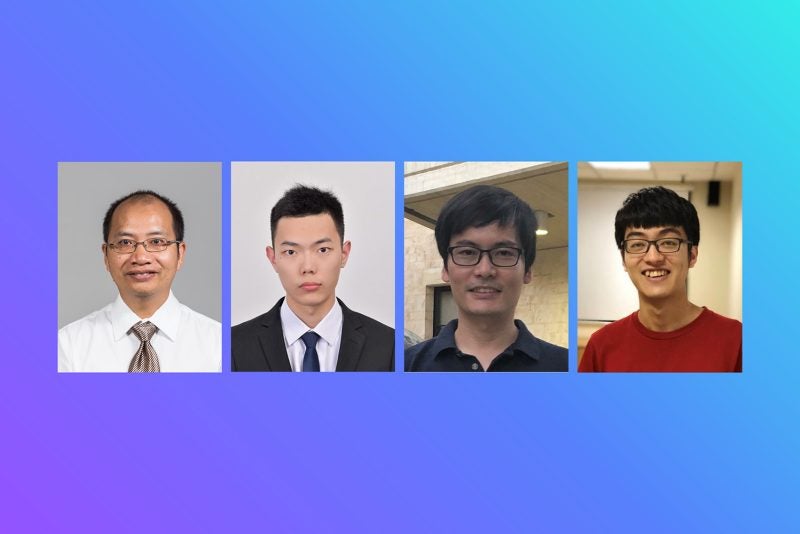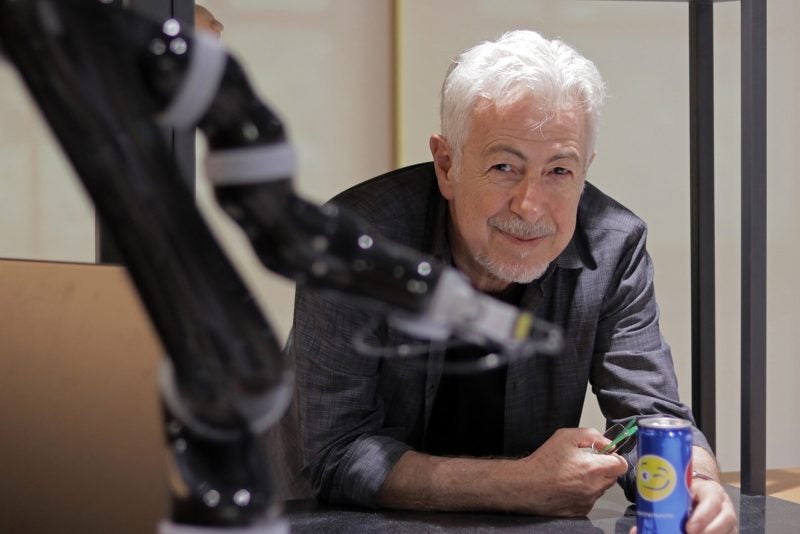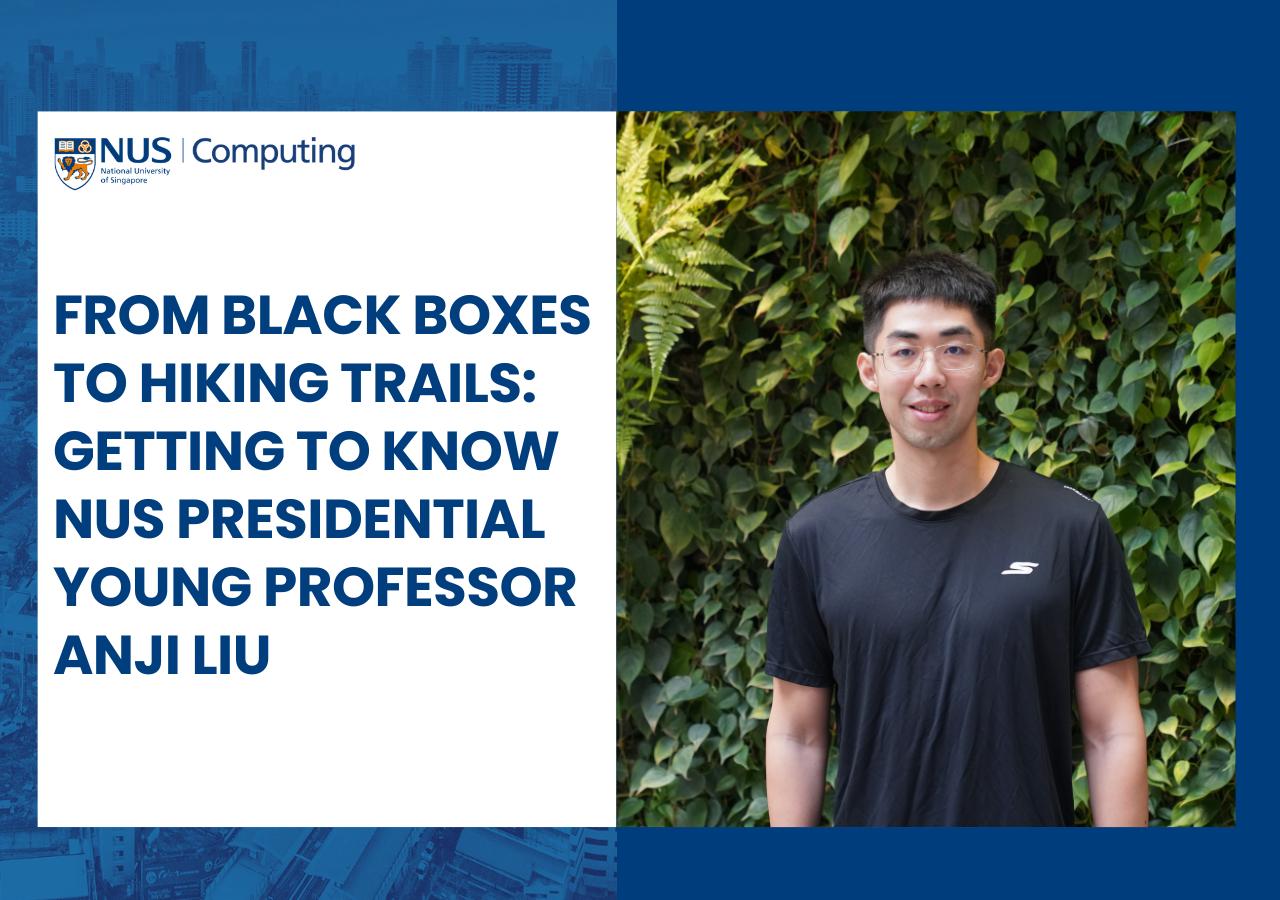
From Black Boxes to Hiking Trails: Getting to Know NUS Presidential Young Professor Anji Liu – What AI actually does (and doesn’t do)
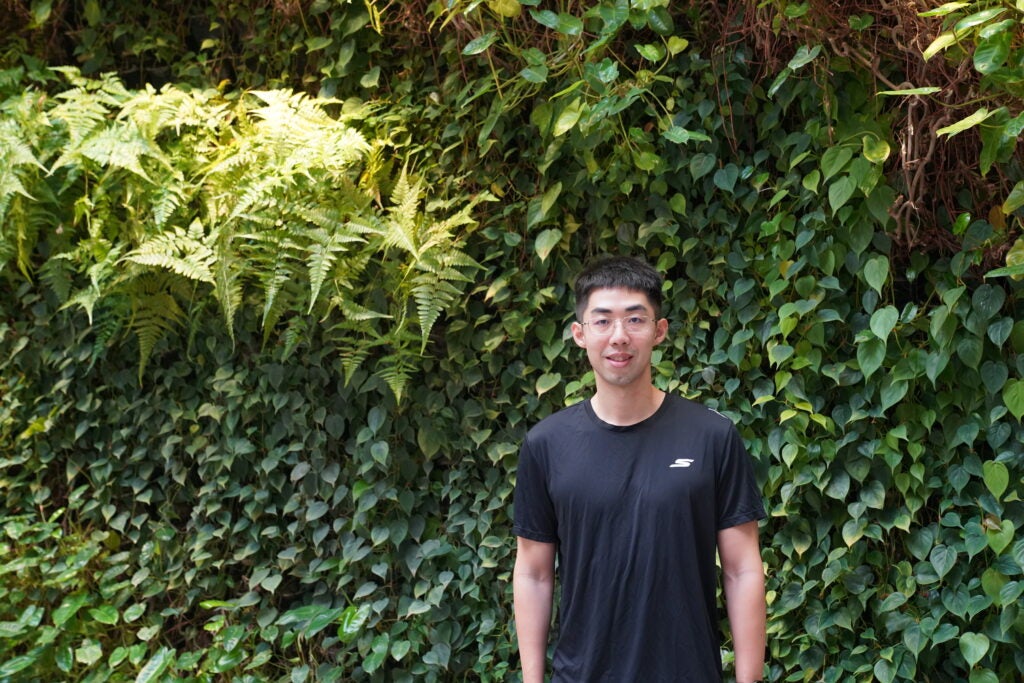
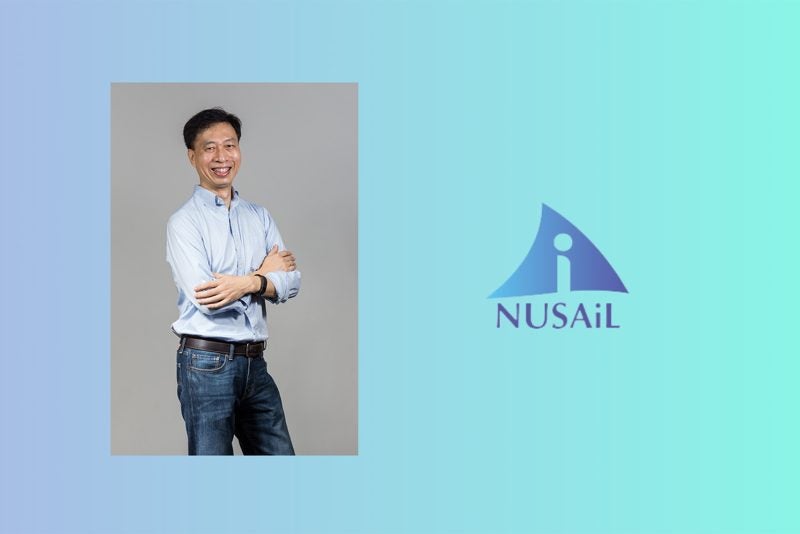
If you’ve ever used ChatGPT and felt that something sounds right, but you’re not entirely sure if it actually is, you’re already thinking about the kind of problems Prof Anji works on.
He studies machine learning, focusing on generative AI. But his work is not about making these systems more impressive. It’s about making them more reliable, getting them to follow logic and constraints, not just patterns.
Because those two things are still far apart.
The question that stayed
Anji did not begin with a clear plan to work in AI.
As an undergraduate, a professor suggested he explore machine learning. The idea that algorithms could “learn” from data sounded interesting, but also slightly strange.
“I remember being both confused and fascinated,” he says. “How can a machine extract patterns on its own?”
That question never fully went away. Over time, it became more specific – not just how machines learn, but how systems that generate text, images, or code can be made to follow rules, respect constraints, and behave in ways we can trust.
What AI actually does (and doesn’t do)
One thing Anji is careful about is how people think about AI.
It’s easy to assume that if something writes well, it must understand what it’s saying. But that isn’t really what’s happening.
“Most current systems are essentially predicting the next likely pattern based on statistics,” he says. “Not deducing the truth. They function more like improvisational actors than logical thinkers.”
That gap – between sounding right and actually being right – shows up in familiar ways. Hallucinations. Confident but incorrect answers. Responses that fall apart once the problem becomes more complex.
That’s the space his work sits in.
 What his class feels like
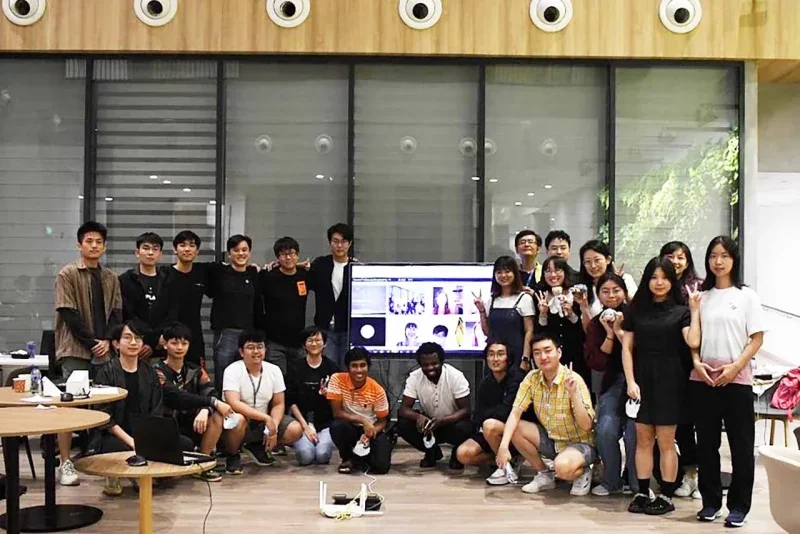
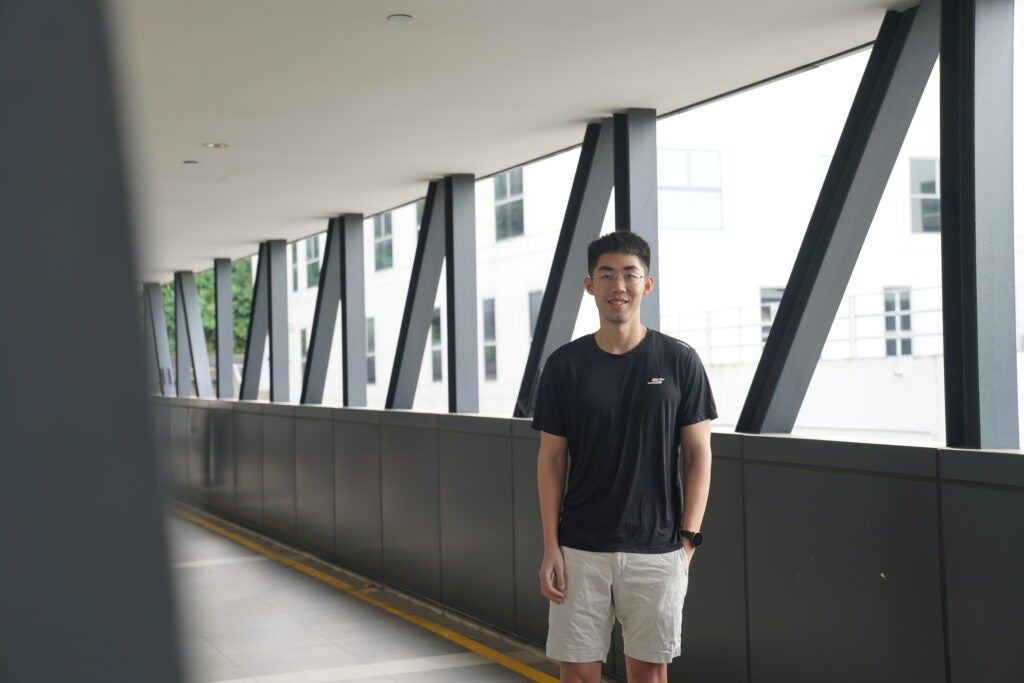
If you take CS6281 – Topics in Computer Science: Inference Algorithms in Deep Generative Models, it will not feel like a typical course chasing the latest models.
Anji tends to slow things down.
The focus is on what sits underneath. Students revisit models like VAEs and diffusion models, but from a different angle – less about how to use them, more about what problem they’re actually solving. The thread running through the course is inference. Different models may look unrelated on the surface, but many of them are working through the same underlying probabilistic questions.
“There’s usually an ‘aha’ moment,” he says, “when you realise the ‘magic’ isn’t really magic.”
It’s a small shift, but it changes how you see everything after that.
The problem he is working on
A lot of the current AI systems share the same limitation: they don’t think ahead.
Language models generate text one word at a time, choosing what seems most likely at that moment. It works surprisingly well – until it doesn’t.
“They are very short-sighted,” Anji says.
His work focuses on changing that. Instead of committing to a single next word, his approach gets models to evaluate how different possibilities might unfold – a kind of probabilistic lookahead. Think of it this way: rather than a writer who barrels through a paragraph and hopes for the best, the model considers where a sentence is heading before choosing how to start it. It can spot a potential contradiction or factual error three lines down the road and steer away from it.
At the same time, his group is tackling a structural flaw in how diffusion models handle text. Most current approaches assume that each word is generated independently – which, in language, is almost never the case. Meaning travels across sentences. Words depend on one another. His team is building a framework that captures those dependencies more accurately, producing text that’s more coherent without the heavy computational cost usually required.
Get it right, and it changes something important. Not just how fluent these systems are, but whether you can trust what they produce.
 Why NUS
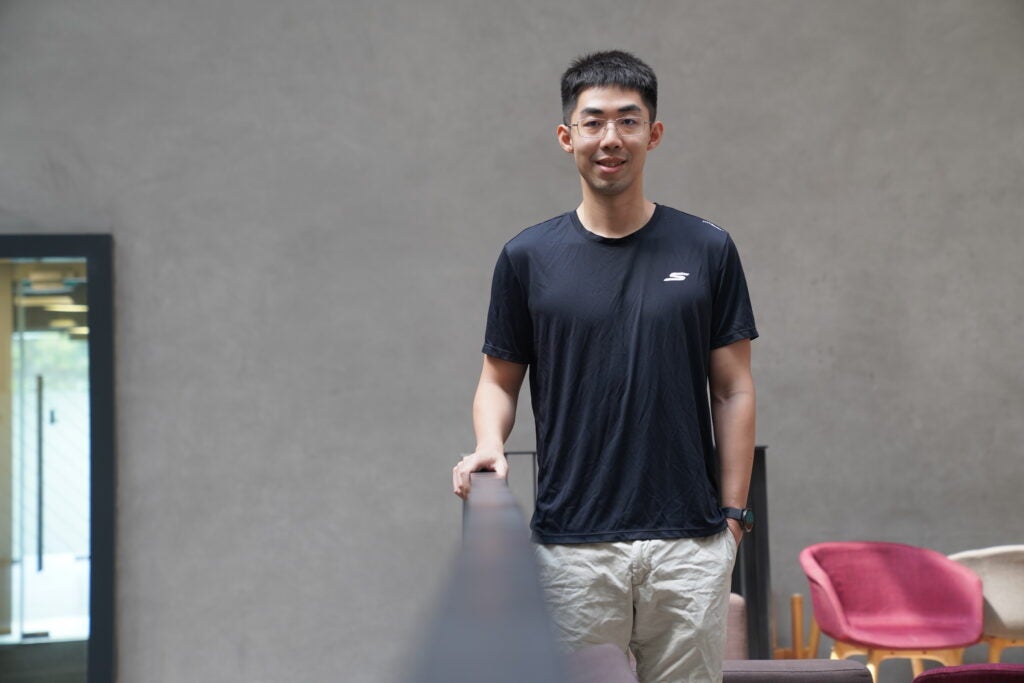
When Anji talks about why he chose NUS, his answer is simple: “Support, freedom, and talent.”
The freedom to work on problems that don’t have immediate answers. The support to follow through on them. And students who are both capable and motivated – which, he says, is the most important ingredient for building a successful lab.
His work sits between theory and application, and being surrounded by colleagues working in databases, security, and robotics makes it easier to move between ideas. “If I have a question,” he says, “the answer is often just a conversation away.”
Singapore’s strategic focus on trustworthy AI also aligns closely with the kind of problems he’s most drawn to – which makes the fit feel less like coincidence and more like the right place at the right time.
Outside of all that
Outside of research, things are simpler.
He hikes.
Since coming to Singapore, he has explored the Southern Ridges and the TreeTop Walk. It’s less about the trails themselves and more about stepping away for a while.
“It helps clear my mind,” he says.
If he weren’t working in AI, he’d probably still be coding, just somewhere quieter. Maybe closer to mountains or forests.

Where it all starts
It’s easy to assume that people in research had everything figured out early on. That’s not really the case here.
Anji’s path didn’t begin with a grand plan. It started with a question that didn’t quite make sense yet – how machines learn.
He’s still working through it. Just deeper now, and with a sharper sense of what it would actually take to trust the answer.