
Building AI That Configures Itself: A/Prof Bryan Low and Team Receive AWS Agentic AI Amazon Research Awards
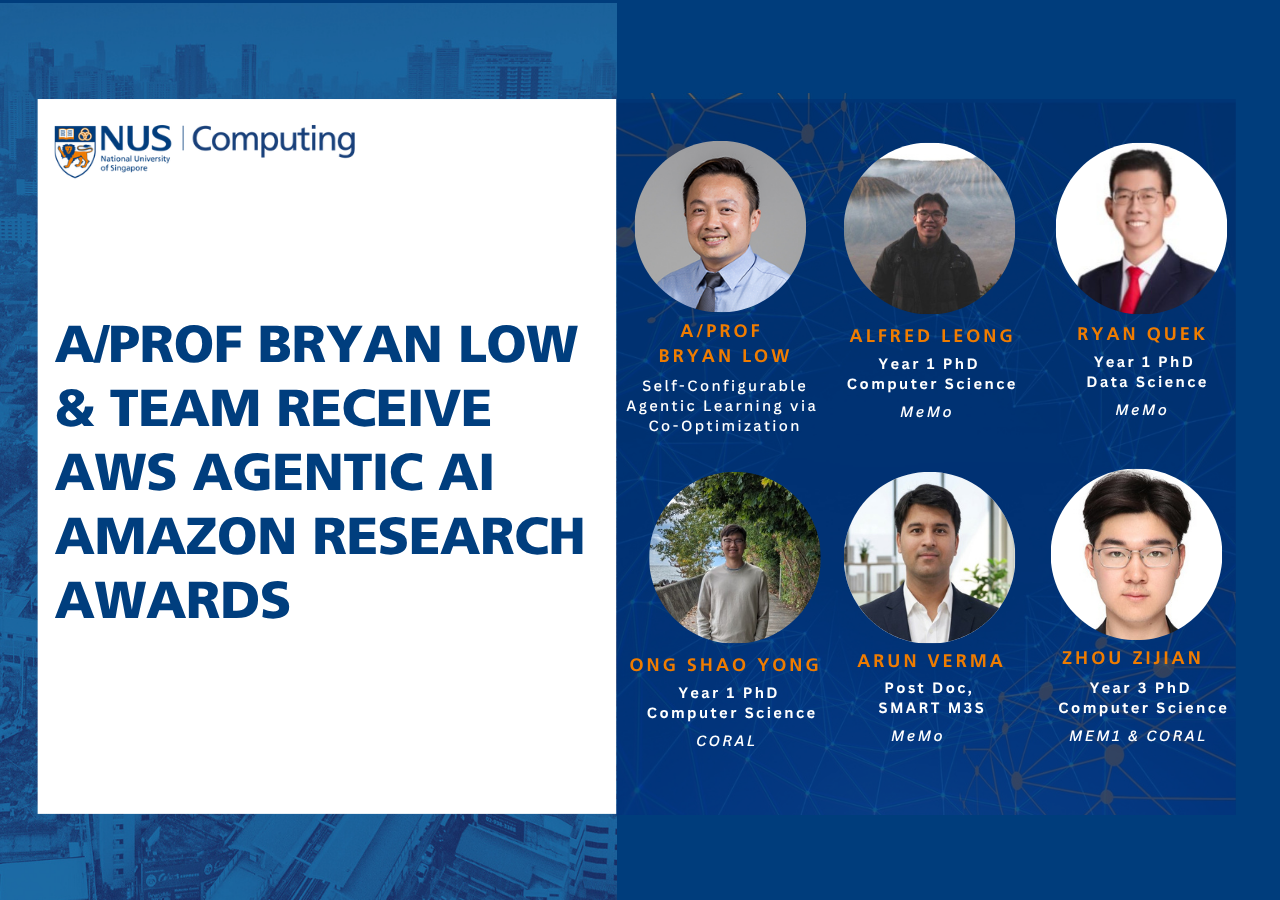
Today’s AI agents can follow instructions, write code, and answer questions. But ask one to adapt to a new workflow or learn from its own mistakes over time, and the limitations surface quickly. Most agents are static: they perform well on the tasks they were designed for, but adjusting them to new environments still requires significant human engineering.
Associate Professor Bryan Low’s project on “Self-Configurable Agentic Learning via Co-Optimization” has been selected for the AWS Agentic AI Amazon Research Awards (ARA). His research explores how to unify the strengths of Context Engineering and Reinforcement Learning into a single coherent approach. The research proposes a continuous co-optimisation loop that jointly updates the agent’s architecture and its underlying model parameters together, enabling agents to learn from their environment without the need for manually designed reward signals.
The idea is that as each agent iterates, its capabilities compound – creating a self-improving cycle that reduces the engineering effort needed to deploy high-performance agents in real-world settings.
The project builds on a series of recent results from Prof Low’s group of PhD researchers. MEM1, a reinforcement learning method for long-horizon agents developed by Zhou Zijian in collaboration with MIT's SMART programme, won the Best Paper Award at the NeurIPS 2025 Workshop on Multi-Turn Interactions and was subsequently accepted to ICLR 2026.
A follow-up framework, MeMo (Memory as a Model), developed by Ryan Quek, Alfred Leong and Arun Verma, introduced a modular approach to encode new knowledge required for multi-hop and long-context understanding tasks without modifying the main agent’s parameters. The work was covered by VentureBeat and drew attention from the wider AI community.
A third project, CORAL, developed with Shao Yong Ong and Zhou Zijian, tackles multi-agent evolution, demonstrating that populations of autonomous agents can collaborate and outperform tightly structured systems on complex optimisation tasks.
Together, these three threads – knowledge compression, knowledge storage, and knowledge utilisation – form the foundation for the self-configurable agents that the AWS-funded project aims to realise. Among the applications the team is most excited about: enterprise-scale deployment, where agents could adapt to custom workflows with minimal engineering, and continuously learning coding, search, and research agents.
Congratulations to Prof Low and team on this well-deserved recognition!