
NUS Computing Researchers Win Outstanding Paper Award at SPAA 2026 and Best Student Paper Award at PODC 2026
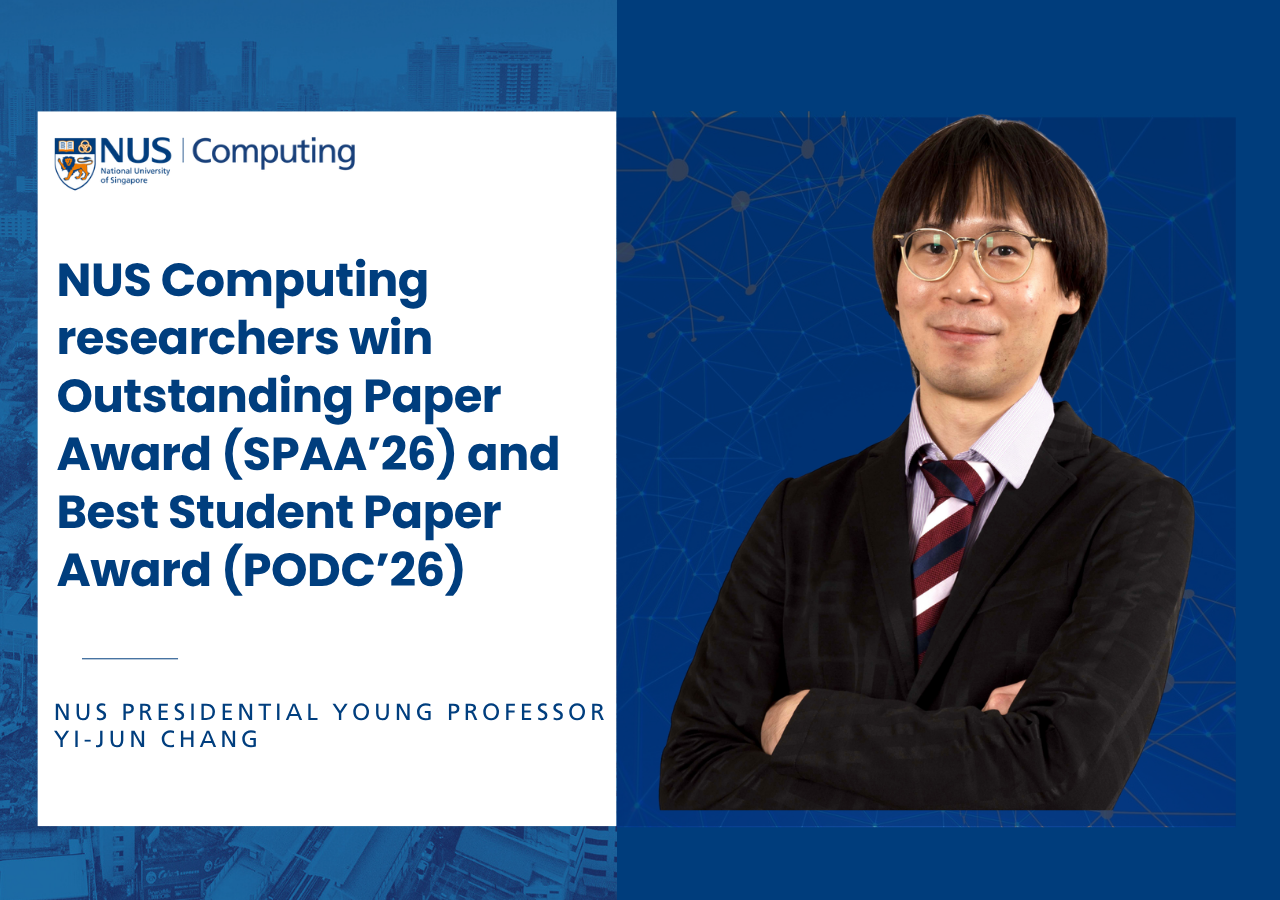
NUS Presidential Young Professor Yi-Jun Chang and his collaborators have won two awards at leading conferences in distributed computing this year: the Outstanding Paper Award at the 2026 ACM Symposium in Parallelism in Algorithms and Architectures (SPAA), given to the top three papers at the conference, and the Best Student Paper Award at the 2026 ACM Symposium on Principles of Distributed Computing (PODC), which recognises the best paper among those with substantial contributions from student authors.
The Outstanding Paper Award at SPAA 2026 recognises “Energy-Efficient Aggregation and Minimum-Degree Spanning Trees in Radio Networks”, joint work by Prof Chang and Guan Yang Ze, who started the project as an undergraduate doing his Final Year Project under Prof Chang. Their starting point was a problem anyone who has managed a network of battery-powered sensors will recognise: devices burn through power just by listening, so pooling readings from across a network can drain them fast.
Prof Chang and Guan built a protocol where devices sleep for most of the process and wake only when needed, still ending up with a combined result, such as a total count or an aggregated reading, from across the entire network. The energy cost comes close to the lowest possible for any network shape, while maintaining efficient running time. The techniques may inform how future sensor networks for environmental monitoring or smart infrastructure are designed to run longer on a single charge.
“Efficient Counting and Simulation in Content-Oblivious Rings” won the Best Student Paper Award at ACM PODC 2026, joint work by Prof Chang, his PhD student Zhou Haoran, Jérémie Chalopin (Aix Marseille Université), and Giuseppe A. Di Luna (Sapienza Università di Roma). The paper studies the content-oblivious model, where devices communicate only through pulses that signal nothing more than that a message was sent, with no data and no sender identity attached. The model represents an extreme fault scenario: an adversary can corrupt the content of every message in the network, though genuine messages cannot be deleted and fake ones cannot be created.
The authors found that this stripped-down setting costs far less than expected. Ordinary digital communication can be reconstructed from these content-free pulses at only constant overhead, well below earlier results where the cost grew with the size of the network. From there, they developed faster algorithms for basic tasks including counting devices and combining information distributed among them, even when the contents of every message may be completely corrupted.
“Both papers improve our understanding of the capabilities of distributed computation under severe communication constraints, showing that surprisingly efficient algorithms are still possible. I am also happy to see the contributions of Yang Ze and Haoran recognised by the research community through these awards,” Prof Chang said.