
Shrinking AI to Fit the Real World: Assistant Ambuj Varshney Receives 2026 Google Research Award
Every major AI chatbot today runs on powerful cloud servers, often thousands of kilometres from the person using it. For a casual conversation, that works fine. But for a wearable monitoring your heart rate, a robot navigating a warehouse, or a sensor detecting hand gestures – applications where decisions need to happen instantly, privately, and with minimal power – the cloud is not a viable option.
This is the challenge at the heart of Physical AI: embedding intelligence directly into the small, resource-constrained devices that populate our physical world. Most of these devices have a fraction of the computing power needed to run today's language models, and sending data back to the cloud introduces latency, privacy risks, and bandwidth costs that defeat the purpose.
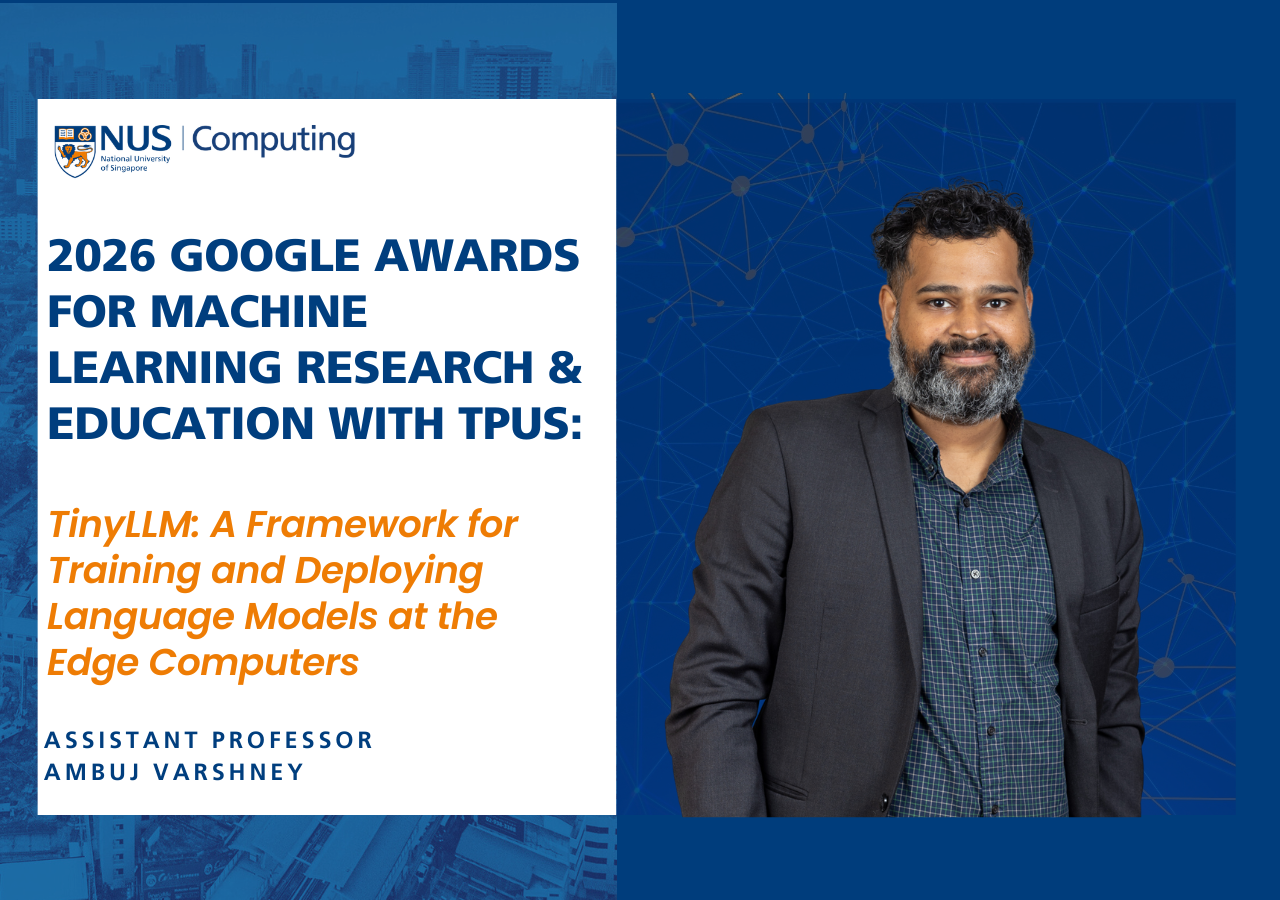
Assistant Professor Ambuj Varshney and his WEISER research group are building a way around this. His project, “TinyLLM: A Framework for Training and Deploying Language Models at the Edge Computers”, has been selected for the 2026 Google Awards for Machine Learning Research and Education with TPUs. The team is designing custom language models – ranging from tens to hundreds of millions of parameters – trained from scratch on curated datasets and optimised to run directly on edge devices.
The group has already developed early prototypes based on optimised GPT-2 architectures, demonstrating that these TinyLLMs can interpret sensor data for hand gesture detection, robot localisation, and vital sign monitoring. The next phase pushes into two domains: wearable health technology, where a local language model can process continuous sensor data without ever leaving the device, preserving patient privacy and enabling immediate feedback; and wireless communications, where TinyLLMs could optimise lower-level network tasks like signal modulation, demodulation, and error recovery.
The project also has a strong educational dimension. Prof Varshney is introducing a new hands-on component in the graduate course CS5272 (Embedded Software Design), where students will learn to design, train, and deploy their own TinyLLMs from scratch for embedded sensing applications.
Working alongside Prof Varshney are PhD students Pramuka Sooriyapatabandige, Rajashekar Reddy Chinthalapani, Kandala Savitha Viswanadh, and Dhairya Shah. The TinyLLM framework is already publicly available as an open-source project. The encourage broader adoption in teaching and research, the team will continue releasing all future models and advances under permissive licenses.
For more information, visit the project page at tinyllm.org or Prof Varshney's homepage at ambuj.se.