
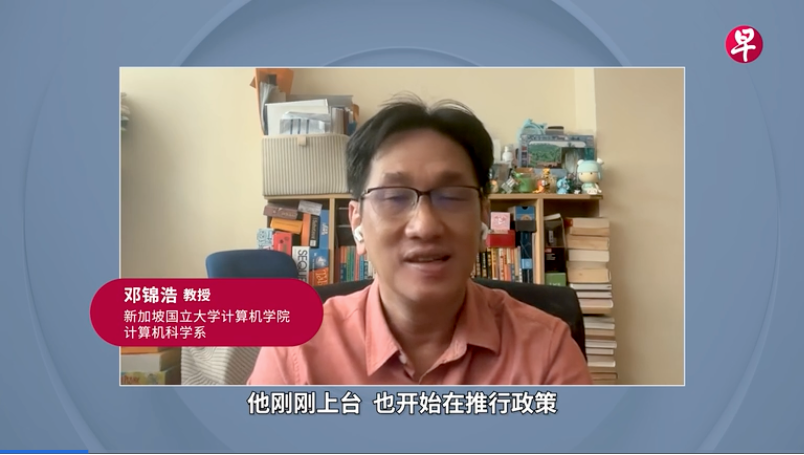
Professor Anthony Tung from the Department of Computer Science at NUS Computing was featured in a Lianhe Zaobao report examining the growing spread of AI-generated fake videos and their potential impact on public trust and political discourse.
The report highlighted how advances in generative AI have lowered the cost and effort required to produce highly convincing misinformation, including fabricated videos that combine synthetic scripts, voices, and visuals. Such content, often designed to provoke emotional reactions, can spread rapidly on social media platforms and distort public understanding.
Professor Tung noted that heightened attention around recent political developments naturally drives engagement with such content, particularly among audiences with anti-establishment leanings. He added that Singapore’s high educational attainment means most citizens are able to exercise discernment when encountering sensational or implausible claims.
Beyond monetising online traffic, Professor cautioned that some videos may conceal deceptive schemes, using fabricated news narratives to promote products or services in ways that are difficult to guard against. He observed that regulating such content remains challenging, and suggested that one of the most effective responses may be to “counter AI with AI” — drawing parallels to how spam emails are filtered rather than prevented.
The report also noted that Singapore’s relatively high media literacy provides some resilience, but warned that misinformation may also be used to mask scams or malicious links. Overall, the report emphasised the importance of public awareness, media literacy, and the development of tools to help detect AI-generated misinformation, as synthetic media becomes increasingly sophisticated.