Filtered by: Department of Computer Science

NUS Tags Filter
13 February 2026
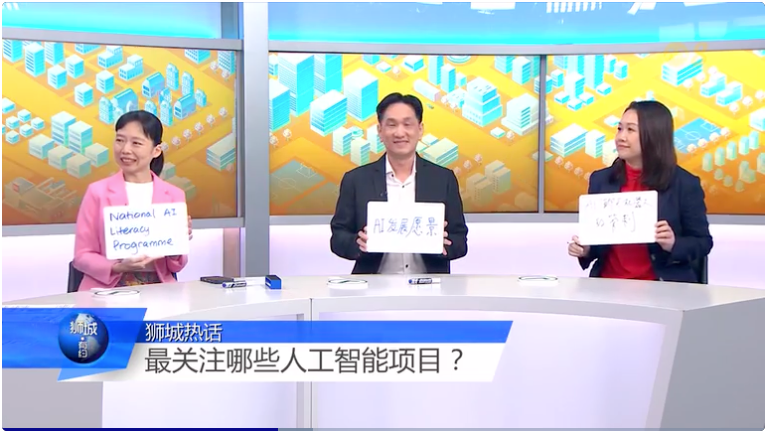
Lianhe Zaobao reported on the Government’s AI initiatives announced in Budget 2026, including the establishment of a National AI Council chaired by the Prime Minister and the prioritisation of four sectors for AI transformation.

Lianhe Zaobao reported on the Government’s AI initiatives announced in Budget 2026, including the establishment of a National AI Council chaired by the Prime Minister and the prioritisation of four sectors for AI transformation.

Professor Anthony Tung from the Department of Computer Science noted that AI has moved beyond the remit of individual agencies and now requires coordinated, high-level alignment across sectors.

"AI has already gone beyond individual institutions. Policy planning and resource allocation need to be coordinated at a high level, covering areas such as economic structure, employment patterns, social governance, public services, and national security."

The article highlighted four priority areas – advanced manufacturing, connectivity, finance, and healthcare – for early AI transformation. Prof Tung explained why sector-specific systems are essential:

"Advanced manufacturing is an important pillar of Singapore’s economy. What is needed are precise and stable systems, not general-purpose AI models."

Lianhe Zaobao (13 Feb 2026): “专家:自上而下统筹AI部署 助我国新型竞争获实际效益”

Media Mentions
13 February 2026
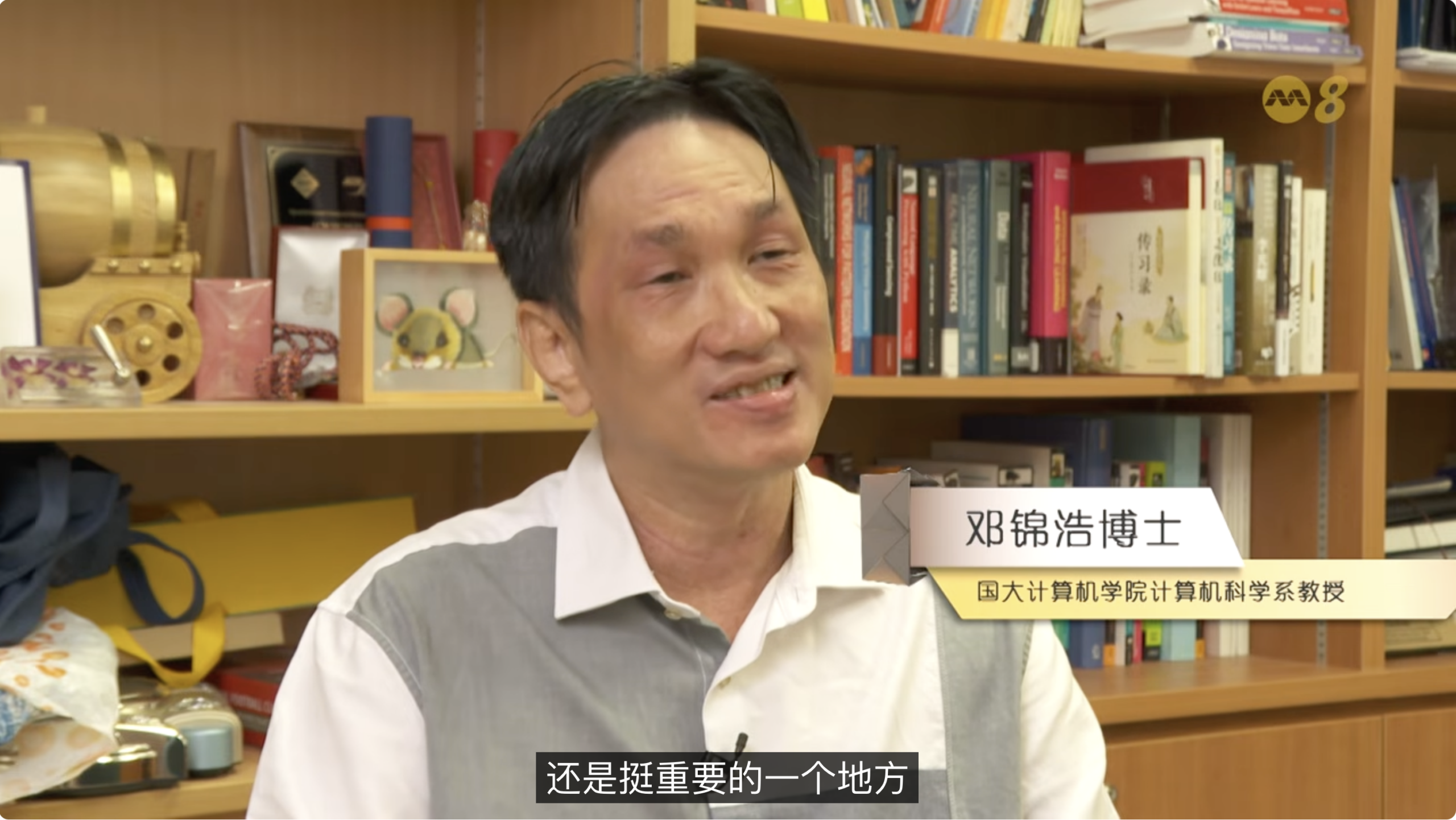
Professor Anthony Tung was featured in a Channel 8 News explainer segment examining advanced persistent threats (APT) and the risks posed to telecommunications infrastructure.

Professor Anthony Tung was featured in a Channel 8 News explainer segment on advanced persistent threats (APT), following reports of a hacking group targeting Singapore’s telecommunications systems.

Professor Tung explained how APT actors differ from conventional cyberattacks:

"If conventional cyberattacks are like bandits who break in and leave after taking what they can, an APT is more like an undercover agent. Its goal isn't immediate theft, but intelligence-gathering – quietly collecting sensitive data and remaining embedded for as long as possible, gaining progressively deeper access within the system."

He noted that telecommunications networks function as a central connective infrastructure, with banking systems, transport networks, and AI-enabled services all dependent on communications connectivity.

"Telecommunications networks are a central system – information flows through them. If they are compromised, it affects efficiency and potentially critical services."

Prof Tung also highlighted Singapore’s role as a regional aviation and maritime hub, underscoring why such infrastructure may be attractive targets. He emphasised the importance of maintaining resilient systems that are monitorable, isolatable, and recoverable – ensuring incidents can be contained, restored, and strengthened against future threats.
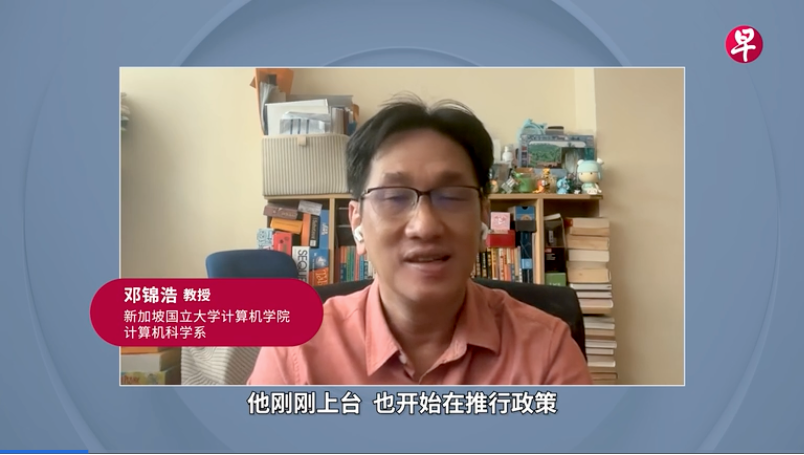
Channel 8 News (12 Feb 2026): "焦点 |黑客藏身电信系统无声息偷走数据”

Media Mentions
12 February 2026

Associate Professor Kan Min-Yen from the Department of Computer Science at NUS Computing was quoted in a Science Magazine, feature examining a new open-source AI system designed to answer complex scientific questions with a high degree of accuracy.

Associate Professor Kan commented on both the promise and risks of using such tools in scientific work, cautioning that researchers must carefully judge how much to trust AI-generated answers, particularly when they are used as substitutes for primary sources.

"If you're using these tools to [substitute] for the primary sources, that can be dangerous because there could be nuances that are lost.," he said. While such tools may be more acceptable in fast-moving fields like AI — where they can help researchers keep pace with rapidly expanding literature — Associate Professor Kan noted that greater caution is required in domains such as psychiatry, where patients' health is at stake.

The article discussed how the open-source system was evaluated against both human experts and leading proprietary AI models, and how it performed strongly on tasks requiring cross-paper reasoning and literature synthesis. Associate Prof Kan noted that while these systems show promise in supporting scientific research, they should be viewed as tools that augment — rather than replace — human expertise and critical judgment.

Science Magazine, 4 February 2026

Media Mentions
6 February 2026

Professor Anthony Tung from the Department of Computer Science at NUS Computing was featured in a Lianhe Zaobao report examining the growing spread of AI-generated fake videos and their potential impact on public trust and political discourse.

The report highlighted how advances in generative AI have lowered the cost and effort required to produce highly convincing misinformation, including fabricated videos that combine synthetic scripts, voices, and visuals. Such content, often designed to provoke emotional reactions, can spread rapidly on social media platforms and distort public understanding.

Professor Tung noted that heightened attention around recent political developments naturally drives engagement with such content, particularly among audiences with anti-establishment leanings. He added that Singapore’s high educational attainment means most citizens are able to exercise discernment when encountering sensational or implausible claims.

Beyond monetising online traffic, Professor cautioned that some videos may conceal deceptive schemes, using fabricated news narratives to promote products or services in ways that are difficult to guard against. He observed that regulating such content remains challenging, and suggested that one of the most effective responses may be to “counter AI with AI” — drawing parallels to how spam emails are filtered rather than prevented.

The report also noted that Singapore’s relatively high media literacy provides some resilience, but warned that misinformation may also be used to mask scams or malicious links. Overall, the report emphasised the importance of public awareness, media literacy, and the development of tools to help detect AI-generated misinformation, as synthetic media becomes increasingly sophisticated.
Lianhe Zaobao (5 Feb 2026): "瞎编新加坡政坛“变天” AI量产假视频损信任"

Media Mentions
5 February 2026

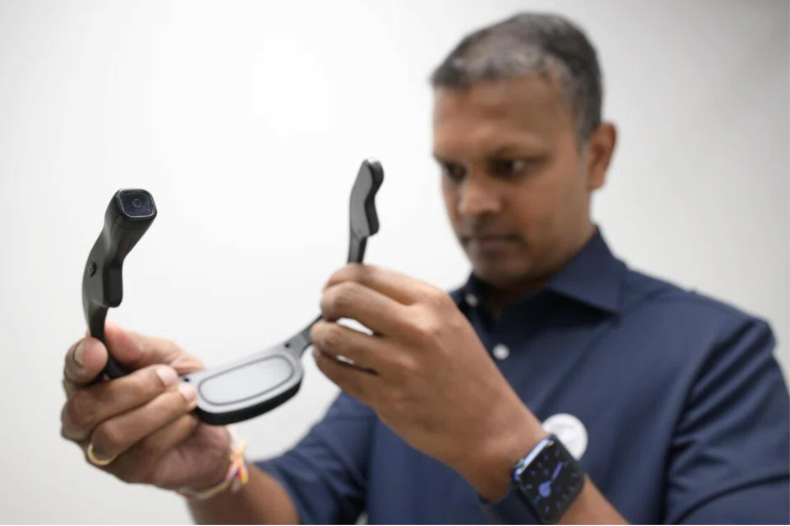
Associate Professor Suranga Nanayakkara from NUS Computing was featured in The Straits Times for his work on an AI-powered wearable headset developed by an NUS research team led by him, aimed at supporting independent navigation and daily activities for persons who are visually impaired.

The article highlighted the experience of Madam Teresa Ng, who shared how the headset could help her commute, shop, and navigate public spaces with greater confidence and independence, reducing the need to rely on assistance from others.

"It could tell me the price, size, colour, and even describe the kin of occasion each outfit is suitable for – very useful. Sometimes when I go grocery shopping, I have to ask the promoters for help and later feel obligated to buy from them. But with AiSee, I won't have to trouble anyone."

The wearable headset, AiSee, uses AI to interpret the surrounding environment and provide real-time audio guidance, helping users navigate public transport, avoid obstacles, and move safely through complex everyday settings. The system is designed to improve mobility and autonomy while preserving users' dignity.

Associate Professor Nanayakkara explained that the project was developed with a strong human-centred focus, emphasising usability, real-world impact and close collaboration with visually impaired users to ensure the technology addresses practical needs rather than laboratory assumptions.

Funded by the Enabling Lives Initiative (ELI) Grant in November 2025, the team is enhancing the AiSee software with onboard object detection, navigation, expert guidance, scene sonification, and task-based functionalities, including pilot testing at the Singapore Botanic Gardens to guide users on curated tours. The ELI Grant, funded by Tote Board and managed by SG Enable, is a strategic fund that catalyses and supports innovations to improve the independence and inclusion of persons with disabilities.

This coverage highlighted the potential of assistive AI to enhance inclusion and accessibility, while recognising the importance of careful design, testing and deployment in complex real-world environments.
The Straits Times, 26 Jan 2026

Media Mentions
4 February 2026
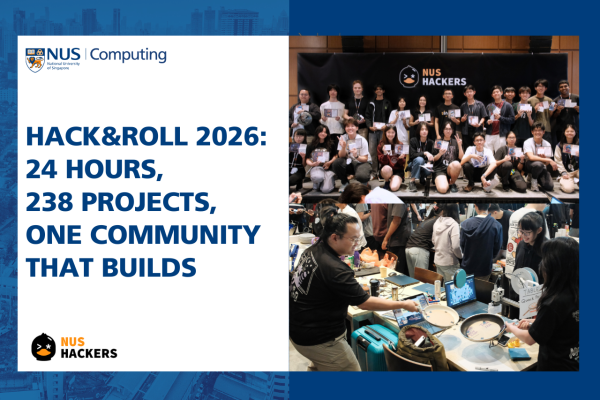
When 800 participants gather with laptops, soldering irons and a single question: what can we build? The answer is never just one thing. Hack&Roll 2026, the flagship annual hackathon organised by NUS Hackers, returned this January for its 15th edition, bringing together builders from across Singapore’s tech community for 24 hours of open-ended experimentation, creativity and problem-solving.
Hack&Roll 2026 Newsbtye SOC
2 February 2026
NUS School of Computing took part in its first-ever reciprocal computing exchange programme with the School of Informatics at Nagoya University. From 8 to 16 December, 14 NUS Computing students joined their counterparts in Nagoya for an academic and cultural immersion focused on artificial intelligence, robotics, and system design.
Newsbtye SOC NAGOYA
30 January 2026
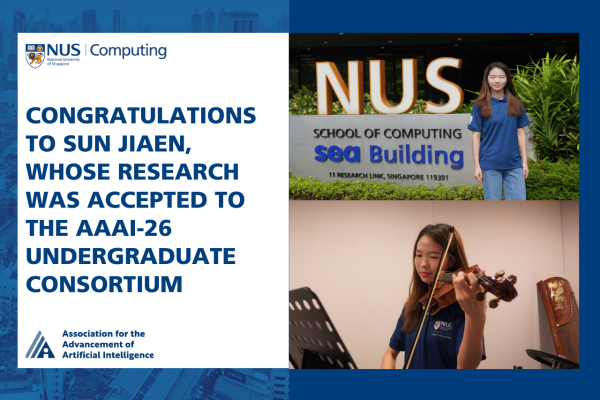
Sun Jiaen thinks about artificial intelligence in practical terms: Who does it work for, and who does it leave out? A Year 3 Computer Science undergraduate at the National University of Singapore (NUS), Jiaen has had her Research Proposal accepted to the AAAI-26 Undergraduate Consortium, with full funding support from the conference
jiaen nb
28 January 2026
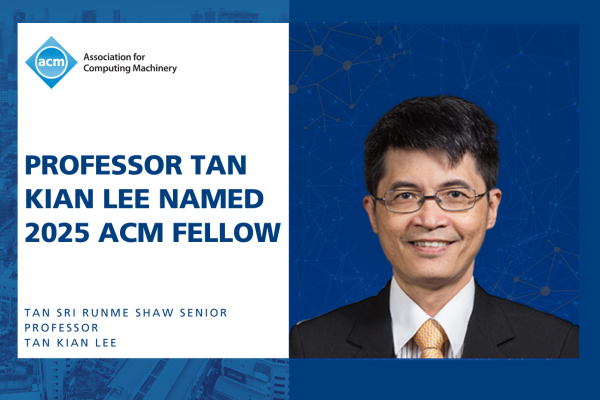
NUS Computing congratulates Professor Tan Kian Lee, Tan Sri Runme Shaw Senior Professor, on being named a 2025 ACM Fellow, by the Association for Computing Machinery. 
Tan KianLee ACM Newsbtye SOC
26 January 2026
When six students from the NUS School of Computing rolled crates of servers into a vast convention hall in St. Louis, they were doing far more than preparing for a competition. They were stepping into the world of High-Performance Computing (HPC) – where building, operating, and optimising powerful computing systems under pressure is part of the challenge.
Newsbtye SOC
23 January 2026
When Darryl looks back on his first year at the National University of Singapore (NUS), one word comes to mind: transformative.  When Darryl looks back on his first year at the National University of Singapore (NUS), one word comes to mind: transformative. Now a Year 2 Computer Science student at the NUS School of Computing (SoC), Darryl is the recipient of the prestigious Toh Chin Chye Prize, an award that recognises students who exemplify excellence beyond the classroom — through leadership, service, and meaningful contributions to society.
Darryl NB
21 January 2026
Congratulations to Professor Mohan Kankanhalli and his collaborators on receiving the 2024 Best Paper Award from ACM Transactions on Computing for Healthcare (ACM Health). 
Newsbtye SOC
19 January 2026
Yong Zhong Rong and Euan Tan from the NUS School of Computing (SoC), along with their teammates, were recognised for their achievements at the Huawei Tech4City Competition Finals 2025.
Huawei Tech4City Competition Finals 2025 Newsbtye SOC (27)
16 January 2026
We’re proud to share that NUS Computing undergraduates Tran Phuoc My and Zhang Hao Dong have received the Reviewer’s Choice Award at the Higher Education Conference in Singapore (HECS) 2025, recognising outstanding work in teaching and learning innovation.
HECS2025 NB
13 January 2026

Associate Professor Harold Soh from NUS Computing provided expert perspectives in CNA's report that examined whether automation and robotics can help address manpower shortages in Singapore's food centres.

Commenting on trials such as a self-cleaning table prototype at NTU, Associate Professor Soh described food courts as a particularly challenging environment for robots.

"Effective cleaning in such a space requires both physical intelligence (dexterous hands, balance) and social intellligence (knowing when to move, stop, and how not to annoy or injure customers), he said. "Robots today struggle with both."

Associate Professor Soh added that while robots can perform impressive feats in controlled settings, they continue to struggle with everyday tasks such as handling irregular food waste, managing spills, and operating safely in dynamic, crowded public environments. Integrating perception, prediction, planning and human-aware interaction remains an unsolved challenge outside the labs.

The report highlighted that while automation may assist with routine tasks, human cleaners and supervision remains essential, emphasising the technology alone is not a simple solution to labour constraints in food centres.

CNA Online, 12 Jan 2026

Media Mentions
5 January 2026
NUS School of Computing PhD student Puru Sharma has won the Sequencing & Decoding Challenge at the MoleculArXiv Workshop on DNA Data Storage, held in Corsica, France. 
Puru Sharma NB
5 January 2026

On 8world (Channel 8 News), Professor Anthony Tung from NUS Computing provided expert insights in an SG60 segment that examined how technology has transformed Singapore's society over the past six decades, from early office automation to the rapid rise of artificial intelligence (AI).

Representing academia, Professor Tung commented on the future direction of AI, emphasising the potential of AI systems to unlock collective potential by connecting people across disciplines, enabling lifelong learning beyond a single field of expertise.

The segment also noted that while AI adoption is accelerating across industries, it is not a panacea, highlighting the need for continued exploration and thoughtful application to meaningfully improve lives.

8world (Channel 8 News), 23 Dec 2025

Media Mentions
29 December 2025
During NeurIPS week on 4 December, NUS Computing hosted its first network session and reception in San Diego, bringing together researchers, industry leaders, and partners for an evening of exchange and connection.
1
19 December 2025
When five members of the NUS FinTech Society touched down in Rome this October, they carried not just laptops, but the quiet ambition to make their mark on one of Europe’s most respected blockchain hackathons: ETHRome 25.
ETHRome 25 Newsbtye SOC
18 December 2025
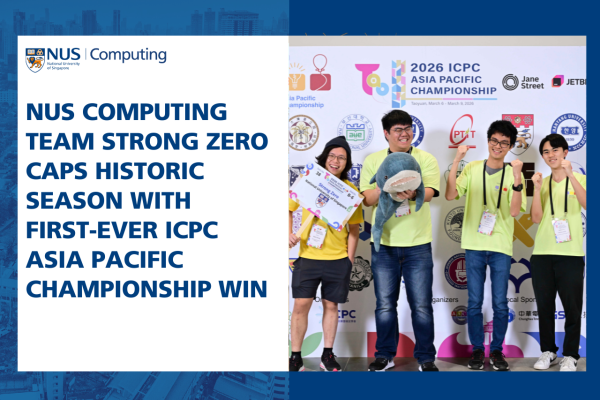
NUS School of Computing has capped an exceptional competitive programming season with another landmark achievement. Team Strong Zero has secured NUS' first-ever ICPC regional victory in Japan, completing a rare double just weeks after its historic win in Taiwan. 
Newsbtye SOC