
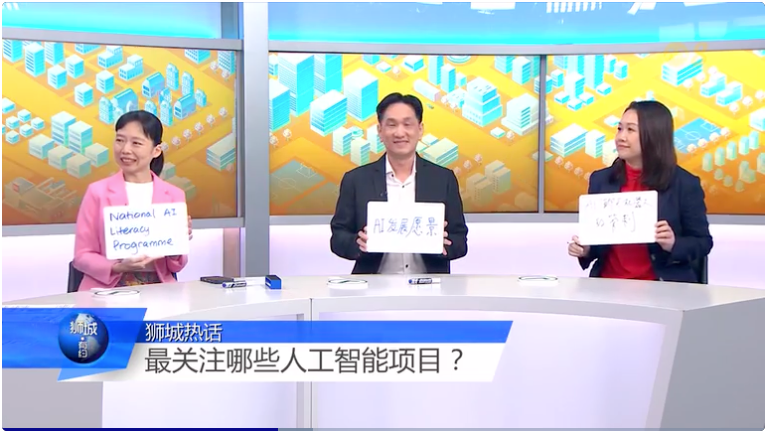
Channel 8's current affairs programme, Hello Singapore, featured Professor Anthony Tung from the Department of Computer Science in a panel discussion on how Singapore can hold its ground in the age of AI – alongside Minister of State for Digital Development and Information (MDDI) and Education, Jasmin Lau, and a media professional.
On the most essential AI skill, Prof Tung kept it simple: Learn to ask better questions. Where most of us are trained to find answers, he argued that the real shift is learning to prompt, to engage AI in a genuine dialogue.
"You can ask AI to introduce 10 useful prompts for your personal use. AI can then customise a learning plan for you – learn to have a dialogue with it, as if it were a real teacher."
Asked which AI initiative Singaporeans should pay closest attention to, Prof Tung pointed to Singapore's AI Mission. His reasoning was that progress with AI is not about speed, but about direction.
"Learning or using AI isn't about being slow – it's about not standing still. Set a goal, and keep moving forward."
On raising kids in the era of AI, Prof Tung drew on classical Chinese philosophy to make his point. He invoked the Zhuangzi principle of 物物而不物于物 – that one should master things, not be mastered by them. In his view, the humanities are not a retreat from technology; they are its counterweight. "AI is a tool. We set goals, let it work for us, and don't let it replace us." That is why, he added, he places emphasis on culture, philosophy, and human thinking in his daughter's upbringing – qualities that remain stubbornly beyond what any algorithm can replicate.
For students anxious about graduating into an AI-transformed job market, his counsel was steadying: cultivate curiosity, not anxiety.
"You set a goal, enjoy the process, and have an experience of self-driven growth. When a new challenge comes, it's a chance to learn something new."

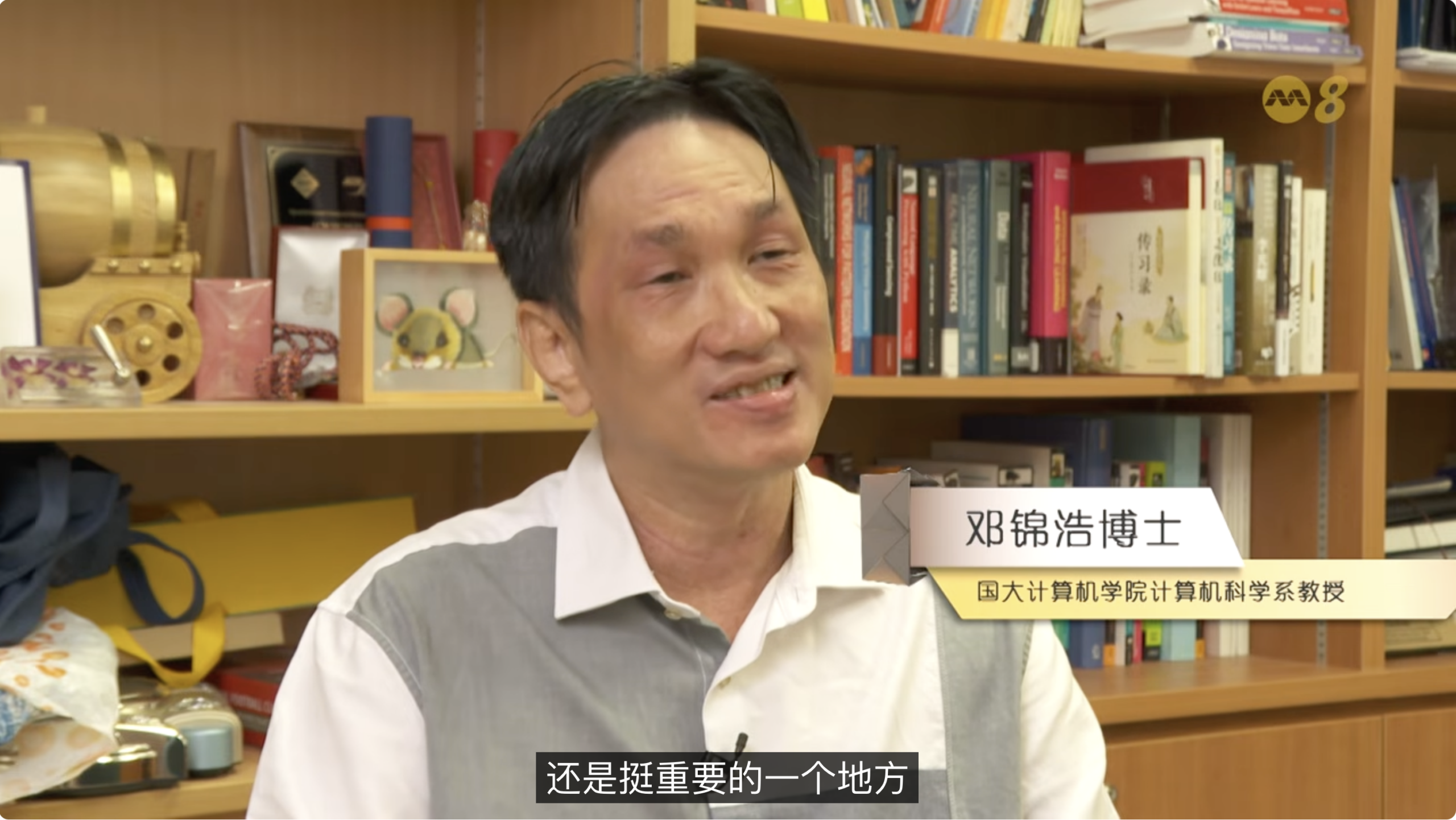
Professor Anthony Tung was featured in a Channel 8 News explainer segment on advanced persistent threats (APT), following reports of a hacking group targeting Singapore’s telecommunications systems.
Professor Tung explained how APT actors differ from conventional cyberattacks:
"If conventional cyberattacks are like bandits who break in and leave after taking what they can, an APT is more like an undercover agent. Its goal isn't immediate theft, but intelligence-gathering – quietly collecting sensitive data and remaining embedded for as long as possible, gaining progressively deeper access within the system."
He noted that telecommunications networks function as a central connective infrastructure, with banking systems, transport networks, and AI-enabled services all dependent on communications connectivity.
"Telecommunications networks are a central system – information flows through them. If they are compromised, it affects efficiency and potentially critical services."
Prof Tung also highlighted Singapore’s role as a regional aviation and maritime hub, underscoring why such infrastructure may be attractive targets. He emphasised the importance of maintaining resilient systems that are monitorable, isolatable, and recoverable – ensuring incidents can be contained, restored, and strengthened against future threats.
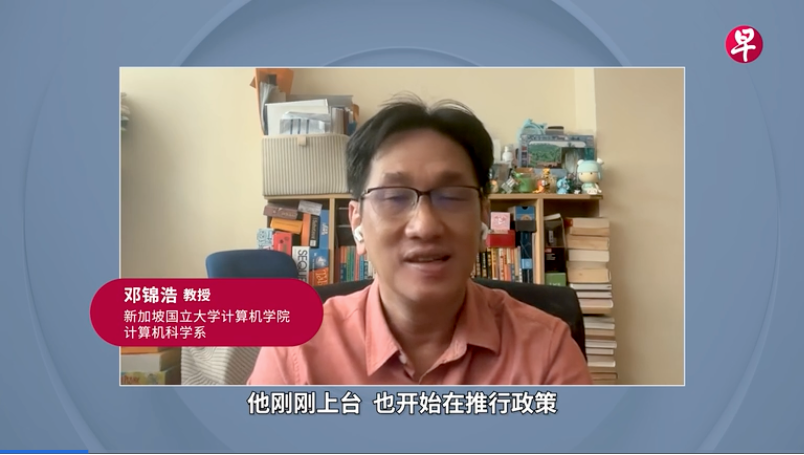
Professor Anthony Tung from the Department of Computer Science at NUS Computing was featured in a Lianhe Zaobao report examining the growing spread of AI-generated fake videos and their potential impact on public trust and political discourse.
The report highlighted how advances in generative AI have lowered the cost and effort required to produce highly convincing misinformation, including fabricated videos that combine synthetic scripts, voices, and visuals. Such content, often designed to provoke emotional reactions, can spread rapidly on social media platforms and distort public understanding.
Professor Tung noted that heightened attention around recent political developments naturally drives engagement with such content, particularly among audiences with anti-establishment leanings. He added that Singapore’s high educational attainment means most citizens are able to exercise discernment when encountering sensational or implausible claims.
Beyond monetising online traffic, Professor cautioned that some videos may conceal deceptive schemes, using fabricated news narratives to promote products or services in ways that are difficult to guard against. He observed that regulating such content remains challenging, and suggested that one of the most effective responses may be to “counter AI with AI” — drawing parallels to how spam emails are filtered rather than prevented.
The report also noted that Singapore’s relatively high media literacy provides some resilience, but warned that misinformation may also be used to mask scams or malicious links. Overall, the report emphasised the importance of public awareness, media literacy, and the development of tools to help detect AI-generated misinformation, as synthetic media becomes increasingly sophisticated.
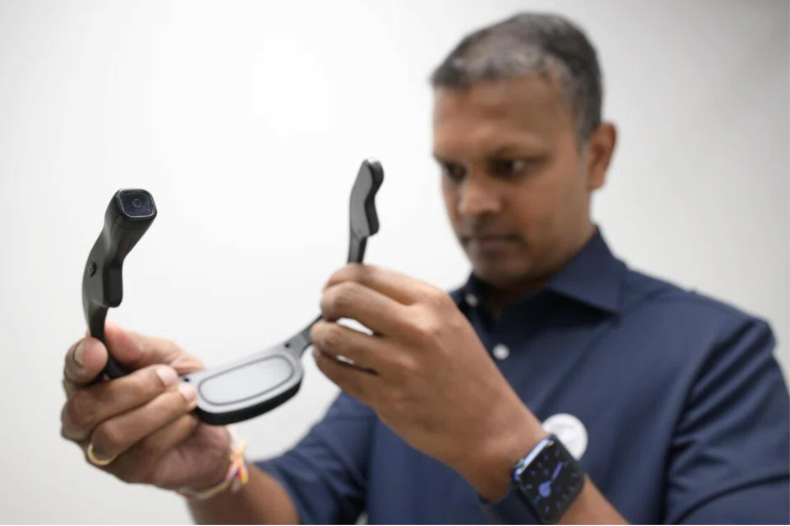
Associate Professor Suranga Nanayakkara from NUS Computing was featured in The Straits Times for his work on an AI-powered wearable headset developed by an NUS research team led by him, aimed at supporting independent navigation and daily activities for persons who are visually impaired.
The article highlighted the experience of Madam Teresa Ng, who shared how the headset could help her commute, shop, and navigate public spaces with greater confidence and independence, reducing the need to rely on assistance from others.
"It could tell me the price, size, colour, and even describe the kin of occasion each outfit is suitable for – very useful. Sometimes when I go grocery shopping, I have to ask the promoters for help and later feel obligated to buy from them. But with AiSee, I won't have to trouble anyone."
The wearable headset, AiSee, uses AI to interpret the surrounding environment and provide real-time audio guidance, helping users navigate public transport, avoid obstacles, and move safely through complex everyday settings. The system is designed to improve mobility and autonomy while preserving users' dignity.
Associate Professor Nanayakkara explained that the project was developed with a strong human-centred focus, emphasising usability, real-world impact and close collaboration with visually impaired users to ensure the technology addresses practical needs rather than laboratory assumptions.
Funded by the Enabling Lives Initiative (ELI) Grant in November 2025, the team is enhancing the AiSee software with onboard object detection, navigation, expert guidance, scene sonification, and task-based functionalities, including pilot testing at the Singapore Botanic Gardens to guide users on curated tours. The ELI Grant, funded by Tote Board and managed by SG Enable, is a strategic fund that catalyses and supports innovations to improve the independence and inclusion of persons with disabilities.
This coverage highlighted the potential of assistive AI to enhance inclusion and accessibility, while recognising the importance of careful design, testing and deployment in complex real-world environments.