Filtered by: School of Computing

NUS Tags Filter
27 March 2026
There’s a particular kind of restlessness that drives someone to build things when no one is asking them to. For Andre Liu, a Year 1 Computer Science student with a minor in Mathematics at NUS School of Computing (SoC), that itch showed up early – in middle school, in hackathon halls, in the quiet corners of National Service (NS).
SoC NewsByte_Andre Liu StarryTrader
26 March 2026
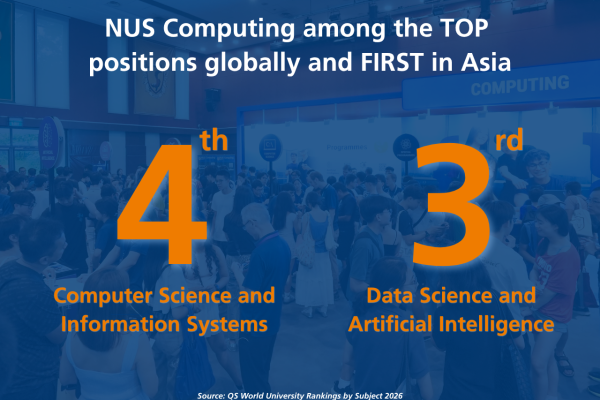
In the latest QS subject rankings, SoC is placed 4th globally in Computer Science and Information Systems and 3rd globally in Data Science and Artificial Intelligence, positioning it among the leading institutions shaping the future of technology and innovation.
SOCQSRanking
26 March 2026
CNA spoke to experts on the growing risks of telco service disruptions following a series of Singtel outages last week, with Professor Anthony Tung from the Department of Computer Science weighing in on what operators can do better, and why the stakes extend well beyond dropped calls.

CNA spoke to experts on the growing risks of telco service disruptions following a series of Singtel outages last week, with Professor Anthony Tung from the Department of Computer Science weighing in on what operators can do better, and why the stakes extend well beyond dropped calls.

Prof Tung called for stronger real-time monitoring and earlier detection systems, including AI tools where appropriate.

"Operators need earlier warning signs. Better real-time monitoring and anomaly detection, including AI tools where useful, can help spot unusual behaviour before it becomes a larger disruption," he said.

On the wider impact of outages, Prof Tung was direct. Many people now rely on mobile networks as their primary means of accessing the internet – for payments, transport, work, and everyday services. A disruption, he noted, can quickly render much of daily life inaccessible, even if the broader internet remains technically functional.

"That is why an outage can quickly disrupt daily life and business activities. It is also a reminder that important services and organisations should not rely on a single access channel, but should have fallback options in place."

His broader point was structural: telcos should be treated as a core part of national resilience, not just from a cybersecurity standpoint, but operationally. As high-concentration infrastructure serving consumers, enterprises, and critical services simultaneously, the risks and consequences of failure are, by nature, highly concentrated.

CNA Digital, 26 Mar 2026

Media Mentions
25 March 2026
Associate Professor Ooi Wei Tsang from the Department of Computer Science was featured in a report by The Business Times on the rapid uptake of new open-source AI agent OpenClaw and the risks it raises for enterprise use.

Associate Professor Ooi Wei Tsang from the Department of Computer Science was featured in a report by The Business Times on the rapid uptake of new open-source AI agent OpenClaw and the risks it raises for enterprise use.

The article looks at how tools like OpenClaw can carry out multi-step tasks with minimal human input, allowing users to automate workflows quickly. However, this ease of use also means such tools may be deployed without proper oversight or safeguards.

A/Prof Ooi cautioned that using these systems without appropriate controls can expose organisations to significant risks.

He likened it to “hiring an intern who blindly obeys instructions, while still giving them deep access to enterprise system, and allowing external parties to send instructions directly.”

A/Prof Ooi added that large language models can produce incorrect or misleading instructions, which may lead to unintended or harmful actions when executed by autonomous systems.

The report highlights growing concerns around “shadow AI”, where such tools are used outside formal IT governance, and the need for stronger safeguards including validation, human oversight and secure system design.
The Business Times, 25 Mar

Media Mentions
25 March 2026
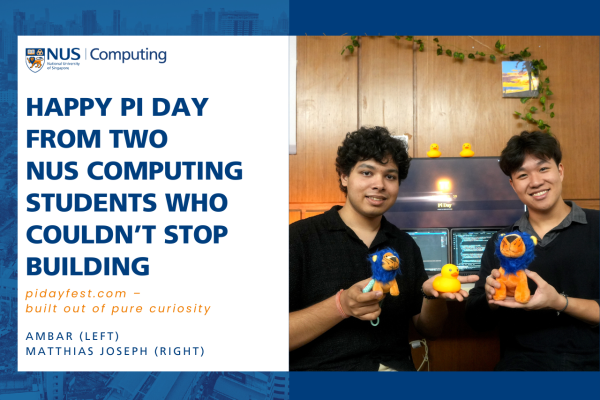
Every year on 14 March, the world marks Pi Day – a small tradition honouring the mathematical constant that appears everywhere from engineering equations to planetary motion. This year, two NUS Computing students decided to mark the occasion by building something. 
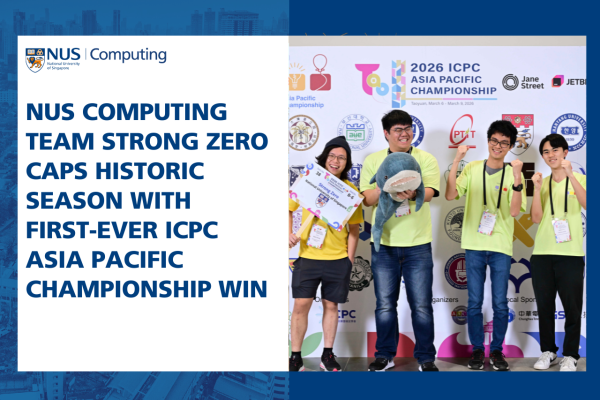
SoC NewByte_ICPC Asia Pacific Championship
23 March 2026
The Edge Singapore spoke to business leaders, investors, and academics on Singapore's multibillion-dollar push to harness AI – from national policy and workforce reskilling to what it means for local companies and startups.

The Edge Singapore spoke to business leaders, investors, and academics on Singapore's multibillion-dollar push to harness AI – from national policy and workforce reskilling to what it means for local companies and startups.

Associate Professor Ben Leong from the Department of Computer Science offered a grounded take on where Singapore stands in the global AI race. Rather than competing head-on with the United States – the world's dominant technology powerhouse for the past two decades – he argued that Singapore's edge lies in finding the right niches.

"That's not to say that we shouldn't care. We don't have a choice. It is not possible for us to be Number One or Number Two in AI. Despite this situation, what can we do? Give up? That cannot be right. So we try to find niches that make sense for us."

On the productivity gains AI has delivered so far, Assoc Prof Leong was measured. While AI has meaningfully lifted output, the benefits are not uniform, and the pace of change may be slower than the hype suggests.

"The reality is that AI has somewhat increased productivity, about 20% to 30%. It's not massive, but there are some productivity gains. But if you ask me, will AI change everything? Not really or perhaps not so fast."

His sharpest observation, though, was about people rather than technology. Ultimately, he noted, how quickly a company adopts AI comes down to management decisions, and the willingness to change behaviour.

"Adoption of AI is not a tech problem. It's a human problem where you are trying to change behaviour."
The Edge Singapore, 23 Mar

Media Mentions
19 March 2026
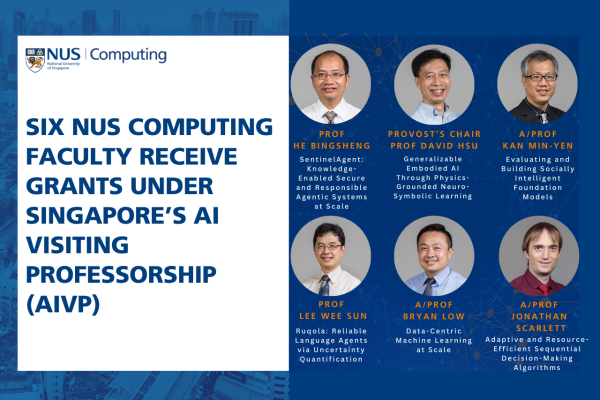
Six faculty members from the NUS School of Computing have been awarded grants under the Singapore Global AI Visiting Professorship (AIVP), an initiative by the Ministry of Digital Development and Information (MDDI) to strengthen Singapore's AI research capabilities and attract world-class expertise to its shores.
SoC NewsByte_AIVP
19 March 2026
CNA's Singapore Tonight featured Professor Anthony Tung from the Department of Computer Science as a live studio guest on Singtel's two consecutive days of mobile connectivity disruptions.

CNA's Singapore Tonight featured Professor Anthony Tung from the Department of Computer Science as a live studio guest on Singtel's two consecutive days of mobile connectivity disruptions.

On the cause of the outage, Prof Tung pointed to (possibly) cascading errors across hardware, software, and core routing systems — rare combinations that engineers have never encountered before, making them exceptionally difficult to diagnose and resolve.

Asked whether current safeguards are sufficient, he offered a vaccine analogy: just as no vaccine is failproof, no network can anticipate every unforeseen failure. Beyond a certain reliability threshold, he noted, the cost of incremental improvement becomes prohibitive — making rapid detection, isolation, and recovery the more practical priority.

On whether consumers should expect better, Prof Tung gave a characteristically balanced response — affirming that higher standards are warranted, while also calling on individuals to reduce over-reliance on mobile connectivity and maintain fallback options.

"We should always expect better, but I would also take proactive action to ensure there is no over-reliance on the phone, and always have something to back up on."

CNA Singapore Tonight (17 Mar 2025): "Singtel faces second straight day of connectivity issues"
Media Mentions
13 March 2026
Every year on 14 March, the world marks Pi Day – a small tradition honouring the mathematical constant that appears everywhere from engineering equations to planetary motion. This year, two NUS Computing students decided to mark the occasion by building something. 
SoC Newsbyte_Pi Day Project
12 March 2026
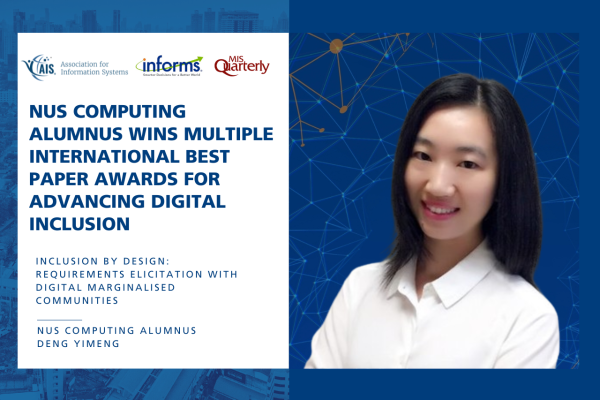
Congratulations to alumnus Dr Deng Yimeng and collaborators on receiving multiple international Best Paper Awards for their research on digital inclusion.
SoC Newsbyte_Deng Yimeng
11 March 2026
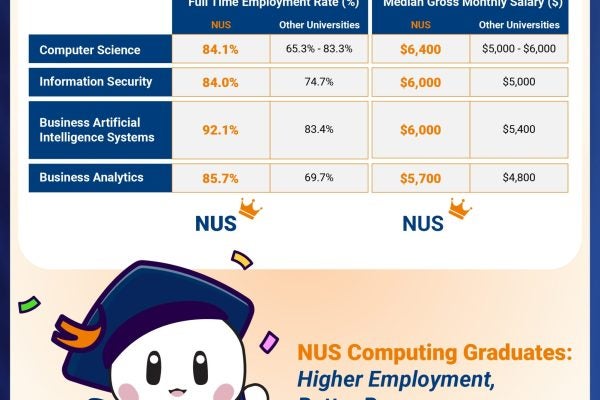
Graduates from the NUS School of Computing (SoC) continue to rank among the most employable and highest-earning fresh graduates in Singapore, according to the 2025 Joint Autonomous University Graduate Employment Survey (JAUGES).
GES 2025 SM Post R3 1
11 March 2026
We are pleased to congratulate Assistant Professor Warut Suksompong on his appointment as Associate Editor of Mathematics of Operations Research, a leading journal in the mathematical foundations of operations research.
SoC Newsbyte_ASSISTANT Professor WARUT SUKSOMPONG
9 March 2026
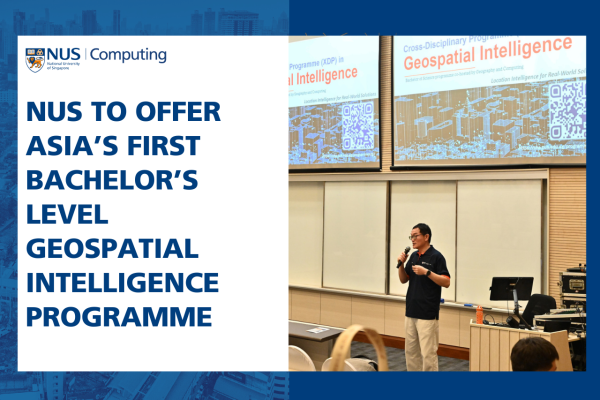
The National University of Singapore (NUS) will offer a new major in geospatial intelligence that will train students to harness geospatial data and emerging technologies such as artificial intelligence (AI) to address complex problems in climate change mitigation, smart city design, business planning and more.
GIX
6 March 2026
Tech in Asia reported on NUS School of Computing's collaboration with OpenAI to integrate Codex and other tools from OpenAI's enterprise platform into its undergraduate curriculum – giving students hands-on experience with AI-assisted development in secure educational environments. 

Tech in Asia reported on NUS School of Computing's collaboration with OpenAI to integrate Codex and other tools from OpenAI's enterprise platform into its undergraduate curriculum – giving students hands-on experience with AI-assisted development in secure educational environments.

The tools will be progressively incorporated into over 30 undergraduate courses spanning software engineering, systems, and capstone projects. Beyond the classroom, students will participate in workshops, hackathons, and build days organised with OpenAI and other industry partners.

At its core, the collaboration is about equipping graduates with practical fluency in AI-assisted development while keeping computing fundamentals like algorithms, systems thinking, and problem-solving firmly at the centre.
Tech in Asia, 6 Mar 2026

Media Mentions
6 March 2026
The National University of Singapore’s School of Computing (NUS Computing) is deepening the integration of advanced artificial intelligence (AI) technologies across its curriculum and student learning experiences through a collaboration with OpenAI, as part of the School’s broader strategy to prepare Computing graduates for a world increasingly shaped by AI. 
SoC x OpenAI
5 March 2026
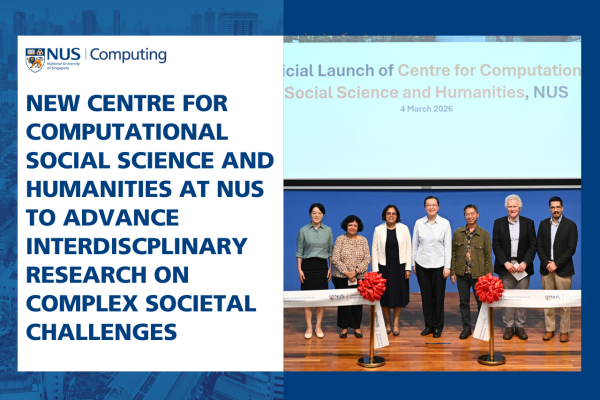
A new research centre at the National University of Singapore (NUS) is bringing together data science, AI and computational methods with deep insights from social sciences and humanities to better understand complex social phenomena and develop solutions to pressing societal challenges. By combining technological innovation with human insight, the Centre for Computational Social Science and Humanities (CSSH) aims to generate research that improves lives, strengthens institutions, preserves cultural knowledge, and shapes more inclusive and resilient societies in Singapore and beyond.
CSSH Launch
4 March 2026
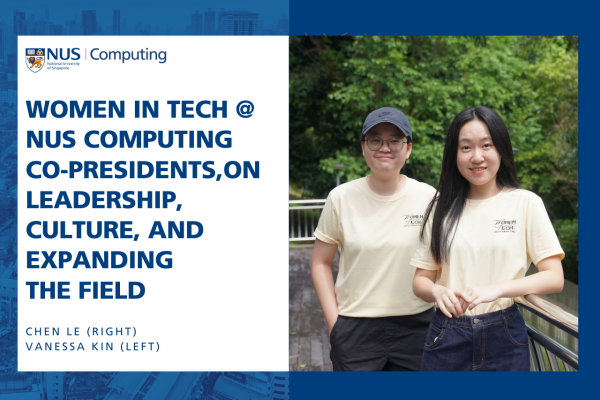
In a room of 20 computing students, sometimes only three are women. At the NUS School of Computing, women make up 23.7% of undergraduates (AY24/25). The gender ratio remains uneven – a reality that shapes classroom dynamics in subtle yet tangible ways. 
IWD
28 February 2026
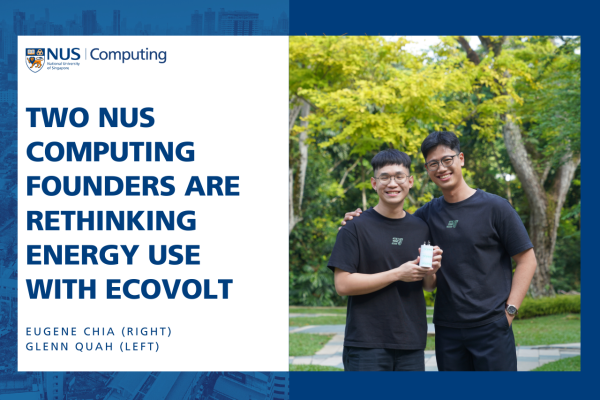
For Eugene and Glenn, sustainability did not begin as a grand mission. It started with frustration – high electricity bills, limited visibility, and the sense that energy was being wasted in ways no one could clearly explain or control. Eugene Chia, a Computer Science graduate from NUS School of Computing, and Glenn Quah, a final-year Information Systems student, are co-founders of Ecovolt, a startup developing smart energy solutions for schools and commercial buildings. Together with their third co-founder, Raphael, they are building systems that help organisations see, understand, and reduce energy waste at scale.
Newsbtye SOC (6)
24 February 2026
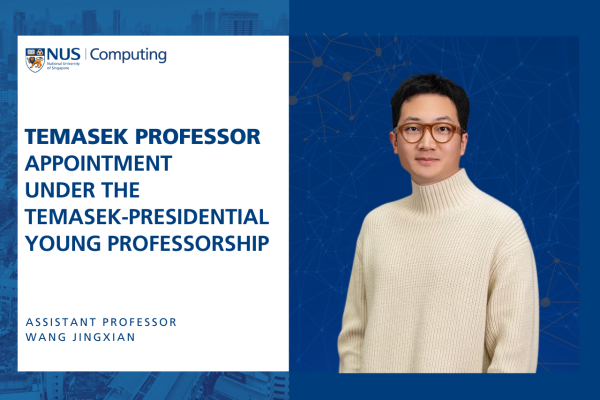
NUS Computing congratulates Assistant Professor Wang Jingxian on his appointment as a Temasek Professor under the Temasek-Presidential Young Professorship.
Newsbtye SOC Wang Jingxian-Temasek Professor
21 February 2026
NUS School of Computing took part in its first-ever reciprocal computing exchange programme with the School of Informatics at Nagoya University. From 8 to 16 December, 14 NUS Computing students joined their counterparts in Nagoya for an academic and cultural immersion focused on artificial intelligence, robotics, and system design.
Newsbtye SOC (6)