

Global Opportunities

Through the University’s strategic partnerships with more than 300 leading universities worldwide, NUS Computing students gain access to diverse study programmes, cultures and learning environments.
These opportunities enrich their academic journeys, foster personal growth, and provide a competitive edge in a globalised world. Explore our international network to find an experience that matches your aspirations.
Your Gateway to Global Opportunities
The Student Exchange Programme (SEP) offers Computing students the opportunity to spend a regular semester at one of our 300+ partner universities across 40 countries. While earning academic credits towards your degree, you will immerse yourself in diverse learning environments and gain fresh global perspectives on computing.
Why Participate in SEP?
Global Academic Enrichment: Access unique curricula and teaching methodologies at leading international institutions.
Professional Growth: Develop the adaptability and cross-cultural competencies essential for a successful career in an interconnected world.
Personal Transformation: Join thousands of NUS students who build confidence, broaden their perspectives and lifelong connections through this signature global experience.
Explore the World. Expand Your Mind. Elevate Your Journey through SEP
Before applying, we strongly encourage you to leverage the comprehensive resources provided by the NUS Global Relations Office (GRO). Their website is your primary source for University-wide Partner University factsheets, which provide essential information such as course offerings, eligibility criteria, and estimated living costs.
You are also encouraged to read the GRO Essential Guide for International Programmes and our SEP FAQs.
Students are responsible for reading and understanding all relevant University policies and requirements to ensure compliance with continuation and graduation requirements.
Credit Transfer Workload from a Semester-long SEP
- For AY2025/26 and earlier: Maximum of 20 NUS units may be transferred
- For AY2026/27 onwards: Maximum of 24 NUS units may be transferred
Eligibility Criteria
To participate in the Student Exchange Programme (SEP), you must meet the following eligibility criteria:
- Be a full-time NUS undergraduate student
- Have completed at least two semesters of study at NUS*
- The SEP period must not fall in your final semester
- Have a GPA of at least 3.00, with no grade below ‘C’ (grade point of 2.00) in any course**
- Maintain a good disciplinary record#
- Complete submission of CCA achievements via the SoC in-house system
- Meet the host institution and host country entry requirements
- Satisfy the terms and conditions of your scholarship, where applicable
- Have sufficient financial means to support your SEP (Documentary proof may be required)
- SEP Duration: One regular semester
Footnotes:
* Polytechnic graduates with advanced standing must complete at least one semester at application and two semesters before admission to the assigned Partner University.
** Some popular universities may require a higher GPA to qualify.
# Students are expected to maintain good conduct throughout the SEP journey. SEP offers may be withdrawn, and credit transfers may be affected in cases of inappropriate conduct.
Due to high demand and limited placement capacity, the School reserves the right to prioritise students who have not previously participated in an SEP. Students seeking a second exchange may be asked to withdraw if a place is required for a student on the waitlist.
Who are not eligible?
Students are not eligible if they are:
- in their final semester of study.
- scheduled to undertake their Final Year Project (FYP), internship or industrial attachment.
- on scholarships with restrictions on overseas study (at the discretion of Faculty, Department or host university).
- applying for or participating in another programme (e.g. NOC) during the same period. EduRec does not permit overlapping applications or offers.
Application Period
The SEP application process is conducted on a semester basis for exchange taking place in the next academic year. Students should apply one academic year in advance.
The tentative schedule is as follows and may be adjusted depending on the actual opening dates for each application round:
| Application Round | Application Timing | Eligible SEP Semester | Application Outcome |
| Round 1 | Late August – September | Semester 1, Semester 2, and Full-Year exchanges | October/November |
| Round 2 | Late January – February | Semester 2 exchanges only | April/May |
Schedule of AY2027/28 Application Rounds:
Round 1: 10 September – 11 October 2026
Round 2: 8 March – 11 April 2027 (Tentative)
Complete NUS Travel Preparedness Course (TPC) Online
The Travel Preparedness Course (TPC) provides students with information on anticipating and mitigating risks, and handling emergencies while abroad. This is a compulsory course for all students who intend to embark on any NUS-endorsed overseas programme.
Please click here for more information and complete the course on Canvas at least 24 hours before submitting your SEP application.
SEP Application via EduRec
Students will be able to view the places allocated to the School for the various universities and submit their application via the NUS Education Records System (EduRec): Academics > Global Education > External Study
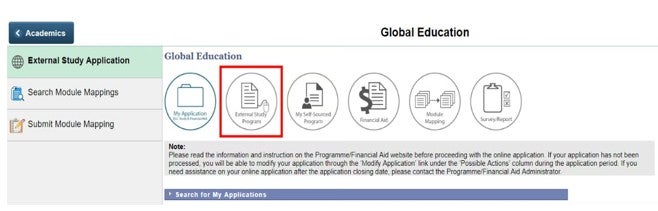
Application Submission Requirements
Please ensure that your application is complete before submission to avoid it being disregarded. No reminders will be sent for missing documents or information.
Required Information:
- Personal Statement: Explain your motivation for applying for SEP, your university choices, and how the exchange will contribute to your personal and academic growth and benefit the NUS Computing community.
- University Rankings: Rank up to five universities in order of preference. Only list institutions that you are genuinely willing to attend, as you will be expected to accept any offer received.
- Tentative Study Plan: Provide a preliminary list of courses you intend to take at your preferred universities. (Note: This is a preliminary list to help you assess academic alignment before ranking your choices. You do not need to contact SEP coordinators at this initial application stage.)
To avoid potential technical issues or system congestion on the EduRec, we strongly advise you to submit your application well ahead of the deadline. Late applications will not be entertained.
Study Plan Submission Protocol (Effective AY2026/27)
To streamline the application process, submission of a study plan during the initial application phase is encouraged but not mandatory. Please refer to the Study Plan Template.
Students are expected to conduct their own research into partner university course offerings before applying for the preferred destinations. This will help you make informed choices and enable the School to better evaluate your academic fit with the selected universities.
Selection of Partner Universities
When ranking your five preferred partner universities, please carefully evaluate the following factors:
- Academic Fit: Ensure the partner university offers courses that fulfil your degree requirements. Carefully review its course catalogue to ensure a strong academic fit.
- Academic Calendar Compatibility: Ensure the partner university’s academic term does not overlap with the NUS academic calendar to facilitate a seamless transition. Leave of Absence (LOA) will not be approved for exchange programmes.
- Language Proficiency: Check the medium of instruction and ensure that you are comfortable studying in the language of instruction.
- Financial Feasibility: Estimate the total cost of the exchange, including living expenses, accommodation and travel, to ensure it fits your budget.
- Programme Research: Browse the Global Relations Office (GRO) website and SoC Programme Requirements.
- Review FAQs: Refer to the SEP FAQs for more information on the School of Computing’s application and selection process.
Update SEP-CCA System
The SEP-CCA system adopts a more holistic approach to recognising student involvement in Co-Curricular Activities (CCAs). Contributions are assessed across three key dimensions each Academic Year:
- Commitment – Recognises sustained participation, with points differentiated by CCA type and duration.
- Achievement – Recognises eligible competitive achievements based on the level of representation or placing.
- Leadership – Recognises students who take on leadership roles, such as directing events, organising activities, or leading hackathons.
To ensure consistency and fairness, a maximum of two CCA entries per category per Academic Year (AY) will be considered for each SEP applicant. Students may submit CCA entries from up to two AYs.
Please access SoC SEP CCA to submit your best performing CCA contributions. Students are reminded to submit accross all three categories – Commitment, Achievement and Leadership, in with one combined evidence PDF.
Withdrawal Policy
Students who withdraw without a valid reason after accepting an offer will incur a S$300 administrative fee, which will be charged together with their tuition fees in the following academic semester.
Academic Planning for SEP – What are the considerations?
It is essential to plan your SEP carefully for a successful exchange. Please consider the following factors when selecting courses at your partner university:
- Restricted Courses: As some courses at partner universities may be subject to enrolment restrictions or limited availability, students are advised to check the partner university’s course catalogue for the latest information on course availability and eligibility requirements.
- Residency Requirements: Ensure that your study plan complies with the minimum number of unit requirements that must be completed at NUS for your Major, Second Major, Minor or Specialisation. Refer to the programme requirements applicable to your admission year for details.
NUS Units Exchange Ratio
When planning for course mapping, students should consider the NUS Units Exchange Ratio as credits earned at Partner Universities (PUs) may not translate to NUS units on a one-to-one basis. The link provided contain critical information regarding how credits are calculated and transferred to you NUS record based on equivalent workload.
Credit Transfer Policies:
- For students on exchange in AY2025/26 and before: Credits are transferred based on a fixed [Unit Ratio]
- For students on exchange in AY2026/27 and onwards: Credits are transferred using the [SEP Credit Transfer Calculator]
Submision of Course Mapping
Student will gain access to the course mapping worksheet upon accepting the internal offer. To submit course mappings, students are required to use the course mapping worksheet in EduRec.
Before making any submissions, it is essential to review the user guide via the Student Portal (Nagivation: Quick Links > myEduRec > Other Functions > Submission of Course Mappings for External Study Programme).
The user guide provides detailed instructions and important information on how to complete the course mapping process correctly.
Course Mapping Guidelines
Course mappings are reviewed periodically to ensure alignment with current NUS curriculum standards. You must submit your mapping requests and obtain approval before making any travel or financial commitments.
For SEP, you may submit up to 20 course mapping requests. As course mapping at this stage is preliminary, please plan your mappings carefully and ensure that each course meets the applicable requirements before submission.The School reserves the right to reject excessive requests involving similar NUS courses.
- Submit only one-to-one course mappings.
- Incomplete submissions or requests to map courses to NUS dummy codes will not be accepted.
- The Pre-approval List in EduRec is indicative only. Always verify current course offerings and restrictions (e.g. graduate-level courses) directly with the Partner University (PU). If course details are not published online, contact the course coordinator directly for additional information.
- You may submit course mappings beyond the pre-approved list. All courses, including pre-approved courses, require formal approval.
- Mappings require at least 70% content overlap and fulfilment of all applicable prerequisites.
- Conduct a preliminary check using the SoC Course Mapping AI-enabled Advisor before submitting requests via EduRec.
- Each request must include:
- Course components and corresponding contact hours
- Assessment methods and weightage
- Direct URL to course information or syllabus
- Grades for the prerequisite of the NUS course you are mapping to (or current enrolment status)
- Where no direct NUS equivalent exists, dummy codes for Programme Elective (PE) or Unrestricted Elective (UE) may be assigned, subject to recommendation by the domain expert.
- As course availability may change, remain flexible and be prepared to take alternative courses, including UEs, while on exchange.
- Previous course mapping approvals do not automatically carry over to future semesters.
- Post-departure mapping is allowed only for course clashes or unavailability.
- Mapping decisions are final. Appeals and requests to delete submitted mappings will not be entertained.
Processing Time: Please allow at least 4 weeks for processing, or may take longer during peak periods.
Credit Workload & Units
- You must read sufficient courses/units to fulfil the required workload for credit transfer to NUS.
- If your approved mappings do not meet the required credit workload, you may need to take additional courses to make up the shortfall.
- If your planned courses do not meet the standard workload (e.g., 30 ECTS/60 credits), you must add courses or select those with higher workloads to meet the requirement.
- Full Workload at Partner University = Full Workload @ NUS
- e.g. 30 ECTS (European PUs) = 20 NUS units
- 5 ECTS = 3.33 NUS units ≈ 4 NUS units (rounded up)
- Unit adjustments are made during the credit transfer stage based on the total workload completed.
Precluded Course Mappings (Strictly Not Approved)
The following categories of courses are strictly not approved for mapping:
- Instructional Format: Distance learning, online courses, and courses with a hybrid delivery option
- Grading: Courses without letter grading (i.e., pass/fail only)
- ECTS Workload: Courses bearing 3 ECTS or below at partner universities using the European Credit Transfer and Accumulation System
- School of Computing (Including CEG): All ITXXXX courses, introductory courses after taken advanced courses in NUS, preclusions to majors
- Department of Information Systems and Analytics: Level 5000 and 6000 courses
- Faculty-Specific Restrictions:
- CDE: Please refer to the [CDE course mapping page] for details.
- FASS: Please refer to the [FASS SEP page] for details.
- FoS:
- Effective from AY2024/25 Special Term, all DSA/ST courses hosted by the Department of Statistics and Data Science cannot be mapped to overseas winter or summer school courses.
- Effective from AY2025/26, ST2137, DSA3361, and DSA3362 are prohibited from being mapped on study abroad programmes.
- For further information, refer to the [FoS SEP website].
- General Education (GE):
- Students admitted from AY2015/16 till AY2020/21 cannot use Partner University courses to fulfil the GE requirement.
- Students admitted from AY2021/22 onwards who receive transfer credits for a course satisfying a GE pillar will be granted an exemption and considered to have fulfilled that pillar. Refer here for more information.
Mapping Procedure for NUS Business Courses
While waiting for your acceptance from the host university, you may start preparing for your SEP by learning more about your exchange destination and finding what to do next on the Global Relations Office (GRO) website.
Application Submission to Partner University
- The Office of the University Registrar (OUR) will nominate selected students to their allocated Partner University (PU).
- Ensure that you meet all deadlines from SoC, OUR and PU.
- Prepare and submit all required supporting documents before the respective application deadlines.
- Send the required documents to the SoC SEP Team for onward submission to the PUs, where applicable.
- You are reminded not to commit to travel plans until you have received your admission offer from the PU.
Plan for Logistics Arrangement to Partner University
- Please refer to the Pre-Departure Guide, video and cheat sheet on GRO website.
- Insurance Coverage: Review the NUS Student Travel Insurance details. We strongly encourage all SEP students to purchase supplementary personal insurance for comprehensive coverage of medical, travel, and emergency expenses while on overseas exchange.
- Tuition Fees: NUS students on exchange programme continue to pay their regular NUS semester fees. Tuition fees at the host university are waived, but you are responsible for any mandatory fees required by the host institution, such as health insurance, campus services, and course materials.
Prepare for Next Course Registration Exercise
If your partner university’s course results are not available at the start of the new NUS semester CourseReg exercise, please perform an Honour Declaration.
The Honour Declaration is an interim measure for undergraduate students returning from the Student Exchange Programme (SEP) to upgrade their CourseReg Seniority while awaiting their Partner University transcript for official credit transfer. It can only be made for courses that were successfully completed and passed during SEP.
The User Guide provides further information. (Navigation: EduRec > Academics > Global Education).
Initiate Unit Transfer Request via EduRec
Credit transfer should be processed and updated by the semester immediately following your exchange.
Please check with your Partner University (PU) on when your official transcript will be released. If you have not received it within 2 months after returning from SEP, follow up with the PU. If your transcript is not in English, request an official English-translated copy from the PU.
Please initiate your credit transfer by following these steps:
- Refer to the Credit Transfer Step-by-Step Guide for assistance.
- Submit your request via the EduRec: Academics > Global Education > Submit Course Mapping > Credit Transfer Request
- Submit your official transcript issued by your Partner University via the SoC Application Portal at http://socug.comp.nus.edu.sg
- Select the “SEP-SUSEP” queue and indicate your NUS Student ID when corresponding with us.
Facilitate a Successful Credit Transfer
- All courses taken must be graded; Pass/Fail options are not permitted for credit transfer.
- Approved mappings are still subject to prerequisite checks during the credit transfer stage, where applicable.
- Credit transfer is not permitted for courses with preclusions.
- Examples of specific programmes rules:
- Business Analytics (BZA) Students: BT4240 precludes CS3244, IS4240, and IT3011. You are not permitted to transfer credits for these precluded courses from your exchange.
- Computer Engineering (CEG) Students: You cannot map back any preclusion courses related to CEG core modules, including CS2100, CS2105, CS2106, and CS2109S. If you take a precluded course during your exchange (e.g., taking CS2106, which precludes CG2271), those credits will count as excess units beyond the 160-unit graduation requirement. You will still be required to read the core course (e.g., CG2271) at NUS.
- Computer Science (CS) Students: CS2109S precludes CS3244 and CS3243. You are not allowed to transfer credits for these precluded courses from your exchange.
- Appropriate unit adjustments are made during the credit transfer stage after the exchange, based on the NUS Unit Exchange Ratio.
- If mapped courses do not have direct equivalence, or if you take fewer courses than required to meet the total workload, where necessary, SoC may top up the credit workload using dummy codes. These may be used to fulfil Unrestricted Elective (UE) requirements.
- Your official transcript will display only the total credits acquired, recorded as OVS (satisfactory), OVU (unsatisfactory), or OVI (incomplete).
If you have further enquiries about the exchange programmes, please submit a request via the SoC Application Portal. Please select the <SEP-SUSEP> category and always indicate your Student ID when corresponding with our administrators.
Participating in short-term summer and winter programmes offers students an opportunity to gain valuable global exposure. To ensure academic rigour and alignment with graduation requirements, the NUS Global Relations Office (GRO) curates a selection of reputable summer and winter programmes offered by leading universities worldwide. As these programmes are carefully selected, students may earn academic credits that can count towards their degree requirements.
Furthermore, students participating in GRO-recommended programmes may be eligible for financial support, as GRO administers various financial aid schemes to assist eligible students with the costs of overseas study. These short-term study opportunities allow students to broaden their academic and cultural perspectives, engage in cross-cultural learning, and gain valuable international experience that contributes to their personal and academic development.
Programme Duration & Timing
Programme dates and durations vary depending on the host university and location. Students should always refer to the information provided by the NUS Global Relations Office (GRO) for the most accurate and up-to-date information.
- Summer Programmes: Usually commence in early June and run until early August, providing at least five weeks of study and cultural immersion.
- Winter Programmes: Typically start in early December and conclude in early January, lasting approximately one month.
Credit Transfer Policy & Unit Limits
- Endorsed Institutions: Only approved summer/winter programmes offered by partner universities endorsed by NUS GRO or at the faculty level will be considered for credit transfer. When selecting your preferred international study programme (i-SP), you must choose from the list of host universities recommended by GRO.
- Maximum Mapping Limits (In-Person) from AY2018/2019 onwards:
- Summer Programmes: Up to a maximum of 10 units per programme.
- Winter Programmes: Up to a maximum of 5 units per programme.
Credit Mapping & Fee Scenarios
| Number of Programmes | Total Units to Map | Special Term Fee Status |
| 2 Programmes | 12 units | No fees required (Fully covered under the exemption cap) |
| 2 Programmes | 18 units | Fees required for 6 units (The amount exceeding the 12-unit cap) |
| 3 Programmes | 12 units | Fees required for the 3rd programme (Exceeds the 2-programme limit, even though total units equal 12) |
Special Term Fees & Exemptions
NUS provides an exemption from Special Term fees for eligible short-term overseas study programmes, subject to the applicable programme and unit limits. Students can take advantage of these opportunities without incurring additional NUS fees, provided they remain within the applicable caps.
The Fee-Waiver Rule
NUS will not impose Special Term fees on students who participate in up to two summer or winter programmes during their three to four years of study at NUS, provided that the total credit transfer does not exceed 12 units.
Students who exceed the 12-unit limit and still wish to transfer the additional credits may do so by paying NUS Special Term fees for the excess units. Please refer to the Office of the University Registrar for the applicable fee rates.
Critical Policies (What You Need to Know)
No Overlaps with the NUS Academic Calendar.
The School of Computing does not support summer/winter programmes that extend into the new NUS semester.
- If a programme overlaps with the start of the new NUS semester, you will not be eligible for a Leave of Absence (LOA).
- You are expected to resume your studies at NUS as scheduled. Always verify the duration and dates of your chosen programme before applying to avoid scheduling conflicts.
Past Approvals Do Not Guarantee Future Outcomes
Previously approved course mappings granted in prior semesters do not automatically carry over to subsequent semesters or years. NUS course hosts regularly review course mappings to adjust for NUS curriculum updates, undergraduate training goals, and content/contact hour changes at partner institutions.
How to Apply
Please refer to GRO’s Official i-SP Application Guide for step-by-step application instructions and deadlines.
The Singapore Universities Student Exchange Programme (SUSEP) is a local version of the Student Exchange Programme (SEP). It provides NUS undergraduates with a unique opportunity to experience a different academic environment and immerse themselves in another local institution for one regular semester. Participating host universities include:
- Nanyang Technological University (NTU)
- Singapore Management University (SMU)
- Singapore University of Technology & Design (SUTD)*
- Singapore University of Social Sciences (SUSS)
- Singapore Institute of Technology (SIT)
*Generally, SUTD does not accept inbound students in Semester 1.
Please refer to this link for more information on SUSEP.
Study Options
During SUSEP, you can choose between two options:
- Full SUSEP Exchange: This option allows students to spend an entire semester reading all your courses at the host university, fully immersing yourself in its campus and learning environment.
- Partial SUSEP Exchange (Default Allocation): This option offers you the flexibility to read courses concurrently at both NUS and the host university. While studying at the host university, you must also complete at least one course at NUS to maintain your academic progress.
Eligibility Criteria & Academic Considerations
To align local exchange arrangements with standard university-wide guidelines, the academic policies, course mapping and unit transfer processes for SUSEP are generally the same as those governing the overseas Student Exchange Programme (SEP).
Application & Timelines
Interested students are required to submit their applications one semester in advance of their intended local exchange period. As the number of available SUSEP places is limited, the School of Computing (SoC) will invite eligible Year 3 students to apply in each application round.
The email invitations to apply for SUSEP are typically sent to eligible students to apply for SUSEP. Students who receive an invitation should submit their applications within the specified timeframe.
Withdrawal Policy
If you formally accept a SUSEP offer and subsequently withdraw without a valid reason, an administrative fee of S$300 will be imposed.
The NUS Overseas Colleges (NOC) programme offers undergraduates global exposure through immersive learning opportunities across more than 15 entrepreneurial hubs worldwide.
Selected students immerse themselves in vibrant start-up ecosystems by undertaking high-impact internships at innovative start-ups in renowned entrepreneurial hubs. Through these internships, students gain first-hand insights into entrepreneurship, innovation and emerging technologies.
While interning at start-ups, students also attend classes at prestigious partner universities, creating a valuable combination of real-world start-up experience and formal education. This integrated approach equips students with global networks, an entrepreneurial mindset and the knowledge and skills needed to collaborate with fellow innovators and thrive in a fast-paced global environment.
Programme Tracks & Duration
Students can choose between two programme options within NOC:
- Year-Long Programme
- Duration: 12 months period (equivalent to two regular semesters).
- Academic Units: Awards up to 40 academic units, depending on the specific location.
- Short Programme
- Duration: 6 months period (equivalent to one regular semester).
- Academic Units: Awards up to 22 academic units.
Note: The localised NOC programme in Singapore awards up to 26 academic units.
Application & Timelines
- March/April for the January Intake
- September/October for the August Intake
Selection is competitive, and NUS reserves the right to assign students to available locations, which may differ from their preferred choices.
How to Apply
All applications must be submitted directly to the NUS Overseas College (NOC) office. Please refer to the NOC Application Guide for programme details and application information.
You may access the NOC Curriculum Mappings Portal to review the course mapping rules and requirements applicable for your major.
