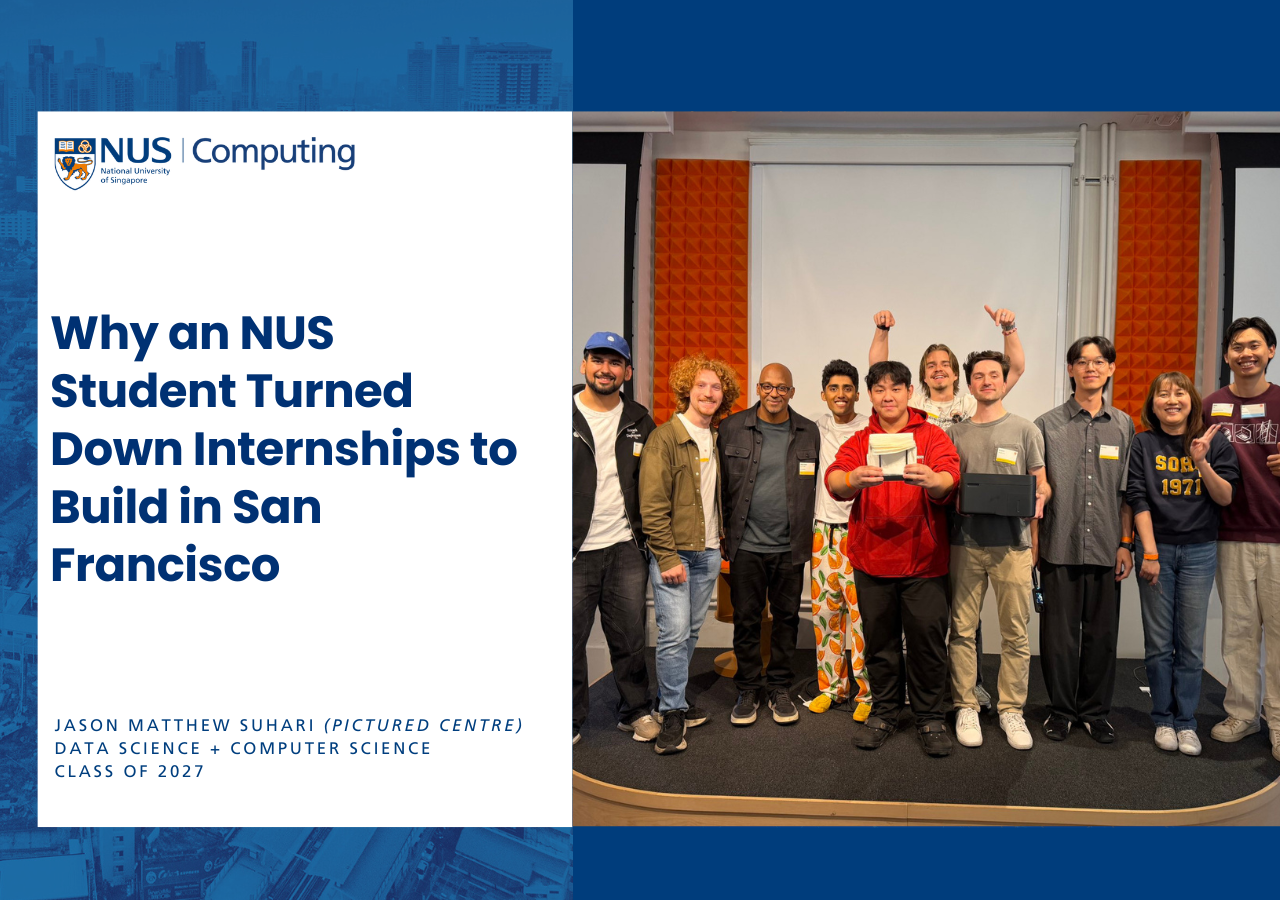
Why an NUS Student Turned Down Internships to Build in San Francisco
Jason Matthew Suhari was a sentence into his final presentation when his nose started bleeding.
By the time the judges called his name as the winner of the YC AI Growth Hackathon, the NUS Data Science and Computer Science student wasn’t thinking about the win. He was looking for tissues.
“I was so lightheaded by that point that even now, I don’t remember what I said on stage,” he says. “When they announced me as first place winner, I was honestly just scrambling around for some tissues.”
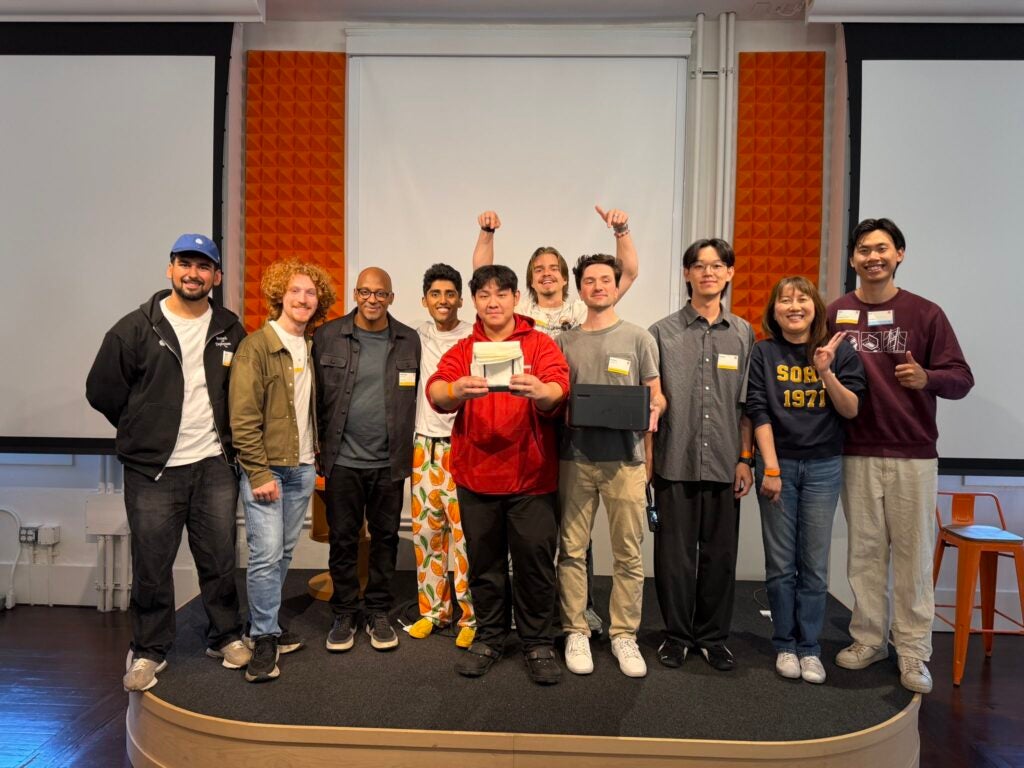
The photo from the podium says as much: Jason, holding up a stack of tissues having just beaten 59 other submissions in a 24-hour build at Y Combinator’s San Francisco office, a city he’d moved to weeks earlier for Founders Inc.’s Off Season II, a six-week programme at Fort Mason to build his own startup.
Building Peel
The project that won him first place is Peel, a tool that lets advertisers test physical billboard placements before committing to them. It simulates a city in 3D, pulls in real billboard listings, and generates a profile of a company’s ideal customer based on its website.
From there, Peel identifies where those customers cluster in a given city, and scores how visible a billboard would actually be to them by simulating thousands of pedestrians with human-like attention and movement.
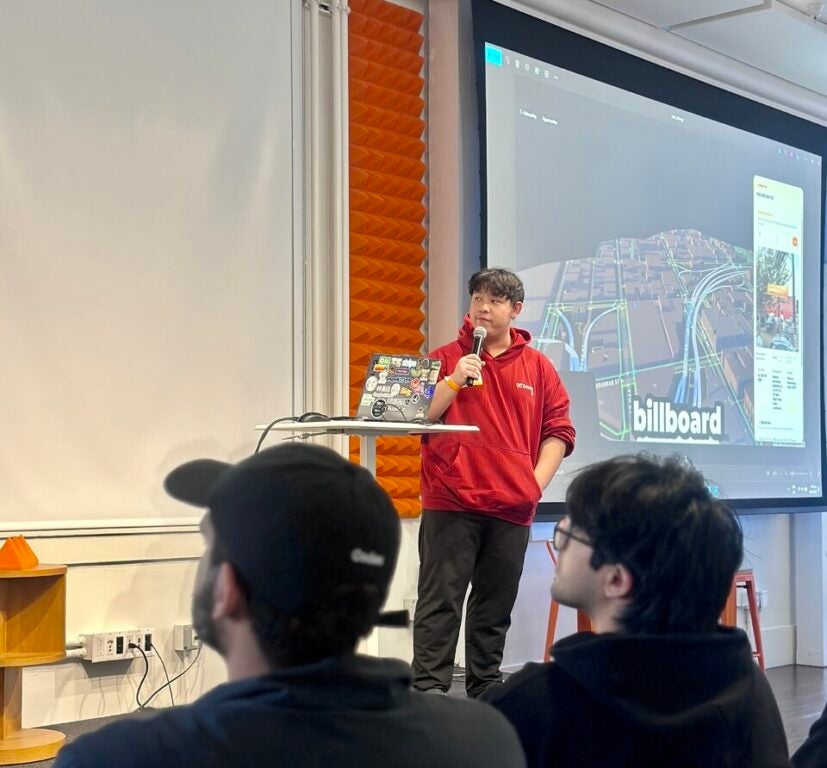
The idea came from looking out of a window.
“The hackathon was on growth and marketing, which obviously pointed towards projects like social media management,” Jason says. “I did not want to build the obvious, especially in a field where thousands of startups exist just for that.” He started thinking instead about marketing channels nobody could reliably measure, and landed on out-of-home advertising. “I knew the problem was a real one worth solving when I looked out of any given window at the Y Combinator office and saw at least five billboards, banners, or bus stop ads.”
Getting a model to convincingly mimic human attention was the hardest part – layering an object detection model, a visual saliency model, and a vision-language model on top of real street-view imagery, adjusted for weather and time of day. He built it alone. “I usually go solo for hackathons for the sake of speed, though I didn’t forget to go around the room and make a bunch of new friends.”
Jason has since turned down offers to fund Peel and requests to co-found it. Fort Mason was waiting.
Where it started
Jason points to CS1010S, the introductory programming module every Computing student takes, as the moment his approach to building started. It ran optional, ungraded coding tasks on Coursemology. “I decided to do it anyway, for the aura,” he says. “There was none gained, just sleep lost. That’s pretty much how I’ve been living life ever since.”
The moment building felt real came later, through Orbital, NUS’ summer software development programme, where he and a friend of a friend built a game together. It clicked when someone outside the two of them actually played it. “That was such a visceral ‘wow, this actually exists’ moment. I will never forget it.”
By the time he applied to Founders Inc., 10 minutes before the deadline, after seeing the programme on Instagram, that instinct was well formed. An interview invite from a general partner came the next day. Getting to Fort Mason meant turning down summer internship offers. “I had a long, hard think about how doing so many internships would surely bring diminishing returns,” he says. “This was a fresh, new world that seemed more interesting than the normal 9–5, and I wanted to take a chance on it while I still had the leeway to do so.”
The first lunch there recalibrated him. Some of the other founders had FAANG-level experience, or had sold companies before turning eighteen.
“I knew the fastest way to adapt and find my place would be to prove that I deserved to be there,” he says, a reflex he traces back to moving from Indonesia to Singapore. “Seeing people whose ambitions extended past good grades or a job at a big tech company, and into changing the world, made me realise there really is more that I can do.”
Betting on Fluent
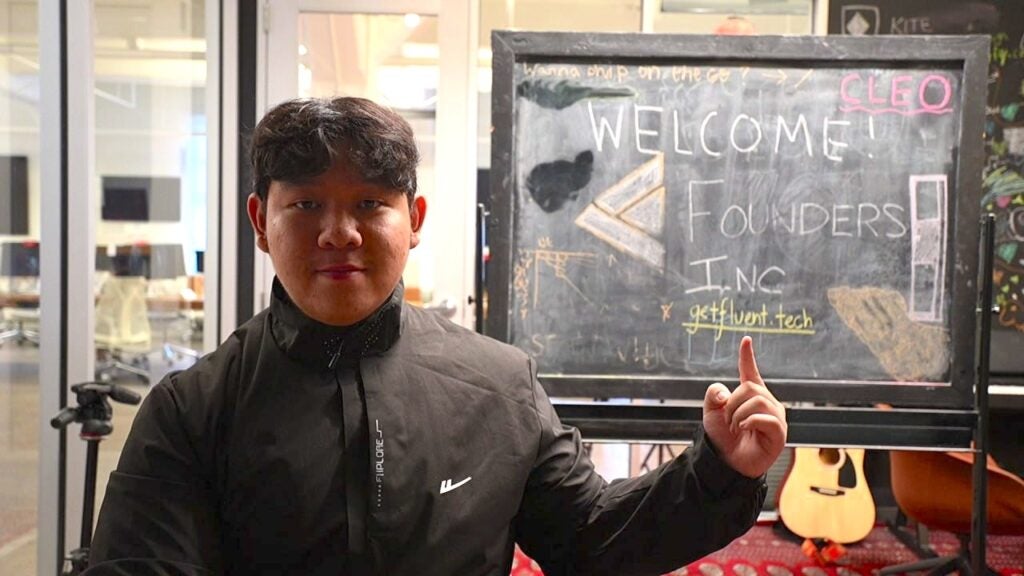
The startup he’s building at Fort Mason is Fluent, an AI agent that lets people control their computer using only their voice. Jason built it with people who have repetitive strain injury or motor impairments in mind, users for whom a keyboard and mouse aren’t always practical.
“Fluent is the first piece of software ‘fluent’ enough to understand what you’re trying to do with your computer, without you having to explicitly act on it,” he says.
The product has already reached more than 1,000 enterprise pilot users across hospitals and disability groups according to Jason. Southeast Asia is the primary market for now, with early interest also building in the US. A consumer launch is planned for July 2026, with a launch video currently in production at Founders Inc.’s media lab.
What he’s carrying forward
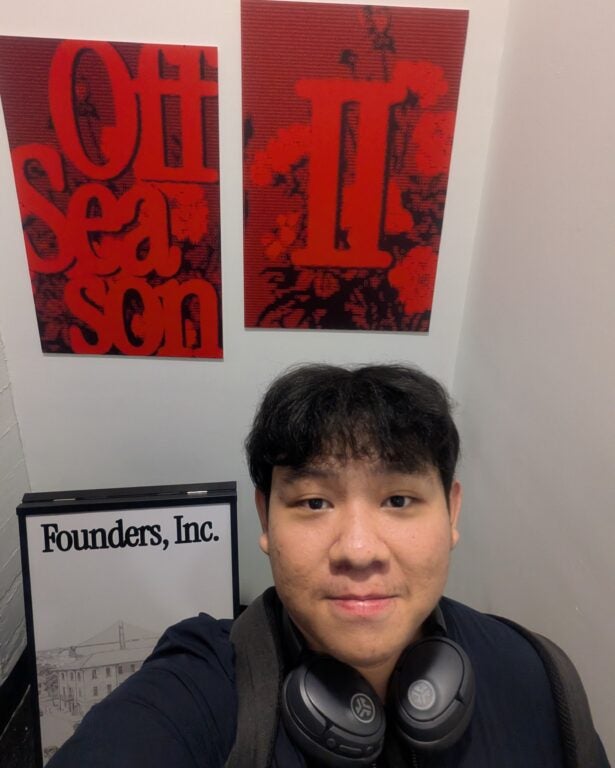
Jason credits Founders Inc.’s culture for a piece of advice he now repeats to himself: GTFOL, short for “Get The F Off Localhost.”
“You could build the coolest thing, but what’s the point if it never gets in the hands of the people who need it, or better yet, would pay for it?”
To a fellow NUS student weighing a similar leap, his advice is blunt:
“Realise that not trying is arrogant. You are not omniscient enough to assume that you’ll fail, or waste your time, or not meet anyone great. You owe it to yourself to do the hard work of trying without a guarantee, to see how far you can go. Join a local hackathon, or build an app for your own use, and really try to make something great, even if you don’t feel like you deserve to.”