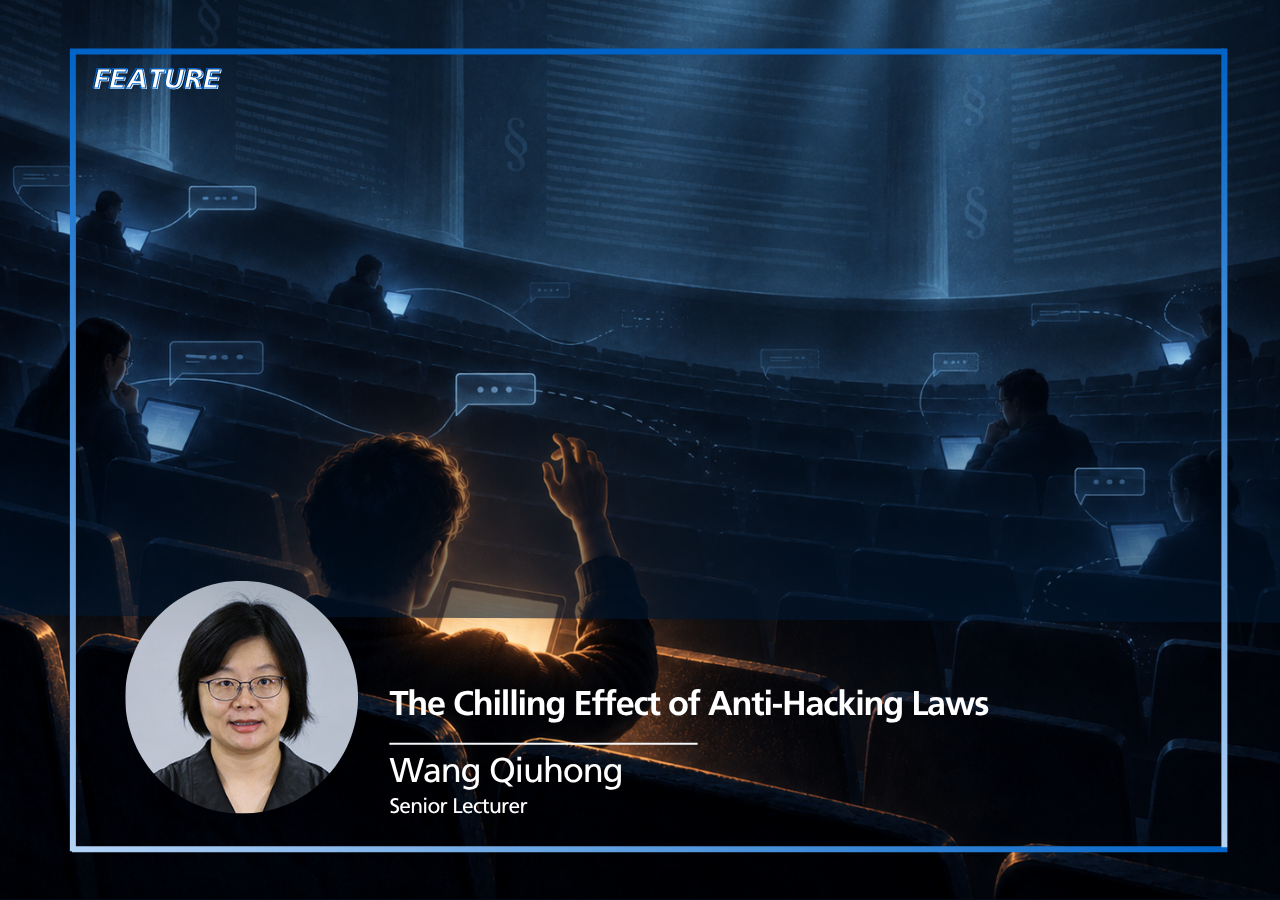

The Chilling Effect of Anti-Hacking Laws
How ambiguity in computer misuse legislation unintentionally silences legitimate security discussions
Every lock can be picked. That is roughly the logic of cybersecurity: to protect a system, you first have to understand how someone might break into it. The tools that test a network’s weak spots are the same tools a criminal would use to exploit them. Encryption that keeps your bank details private is the same encryption that hides a ransomware gang’s tracks.
Governments know this. When they write laws against “hacking tools”, they are trying to draw a line through technology that sits on both sides of it. Singapore, the United Kingdom, the United States, Australia, China, France and Germany have all passed some version of a computer misuse act, criminalising the creation, sale or possession of such tools with criminal intent. The UK Home Office has actively consulted on whether its Computer Misuse Act adequately protects legitimate cybersecurity activity, while US lawmakers have repeatedly questioned how to shield information security researchers from unjust prosecution when dual-use tools are mistaken for criminal instruments.
The trouble is that intent is hard to read from a line of code. And when the line is blurry, people who have done nothing wrong may decide it is safer to say nothing at all.
To measure this unintended consequence, empirical research requires an observable legal shock. In the months after February 2009, an amendment targeting unauthorised intrusion programs came into force in a major legal jurisdiction, creating a clear regulatory shift. Following this statutory clarification, prominent online technical forums in that jurisdiction quickly adapted: platforms updated community guidelines, removed ambiguous legacy archives, and aligned their moderation strictly with the new legal requirements. What survived in public discussions was everyday technical talk – how an attack functions, where a vulnerability lies, and how to patch it – none of which was targeted by the statute.
NUS Computing’s Senior Lecturer Wang Qiuhong wanted to know what happens to that lawful discussion once the risk of being misread sets in. With co-authors Associate Profesor Ruibin Geng of Northwestern Polytechnical University and Professor Seung Hyun Kim of Yonsei University, she set out to measure what lawyers call a chilling effect: people abandoning legal activity because they fear being prosecuted by mistake. The concept entered U.S. constitutional law in the early 1950s and was firmly established by the 1960s. To the authors’ knowledge, theirs is the first study to empirically test the chilling effect of legal harm (statutory legislation) at the individual user levell.
A Natural Experiment
Testing a chilling effect needs two things that rarely come together: a large group of people observed before and after a law takes effect, and a similar group the law never touched.
The two domestic platforms subject to the 2009 legal amendment provided the treated group. For the control group, the team turned to Hackforums.net, one of the most visited English-language hacking forums on the internet. It was owned by an American, hosted on servers in India, and operated outside the jurisdiction of the newly enacted statute. Architectural network boundaries and language partitions ensured that the two user communities remained distinct, eliminating cross-border user migration and spillover.
The researchers collected every post from all three forums between May 2007 and March 2011, a span of 205 weeks: more than 250,000 discussion threads from over 50,000 users. Machine learning models then sorted each post. Was it about cybersecurity? Was the author asking for knowledge or offering it? How densely did it use terms from professional security glossaries?
Before the legal shock, the treated and control forums moved together. Security-related discussion rose and fell in step, month by month. After the law took effect, contributions in the treated forums dropped away and stayed down for the two years of data that followed.
What the Numbers Say
Users subject to the statutory enforcement posted fewer cybersecurity threads and, when they did post, used fewer technical terms. In the raw trends, the decline was 27 to 34 per cent steeper than on the English forum across every measure the team tracked.
Once averaged across every user, including the many who seldom posted about security to begin with, the effect came to a fraction of a per cent. Among users who had actively contributed security content before the law, the drop was around one per cent. When the models accounted for behavioural inertia – the tendency of established contributors to stick to their habits despite uncertainty – the baseline chilling effect rose to nearly two per cent. The paper is candid about the modest size and argues the aggregate matters because it is spread across tens of thousands of people.
The team tested the finding against alternatives. They controlled for global swings in interest in cybersecurity using search data. They matched treated users to control users with similar posting histories. They checked whether targeted enforcement actions, such as the criminal arrest of a platform founder, could explain the pattern.
Who Went Quiet
The more revealing findings lie in who was affected.
Veteran contributors, the users with long histories of security posts, carried on much as before. Newcomers and light posters pulled back the most. Furthermore, while both sharing technical solutions and seeking help declined significantly, the chilling effect was slightly more pronounced among users asking questions. The researchers suggest this reflects beginners at work: unsure whether curiosity might be mistaken for criminal intent, they were the most hesitant to post.
Users whose security posts drew replies from other members were less likely to stop. Engagement from peers appears to have signalled that the discussion was safe to have.
Among those who kept posting, the writing itself changed. Contributed posts grew measurably closer in language to reports published by recognised security authorities, such as the SANS Internet Storm Center and Symantec’s threat research. Relative semantic similarity to these institutional benchmarks rose by roughly one-third and one-half, respectively. In line with uncertainty-identity theory, users actively conformed to the vocabulary of established white-hat professionals to reduce the perceived risk of unfounded prosecution.
Policy Implications for Computer Misuse Enforcement
These findings offer practical guidance for legal frameworks globally, such as the UK CMA, the US CFAA, and similar statutory regimes. Singapore’s Computer Misuse Act belongs to the same family of legislation.
The researchers offer several concrete interventions. A neutral panel of security practitioners, civil society groups and other independent parties could assess whether a tool was built in good faith, sitting between enforcement agencies and the wider community. Clear regulatory safe harbors and compliance guidelines should be directed specifically at students and junior researchers, who face the highest perceived uncertainty and are the most susceptible to being chilled. Community administrators should actively facilitate responses to technical inquiries, as constructive peer feedback directly offsets uncertainty and keeps lawful educational discourse alive.
Criminals trading exploits operate in private channels and on the darknet. Public technical forums are where students, junior professionals and defenders learn how attacks work. The paper’s closing warning is that statutory ambiguity which drives discussion off those forums widens the information gap between the perpetrators mounting attacks and the defenders working to prevent them.
Read the full paper here: Wang, Q.-H., Geng, R. and Kim, S.H. (2023) “Chilling Effect of the Enforcement of Computer Misuse Act: Evidence from Publicly Accessible Hack Forums,” Information Systems Research, Articles in Advance, 19 September 2023, https://doi.org/10.1287/isre.2019.0346