NUS Computing Caps Historic Season with First-Ever ICPC
Asia Pacific Championship Win
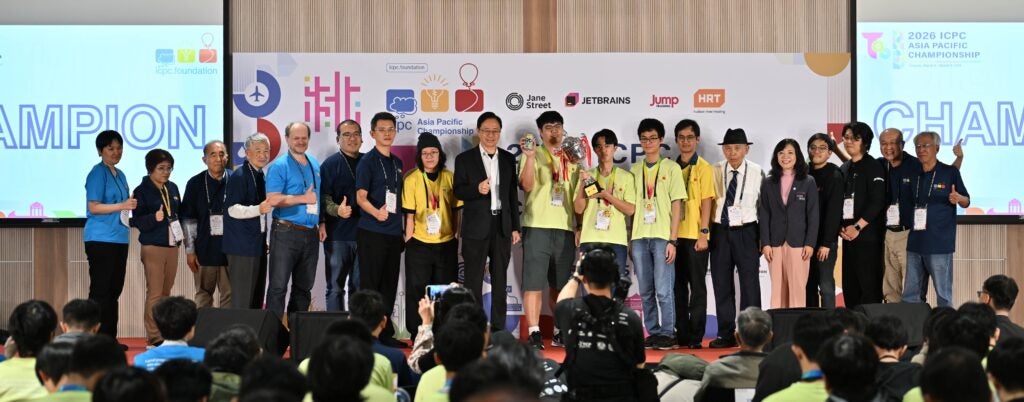
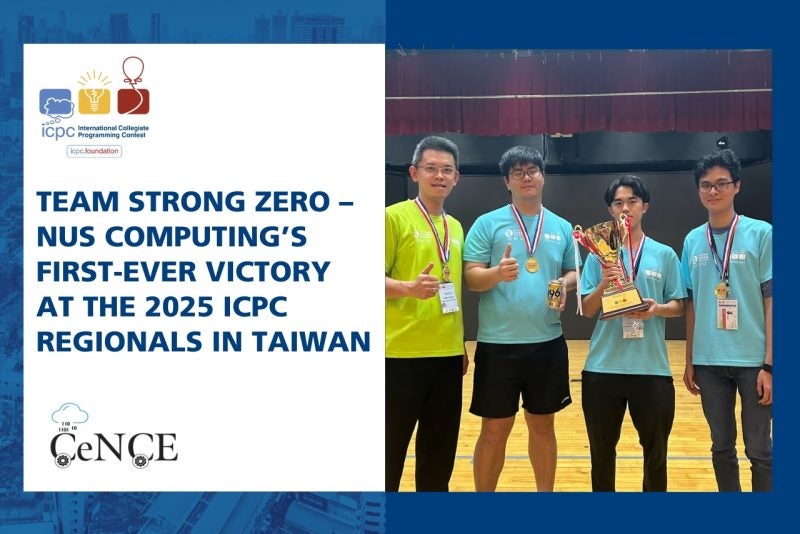
NUS School of Computing has achieved a major milestone in competitive programming, winning the 2026 ICPC Asia Pacific Championship for the first time at the contest held in Taoyuan, Taiwan.
Team Strong Zero – comprising International Olympiad in Informatics (IOI) gold medallists Ashley Aragorn Khoo, Tan Si Jie, and Yuto Watanabe – emerged champions from a field of 70 university teams across the ICPC Asia-Pacific super-region, representing Singapore, Vietnam, Thailand, Malaysia, Indonesia, the Philippines, South Korea, Japan, Taiwan, and Australia.
The victory caps an exceptional ICPC season for NUS and marks a significant milestone in the University’s competitive programming journey.
A commanding performance in Taoyuan
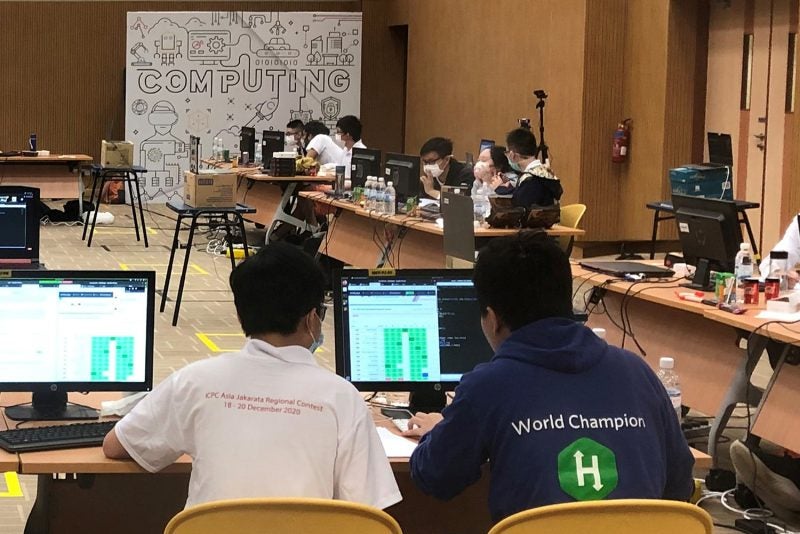
The ICPC Asia Pacific Championship gathers the strongest teams emerging from regional contests across the region. In Taoyuan, competitors faced a demanding set of 13 algorithmic problems, testing speed, teamwork and algorithmic insight under intense time pressure.
Strong Zero established momentum early. Within the first 14 minutes, the team had solved two problems, quickly placing themselves among contest leaders.
Their pace held steady throughout. By the end of the second hour, Strong Zero had solved eight of the 13 problems, opening a clear lead over the field.
The team eventually completed 10 problems, securing the championship title after five hours of intense problem solving.
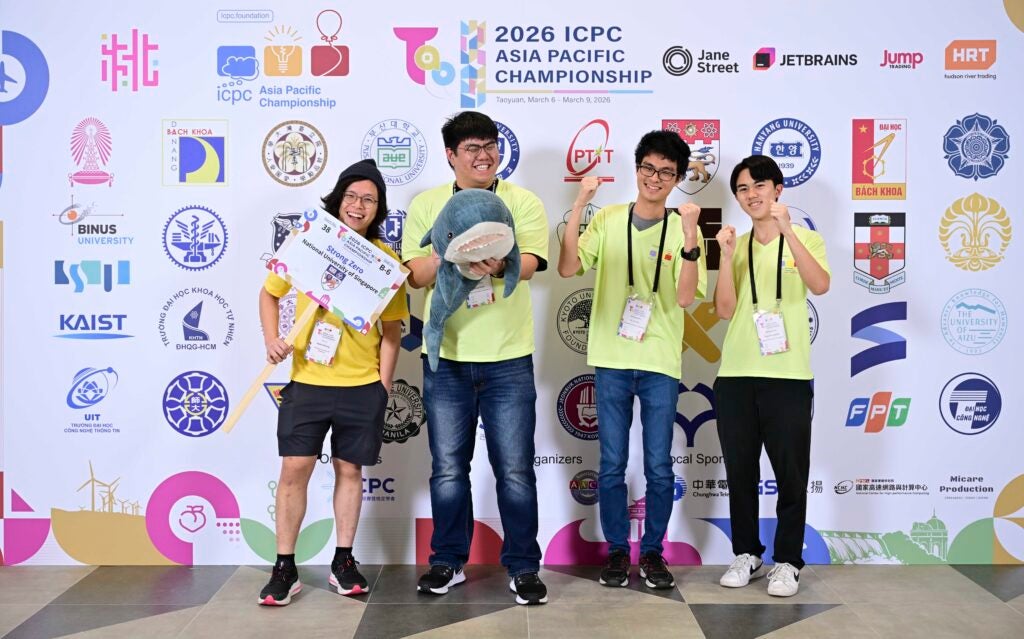
“In the final hour, several strong teams had caught up, and with the scoreboard frozen, it was impossible to tell who was ahead. We waited anxiously for the final results – and it was a huge relief to see Strong Zero come out on top,” said Dr Eldon Chung.
Depth of performance across NUS teams
NUS fielded two teams at the Asia-Pacific Championship.
While Strong Zero claimed the championship title, the second NUS team – Penguin and Tonic (winner of the Ho Chi Minh City Regionals) – also delivered a strong performance, finishing 19th overall with seven solved problems and earning a Silver medal under ICPC medal allocation rules.
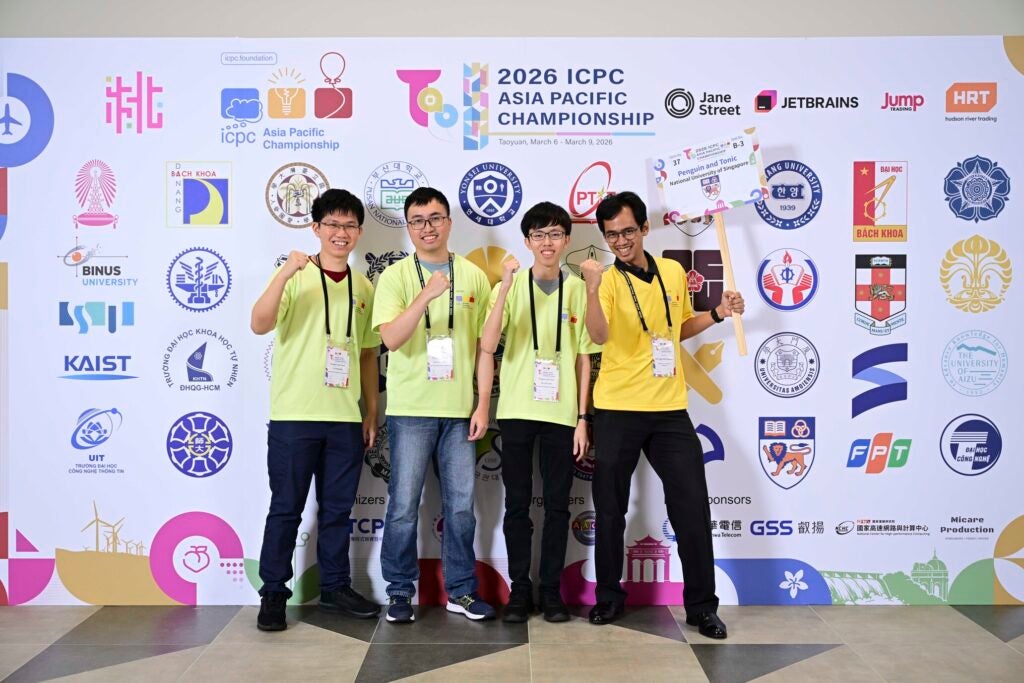
Together, these results reflect the depth of talent within the NUS competitive programming community, with both teams qualifying for the championship through regional victories earlier in the season.
A season of new historical benchmarks
Associate Professor Steven Halim, who has coached the NUS ICPC programme since 2008 and served as Regional Contest Director of the 2025 ICPC Asia Pacific Championship hosted by NUS Computing, noted that Strong Zero’s victory marks a new milestone for the programme.
The team had already secured historic regional victories in Taichung and Yokohama earlier in the season – both first-time wins for NUS at those sites. Their championship win in Taoyuan represents the culmination of a remarkable competitive cycle.
It also marks a breakthrough after NUS teams finished runner-up in the first two editions of the Asia Pacific Championship – with Team Absinthe placing second in Hanoi in 2024, and Team Jägermeister finishing second when NUS hosted the championship in Singapore in 2025.
Strong Zero’s win therefore establishes a new benchmark for the NUS ICPC programme.
Looking ahead to the ICPC World Finals
With their championship victory, Strong Zero will represent NUS at the 2026 ICPC World Finals, where they will compete against top university teams from other ICPC super-regions worldwide.
For NUS Computing, the result also raises a new question: whether Strong Zero can surpass the programme’s best performance at the ICPC World Finals – a Silver Medal (6th place) achieved by Team Absinthe at the 2024 ICPC World Finals in Astana, Kazakhstan.
As the team sets its sights on the ICPC World Finals, the programme continues to welcome new talent. Students who are keen to represent NUS in ICPC can reach out to Dr Adi Yoga Sidi Prabawa, who leads the NUS ICPC programme.
Acknowledgements
Strong Zero’s achievement reflects the broader ecosystem that supports competitive programming at NUS. This includes scholarship pathways that attract Olympiad talent to the University, sustained coaching and mentoring, and long-term industry partnerships under the Centre for Nurturing Computing Excellence (CeNCE).
NUS also recognises the long-standing partnership of the School’s CeNCE supporters – Jane Street, Hudson River Trading, Jump Trading, Optiver, Virtu Financial, Citadel | Citadel Securities, and Presto Labs – whose commitment continues to nurture competitive programming excellence across the region.