Filtered by: School of Computing
NUS Tags Filter
1 September 2026
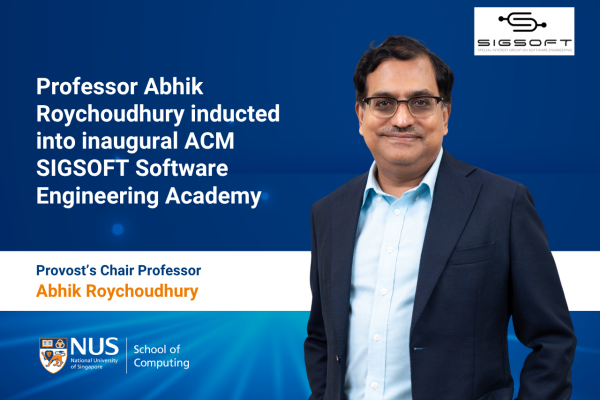
Provost's Chair Professor Abhik Roychoudhury has been named a member of the inaugural class of the ACM SIGSOFT Software Engineering Academy, joining a global cohort recognised for lasting contributions to software engineering research, practice, and education.
NB - ACM SIGSOFT Abhik Roychoudhury
31 August 2026
Three papers co-authored by Professor Xiaokui Xiao have won top honours at leading international conferences this year, recognising work spanning AI system efficiency, differential privacy auditing, and graph algorithms.
Newsbyte Xiaokui Xiao 3 paper wins
28 August 2026
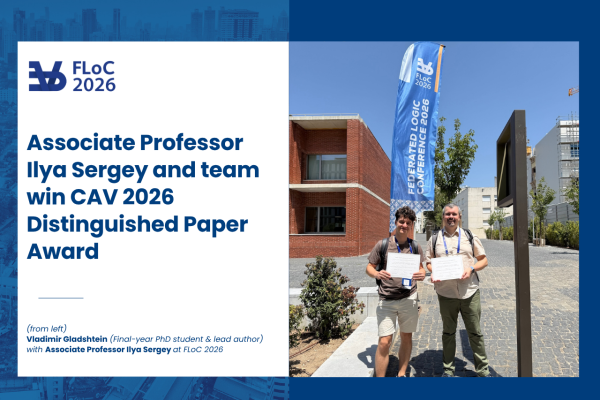
A research group at NUS Computing has received a Distinguished Paper Award at CAV 2026, one of the flagship conferences on formal methods and verification, for their work on Velvet, a tool that automatically proves whether a piece of code does what it’s meant to do. CAV 2026 was held as part of FLoC 2026, the 9th Federated Logic Conference.
NB Ilya Sergey CAV 2026
27 August 2026
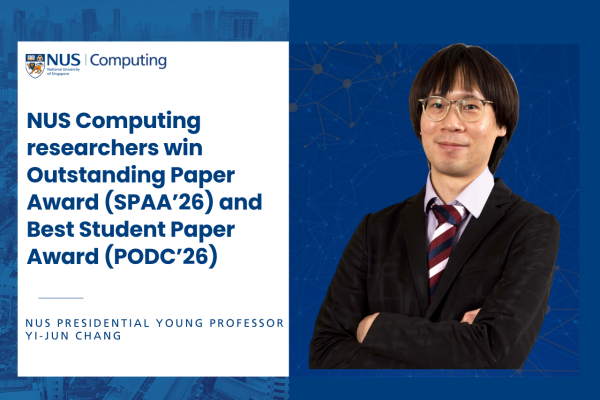
NUS Presidential Young Professor Yi-Jun Chang and his collaborators have won two awards at leading conferences in distributed computing this year: the Outstanding Paper Award at the 2026 ACM Symposium in Parallelism in Algorithms and Architectures (SPAA), given to the top three papers at the conference, and the Best Student Paper Award at the 2026 ACM Symposium on Principles of Distributed Computing (PODC), which recognises the best paper among those with substantial contributions from student authors.
NB YI-JUN CHANG
25 August 2026
Associate Professor Liang Zhenkai from the Department of Computer Science has received the Test-of-Time Award at the 21st ACM Asia Conference on Computer and Communications Security (AsiaCCS 2026), recognising his 2011 paper, “Jump-oriented programming: a new class of code-reuse attack”.
NEWSBYTE FINAL Liang ZhenKai Test of Time Award AsiaCCS2026
24 August 2026
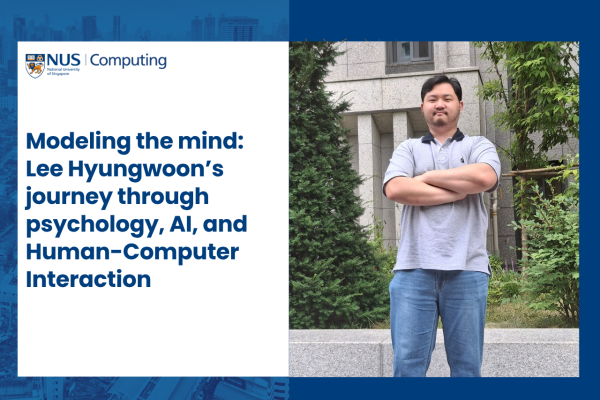
Eu En Wong was tutoring General Paper to a hundred students at one point. He wanted to give each of them proper feedback — the kind that is specific enough to act on, personal enough to land. At that scale, there simply was not enough of him to go around. That experience became the founding logic of Ren.
NB Lee Hyungwoon
18 August 2026
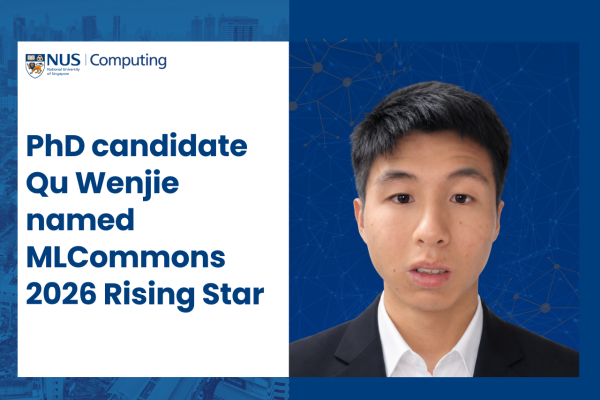
Qu Wenjie, a PhD candidate in Computer Science, has been selected as a 2026 ML and Systems Rising Star by MLCommons, an honour recognising early-career researchers shaping the future of machine learning and systems research. 
NB Qu Wenjie MLCommons 2026 Rising Star
17 August 2026
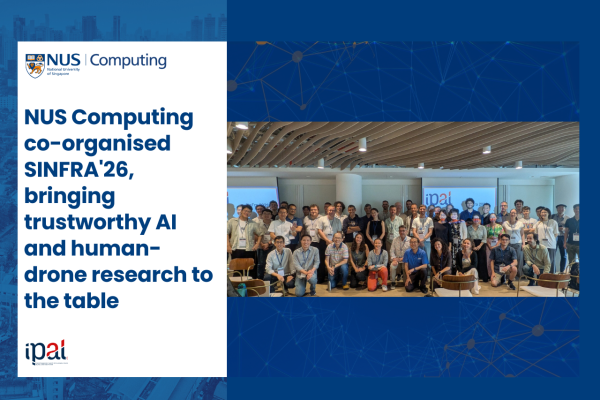
NUS School of Computing (SoC) co-organised this year's edition of SINFRA, the annual Singapore-France workshop on Computer Science and AI, bringing together more than 80 researchers from across the two countries' AI, robotics, and human-computer interaction communities.
NB SINFRA 2026
14 August 2026
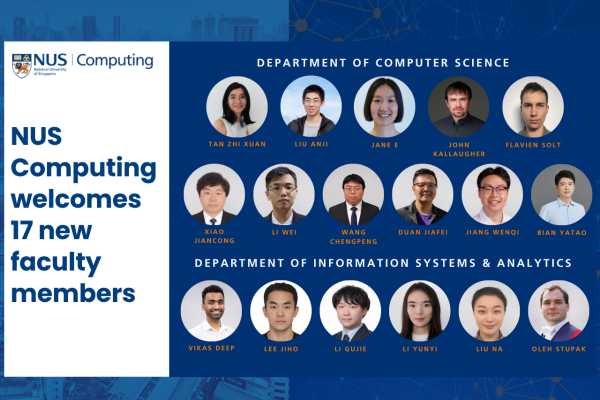
11 new Assistant Professors join the Department of Computer Science, and six join the Department of Information Systems and Analytics, marking one of NUS School of Computing's largest faculty intakes in recent years.
NB-SoC New faculty
13 August 2026
Provost's Chair Professor Hahn Jungpil joined CNA938s The Big Question, to discuss two Singapore-made AI-generated films that have reignited debate over AI's role in creative work – and where the line sits between AI as a tool and AI as a crutch.

Provost's Chair Professor Hahn Jungpil from the Department of Information Systems and Analytics joined CNA938 The Big Question, to discuss two Singapore-made AI-generated films that have reignited debate over AI's role in creative work – and where the line sits between AI as a tool and AI as a crutch.

Prof Hahn warned that critical thinking is the skill most at risk of quietly fading: "It's so accessible, and it provides relatively good output right from the start. You have to dig deeper, challenge it, even fight with it, to get really good content out of it. A lot of people, especially students, stop short of doing that and just accept what they're given. That's the real danger –  we stop exercising our own reasoning."

He also argued that augmentation and replacement aren't opposites but a matter of time: "Augmentation only stays augmentation if you deliberately keep a hand in what you're doing, and that's a very difficult thing to do day to day." Left unchecked, he said, this deskilling happens quietly – "AI attacks that aspect of skills development most critically, and invisibly. We don't realise it until the skill is gone." – with judgement itself eroding the less it's exercised.

On NUS' move to make AI coursework compulsory for all undergraduates, he said assessment needs to evolve in step, favouring oral reasoning tests over take-home essays that AI can easily produce – so students are evaluated on how they think, not just what they output.

Listen to the full segment: CNA938 Rewind - The Big Question (13 Aug): How much is too much when it comes to AI?

Media Mentions
13 August 2026
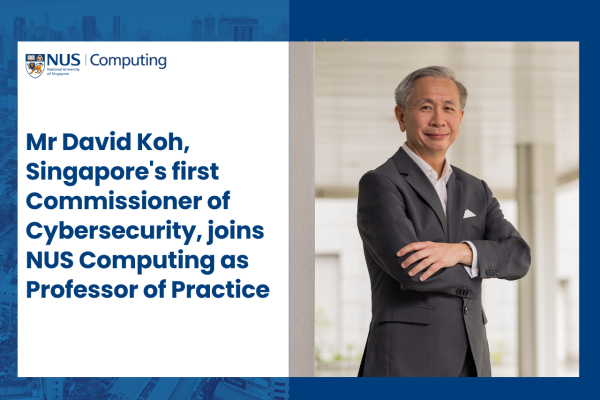
NUS School of Computing has appointed Mr David Koh as Professor of Practice, with effect from 1 August 2026.
NB David Koh Appointment
13 August 2026
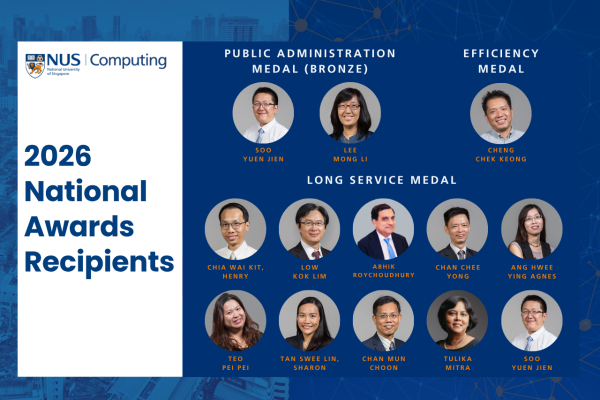
12 NUS Computing staff and faculty members have received the National Awards 2026, recognising their dedication and service to NUS and Singapore.
NB_2026 National Awards Recipients
12 August 2026
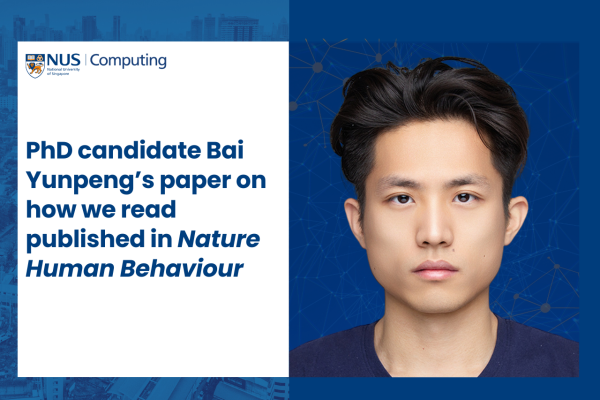
A paper by Bai Yunpeng, a PhD candidate at NUS Computing has been published in Nature Human Behaviour, one of the leading journals in the behavioural and cognitive sciences.
NB Bai Yunpeng (1)
11 August 2026
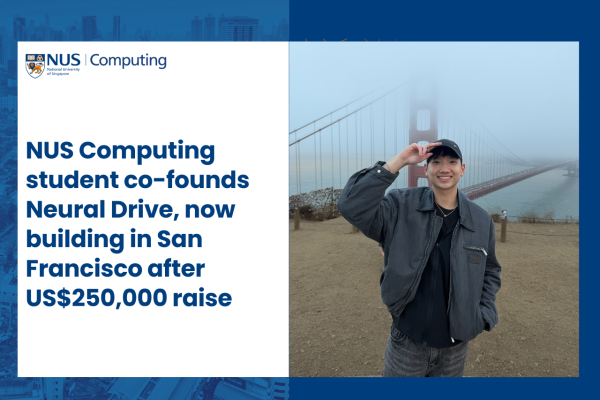
Raymond Ng, an incoming Computer Science student at NUS School of Computing, is a co-founder and Chief Technology Officer of Neural Drive, a startup that has raised US$250,000 in pre-seed funding from Afore Capital, a San Francisco venture capital firm.
NB_Neural Drive
7 August 2026
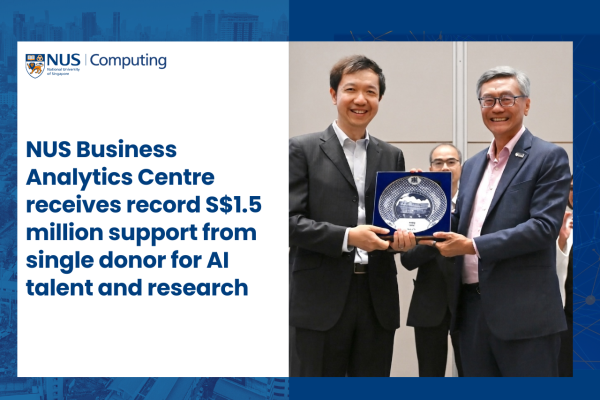
NUS' Business Analytics Centre has received a S$1.5 million personal donation from Mr Xie Xin, President of Lark Technologies, the largest single gift in the centre's 13-year history, Lianhe Zaobao reported on 7 August.

NUS Business Analytics Centre has received a S$1.5 million personal donation from Mr Xie Xin, President of Lark Technologies, the largest single gift in the centre's 13-year history, Lianhe Zaobao reported on 7 August.

S$1 million of the donation establishes a new scholarship for students in the Master of Science in Business Analytics (MSBA) programme, with up to two awards expected in its first year and plans to extend it further. The remaining S$500,000 sets up an AI fund at the centre to support trustworthy AI research, including work on building AI systems that are safer, more reliable and more accountable.
Lianhe Zaobao (7 August): "国大商业大数据分析中心获150万元捐款 设奖学金及AI研究基金"

Media Mentions
7 August 2026
As artificial intelligence (AI) transforms industries and reshapes how organisations make decisions, two gifts totalling S$1.5 million, donated personally by Mr Xie Xin, will bolster efforts at National University of Singapore (NUS) to nurture talent and advance research at the intersection of business, data and AI.
NB BAC Donor
7 August 2026
Associate Professor Terence Sim from the Department of Computer Science joined CNA938 #TalkBack segment on facial recognition technology in public transport, prompted by the closed trial now underway at Punggol Coast MRT Station. 

Associate Professor Terence Sim from the Department of Computer Science joined CNA938 #TalkBack segment on facial recognition technology in public transport, prompted by the closed trial now underway at Punggol Coast MRT Station.

Host Daniel Martin put the question to Prof Sim, whose research spans biometric authentication and facial recognition: can a system built to verify one face at a time handle a gantry at rush hour?

Prof Sim's answer centred on throughput. Similar systems already run in cities such as Beijing, Osaka and Moscow, but Singapore's population is more racially diverse than most, and that diversity exposes a known weak point. "It's been found that darker skin tones cause problems for the systems, elderly women tend to have difficulty, and of course children, because their facial structure changes rapidly," he said, adding that headgear, masks and even a fresh shave can throw off a match against someone's enrolled image.

Average daily MRT ridership hit 3.49 million trips in 2025, according to the latest LTA statistics, concentrated in evening bursts between 5pm and 7pm, a volume far beyond any office facial recognition deployment. Prof Sim outlined three ways such a system can fail: false positives, false negatives, and misidentification, where one enrolled commuter is charged for another's ride. Citing the best error rates he could find, he estimated roughly 10,500 people could be barred from the gate daily, and about 1,750 could be wrongly charged for someone else's trip.

His conclusion: lighting, crowding and privacy concerns mean facial recognition technology is unlikely to replace tapping outright.

Listen to the full segment: CNA938 Rewind - #TalkBack (6 Aug): Is facial recognition effective for public transport? 
Media Mentions
6 August 2026
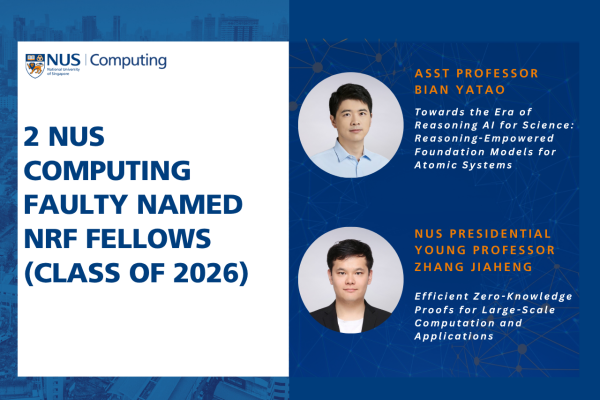
Assistant Professor Bian Yatao and NUS Presidential Young Professor Zhang Jiaheng have been awarded the National Research Foundation (NRF) Fellowship (Class of 2026), one of Singapore’s most competitive programmes for early-career researchers.
NRF F
6 August 2026
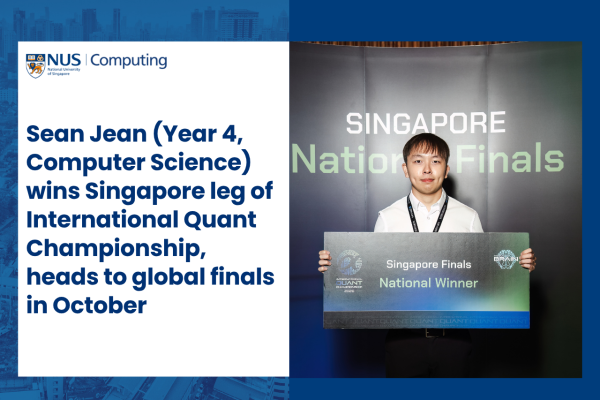
Sean Jean (Year 4, Computer Science) has won the Singapore National Finals of the International Quant Championship (IQC), organised by WorldQuant. He will represent Singapore at the Global Finals on 6-7 October, competing against champions from 12 other countries. 
NB IQC Sean Jean (1)
5 August 2026
The Straits Times covered the launch of the Razer-NUS Joint AI Research Lab on 5 August, reporting on the lab's role in advancing AI models that support both in-game and real-life tasks.

The Straits Times covered the launch of the Razer-NUS Joint AI Research Lab on 5 August, reporting on the lab's role in advancing AI models that support both in-game and real-life tasks.

The article detailed how research from the lab will feed into two Razer products. The first is AVA, a 3D holographic desk companion first shown at CES 2026, which uses camera and microphone sensors to manage schedules, offer reminders and assist with gaming. Razer's chief strategy officer Li-Meng Lee described the ambition as moving digital companions "to the next level" beyond earlier concepts like Tamagotchi. The second is Project Motoko, a wearable AI headset that scans a user's surroundings to provide contextual advice, positioning Razer against wearables from Meta and Google.

The piece reported that the lab, based at NUS, will house around 20 PhD and postdoctoral researchers with direct access to Razer's engineering team for real-world validation and product integration. Both parties will jointly fund operations and jointly own resulting intellectual property.

Associate Professor Ooi Wei Tsang, co-director of the lab, was quoted describing the collaboration as charting "the pathway towards next-generation intelligent systems that will shape the future of interactive gaming experiences."

The Straits Times (5 August): "New Razer-NUS AI lab to build companions beyond Tamagotchi, gaming intelligence"

Media Mentions