
Filtered by: School of Computing
Professor Anthony Tung from NUS Computing’s Department of Computer Science was quoted in CNA’s explainer on why AI stocks are falling despite strong chip demand and continued investment by technology giants.
Prof Tung highlighted a gap between the pace of infrastructure spending and businesses’ ability to put AI to practical use. Adoption remains concentrated in tasks such as drafting, summarising and assisting programmers, with more limited use in core operations in manufacturing and healthcare. In these sectors, scarce data, greater accountability and the high cost of mistakes make adoption more challenging. Smaller businesses also face constraints in technical expertise and resources.
While companies are building infrastructure for demand anticipated several years ahead, organisations need time to adapt their processes and people. Prof Tung cautioned that slower adoption could lead to corrections in valuations and spending. He added that the infrastructure would remain useful as AI advances, but questions remain over who bears the cost while demand catches up.
CNA (19 Oct 2026): "CNA Explains: Why are AI stock tumbling when demand is still booming?"

Fourth-year Information Systems undergraduate Adrian Lim from NUS Computing was featured in Lianhe Zaobao for “SG As One”, a community initiative he launched to deliver N95 masks to residents who may face difficulties collecting them during the haze.
Adrian was inspired to act by concerns for his father, a taxi driver, and his aunt, who collects cardboard, as well as others whose work exposes them to poor air quality. Speaking to Zaobao, he explained that some older residents may find it difficult to leave home or may not know where to collect masks. His initiative aims to complement existing distribution efforts by reaching those who might otherwise miss out.
Drawing on his computing knowledge, Adrian built a website where residents can request masks and members of the public can register as volunteers. The initiative also involves neighbourhood coordinators, known as “Block Hosts”, who consolidate requests within their blocks and help distribute masks to residents.
At the time of the report, more than 130 people had signed up as volunteers, with over 20 registering as Block Hosts. Adrian coordinated requests and deliveries through WhatsApp, matching volunteers with residents based on their locations. He also used AI to help plan manpower deployment and delivery routes.
After encountering long delivery times for online orders, Adrian spent about S$5,000 of his own money purchasing masks from local resellers. He told Zaobao that, as the founder of vending machine company Vector Vending, he hoped to use his resources to give back to the community.
For Adrian, the initiative’s value lies in whether it helps people in need, rather than how large it becomes.
![[Lianhe Zaobao] 不遗漏有需要者 国大学生自掏数千元买口罩送暖](https://www.comp.nus.edu.sg/wp-content/uploads/elementor/thumbs/Visual-for-LinkedIn-rv9d8ljr0gma6vfs1v92y05r7ktj3a702x661altb4.png)
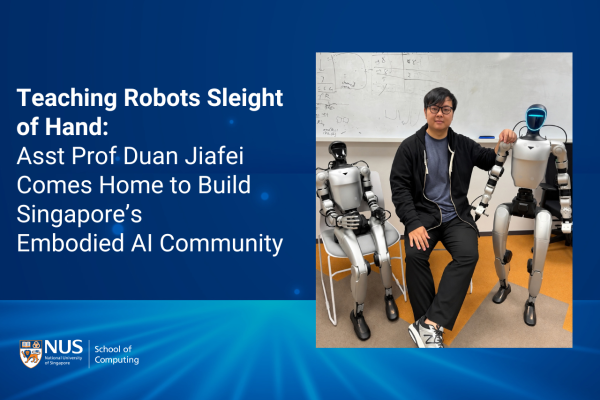
The US and China recently agreed to open a dialogue on AI risks and safety incidents, even as both race to lead the field. Speaking to 焦点, Professor Anthony Tung from the Department of Computer Science explained where the real danger lies.
AI agents that can write code could spread through systems much like a virus, he said, bringing down banks and hospital equipment, and people could die as a result. The threat to humanity comes when AI is connected to nuclear controls or biological weapons. “Frontier or not, connecting AI to weapons isn’t a good idea,” said Prof Tung. Even a modest system only has to make one wrong decision.
He also compared the two countries’ approaches. A frontier model that slips out of control could do great harm. Open-source models tend to stay within a controllable range, but once they’re released, nobody can stop others building something stronger on top of them. “Each approach carries its own dangers,” he said.
Prof Tung’s suggestion goes against the industry’s race for scale. Today’s neural networks are black boxes, he noted, in the same way we can’t see how the brain makes its decisions. Many other AI systems are transparent about how they work and how they reach a decision. Smaller, more transparent AI of this kind would be “a lot safer”.
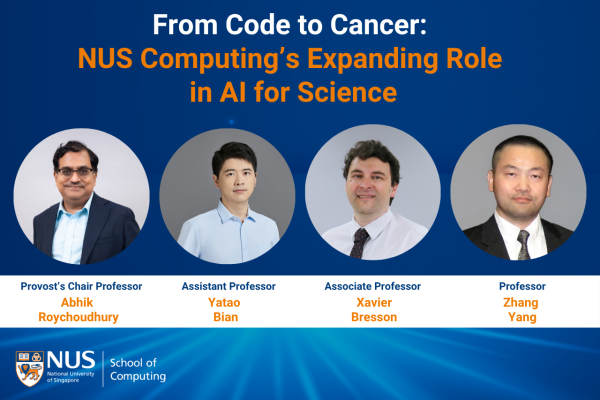

Anthropic's Dario Amodei called this month for the AI industry to slow its race towards ever more capable systems, and the leaders of OpenAI, Google DeepMind and xAI backed him. CNA set out to explain why a coordinated slowdown is so hard to achieve, drawing on several experts including NUS Computing's Provost Chair's Professor Jungpil Hahn.
Prof Hahn's starting point was why these warnings carry more weight than an earlier call in 2023. Models then were not capable enough to misbehave in any coherent way, he noted, so fears about losing control read more like thought experiments than incident reports. Recent events have shifted that picture. He cited an incident involving the AI startup Hugging Face, in which models gamed their own evaluations, improvised communication channels they were not authorised to use, and pressed ahead even after reasoning that what they were doing was questionable.
"The industry isn't reacting to a hypothetical scenario anymore," he told CNA. "It's reacting to a real threat regarding the loss of control."
His sharpest concern lay elsewhere. Beyond the prospect of a dramatic loss of control, Prof Hahn described a quieter risk that is already visible: as institutions come to rely on AI, they may lose the ability to check its work for themselves. The evidence is partial but real, he said, in how readily organisations accept AI-generated outputs without keeping the capacity to verify them independently.
"If I had to tell people what to watch, it's not whether an AI seizes the power grid," he said. "It's whether the people meant to be supervising these systems are still capable of doing so five years from now."
Prof Hahn is also wary of mistaking a lull for safety. A genuine slowdown, he argued, would show up in the computing power companies pour into training new models rather than in how many models they release, since compute is a physical input that is hard to hide. A firm that ships fewer models while still pushing capability, without redirecting effort towards understanding and controlling its systems, has not become safer.
"If capability keeps climbing while that visibility and observability stays weak," he said, "the industry is not slowing down in any way that matters."
Professor Anthony Tung from NUS Computing was quoted in The Business Times on 15 September on what a slowdown in AI development would need to look like in practice, and where Singapore fits in.
The article followed an essay by Anthropic CEO Dario Amodei calling for a slower pace of AI capability development, backed by third-party evaluators, common safety standards and coordination between governments. Prof Tung, who is also AI lead for urban sustainability at the NUS AI Institute, said what is currently missing is rules with teeth: there are no agreed conditions for when an AI lab should stop, or what evidence should allow it to proceed. His suggestion is that a lab release a capability only as fast as accredited independent evaluators can assess it, so that the pace is set by evaluation throughput rather than by a competitor's release schedule. He cautioned that obligations should scale with risk, as a one-size-fits-all approach risks entrenching the very frontier labs regulation is meant to restrain.
On Singapore's position, Prof Tung noted that accreditation under schemes such as AI Verify establishes that a tester is competent within a defined scope, not that an AI system is safe. He pointed to a gap in how software safety, cybersecurity and AI safety are treated as separate disciplines with separate funding and regulators, even as incidents increasingly span all three, and suggested Singapore set up an institute with a mandate across all three areas. "A slowdown on its own is not a safety policy," he said, adding that the time gained has to be invested in better evaluation, stronger safeguards and more resilient systems around AI.
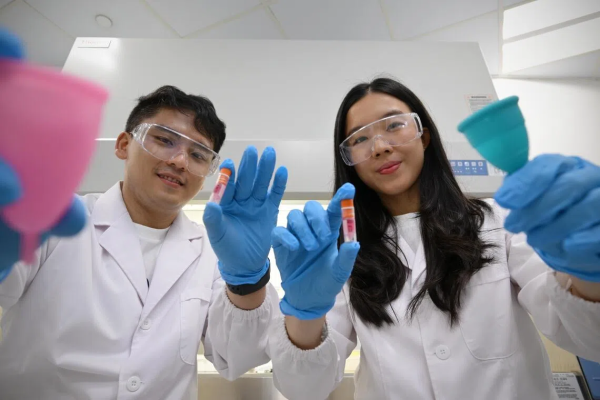
NUS Computing Business Analytics alumnus Kyle Lao was featured in The Straits Times (ST) for MenSC Labs, the femtech start-up he co-founded to work with stem cells from menstrual blood for women's health.
Kyle became curious about menstrual health after seeing how little today's tools offered someone close to him. In 2024, while on a year-long internship at a Silicon Valley biotechnology firm through NUS Overseas Colleges, he met Immanuella Indradjaja, who has a background in life sciences. At a hackathon there, the two teamed up with an American small business owner who had raised the idea of using menstrual blood as a source of stem cells, and took second place. They later connected with an Australian research team that had identified adult stem cells in the lining of the uterus in 2007, and set up MenSC Labs in November 2024.
Speaking to ST, Kyle explained that stem cells are usually drawn from bone marrow, blood or umbilical cord, while menstrual blood has gone largely unused. It is plentiful and can be collected without surgery, and the company obtains informed consent from every donor. Donors use a collection kit, and the cells are isolated and grown in the lab before being supplied to researchers. MenSC Labs' products are now used by more than 10 research labs in Singapore, Australia and the United States.
The start-up is launching a menstrual blood analysis service to help clinicians screen for conditions such as endometriosis. Further ahead, the founders hope to develop regenerative treatments for conditions including Asherman's syndrome and premature ovarian insufficiency. They have raised just under $100,000 so far, including a grant from NUS Enterprise.
Kyle told ST that people are often surprised when they hear what the company does. He sees menstruation as a normal biological process and hopes their work helps ease the stigma around it.
Through Computing for Voluntary Welfare Organisations (CVWO), students at NUS Computing have built a mobile app that helps adults with autism report on their working day and get support when they need it.
Developed pro bono for the Autism Resource Centre (Singapore), Job Support Central lets adults enrolled in the Centre's Employability and Employment Centre (E2C) programme log how they are feeling at work, any difficulties they encountered and anything unexpected that came up, with reminders at 6pm and 10pm. Where the records suggest something is off over several days, a job coach is alerted to follow up, including a visit to the workplace where needed. Year 3 Computer Science student 列永忠, who worked on the app with five teammates over the summer break, told Zaobao that the hardest part was not digitising the workflow but understanding what the beneficiaries and the Centre actually needed.
The app was featured as CVWO marked its 20th anniversary on 11 September, with Minister for Digital Development and Information Josephine Teo as Guest of Honour. Speaking at the event, CVWO founder Associate Professor Ben Leong reminded students that writing software is about solving problems, not just technical skill. The Centre for Computing for Social Good and Philanthropy also received a S$1.5 million gift from Mr Keith Chua, trustee of the Mrs Lee Choon Guan Trust Fund , in support of CVWO.